Best Crypto Market Makers for Token Launches at a Glance
How We Ranked Them
The Largest Crypto Market Makers Are Not Always the Right Fit
What Is a Market Maker in Crypto?
What Do Market Makers Do in Crypto During a Launch?
When Your Launch Needs a Market Maker: a Stage-by-Stage Map
Which Firm Fits Which Stage
Binance Alpha: What a Market Maker Can and Cannot Do
What Exchanges Check After You List
Market Maker Programs on Crypto Exchanges
The Top Market Makers in Crypto for Token Launches, Reviewed
1. Wintermute
2. GSR
3. Flowdesk
4. Keyrock
5. EchoTrade
6. BitQuant
7. DWF Labs
8. Acheron Trading
9. Auros
10. Gravity Team
11. Kronos Research
Deal Structures in Short
Your First 30 Days With a Market Maker
What Market Making Does Not Solve
FAQ
How Do Crypto Market Makers Work?
How Do Crypto Market Makers Make Money?
How Do Crypto Teams Choose a Market Maker?
When Should a Token Project Sign a Market Maker?
Can a Market Maker Get My Token Onto Binance Alpha?
What Is a Crypto Market Maker Program?
Share this blog post
The best crypto market makers for a token launch in 2026 are the ones that match your launch stage: Wintermute, GSR, Flowdesk and Keyrock lead on verifiable scale, while EchoTrade, BitQuant and Acheron stand out for publishing how they get paid. We assessed the top crypto market makers on the same public variables (venue coverage, deal-model disclosure, launch support, track record and regulatory standing) and checked each one live against its own site and regulator registers.
CoinLaunch is a token discovery and launch-listing platform. We track token sales, launchpads, funding rounds and unlocks, so we see launches from the issuer's side, and the numbers after TGE are hard. Of 118 token generation events in 2025, 100 (84.7%) were trading below their opening valuation by December, according to Memento Research figures reported by Yellow. A study of more than 120 launches by Arrakis, covered by The Defiant, found that early sell pressure, not market timing, decided which tokens held up, and only one in ten weak launches recovered. Exchanges keep score as well: MEXC's October 2026 warning list ran to 113 tokens.
The first weeks of trading decide most launches, so this guide ranks market makers by the launch stage they fit, not by size. Most market maker rankings are written for traders. This one is for the team preparing a TGE: which firm fits a first CEX listing, which one has Binance Alpha experience, what exchanges start checking the day after you list, and what to watch in your first 30 days.
Best Crypto Market Makers for Token Launches at a Glance
This crypto market makers list is ordered by what a launching team can verify today, not by brand recognition. Read it as a list of crypto market makers that serve token issuers, from the biggest crypto market makers by published scale to smaller firms built around launches.
Best crypto market makers for token launches compared: launch stage, coverage, deal model and regulation (firm sites checked 23 September to 2 November 2026)
Each deal model carries one of three labels. Publicly stated: the firm publishes its model or terms on its own site. Reported: credible third-party reporting describes it, with a link. Not disclosed: nothing public, which is normal in this industry and says nothing bad about the firm.
How We Ranked Them
We screened 21 firms, the ones founders most often search for as top crypto market makers plus BitQuant and EchoTrade, and every site was live with current content. Ten were left out:
Jump Crypto, Jane Street, Virtu Financial and Cumberland (DRW): no market making service for token issuers on their sites.
Flow Traders and B2C2: both serve crypto projects, but their sites lead with institutional and ETP liquidity rather than launches. Both are covered in RGray's general ranking.
Agora: an autonomous desk for tokenized stocks, not an issuer service.
Selini Capital, Amber Group and Kairon Labs: operating, but their sites gave too little launch-relevant detail to record.
Order weighs verifiable scale and venue coverage first, deal-model transparency second, and launch support and track record third. Position is the only ranking signal. Positions 5 to 8 are closely matched; there, scale figures are self-reported and hard to compare, so transparency and launch focus did most of the sorting. The list is selective, re-reviewed every year, and firms that publish more or change terms can move.
The Largest Crypto Market Makers Are Not Always the Right Fit
The largest crypto market makers publish numbers that dwarf any single launch: Wintermute cites $1T in cumulative liquidity provided and Auros $1.3T+ in year-to-date volume. None of it is audited. For a launch, a firm's commitment to the two or three venues where you actually list matters more than its total count.
What Is a Market Maker in Crypto?
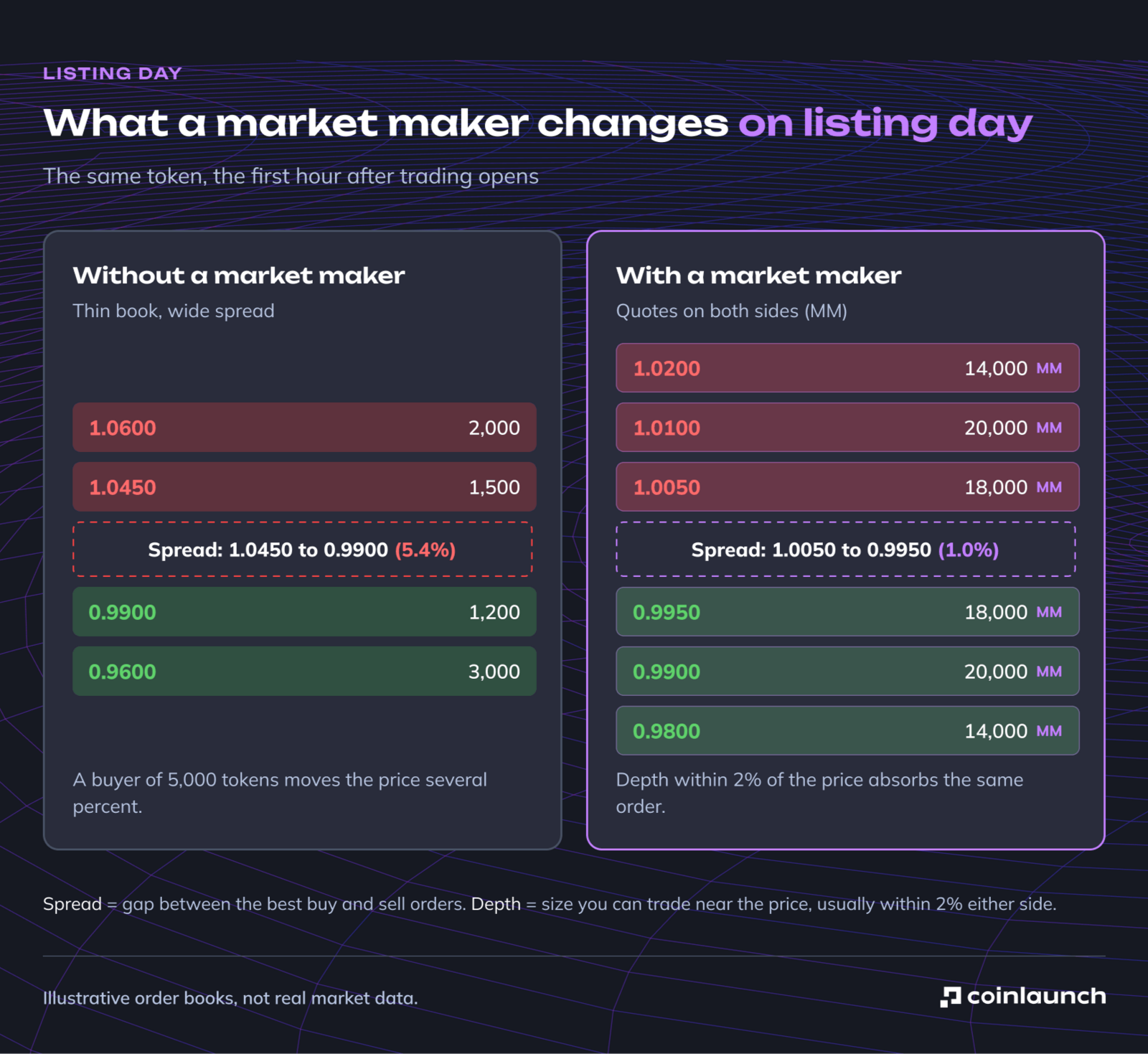
A market maker in crypto is a firm that posts buy and sell orders around the current price so a token can trade at any moment. It earns the difference between the two prices and accepts the risk of holding the token while it does.
Two numbers describe how well it is doing that. Spread is the gap between the best buy and sell orders. Depth is how much you can trade near the current price before it moves, usually measured within 2% either side.
What Do Market Makers Do in Crypto During a Launch?
On listing day they place the first orders so the book is not empty when trading opens. Over the following weeks they keep the price consistent between centralized exchanges and on-chain pools, rebalance inventory as buyers and sellers arrive, and absorb part of the selling around token unlocks. What they cannot do is create buyers who are not there.
When Your Launch Needs a Market Maker: a Stage-by-Stage Map
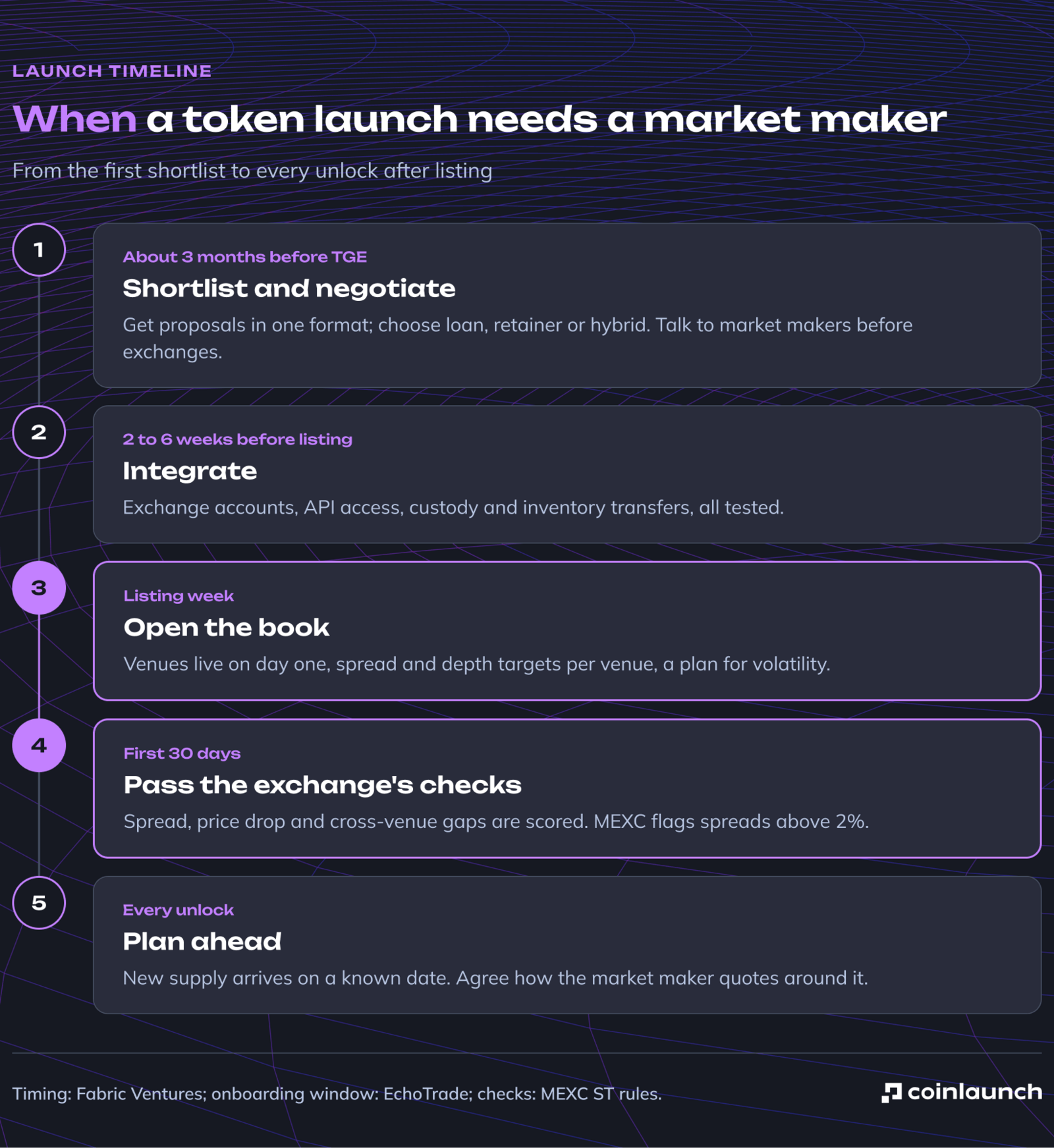
A token launch needs a market maker from roughly three months before TGE until well after the first unlock. Fabric Ventures advises settling the token's role about six months out, approaching market makers around three months before TGE and talking to them before exchanges, because some exchanges want an agreement in place before they list you.
Three months out: shortlist and negotiate. Deals take weeks. Use this stage to get proposals in the same format and decide between a loan, a retainer or a hybrid (see the deal section below).
Two to six weeks out: integrate. Exchange accounts, API access, custody and inventory transfers all need testing. EchoTrade, for example, quotes two to six weeks of onboarding before a listing. If your launch spans DEX pools and CEX books, check whether one team can integrate both: BitQuant, for example, offers AMM management alongside centralized exchange market making. Fabric's sources put it bluntly: set up custody early.
Listing week: open the book. Agree in writing which venues are live on day one, the spread and depth targets on each, and who decides when volatility spikes.
First 30 days: pass the exchange's checks. This is where many launches quietly fail (see what exchanges check, below).
Every unlock: plan ahead. Unlocks add supply on a known date. Track yours alongside the market's on CoinLaunch's token unlocks calendar and agree with your market maker how it will quote around each one.
Which Firm Fits Which Stage
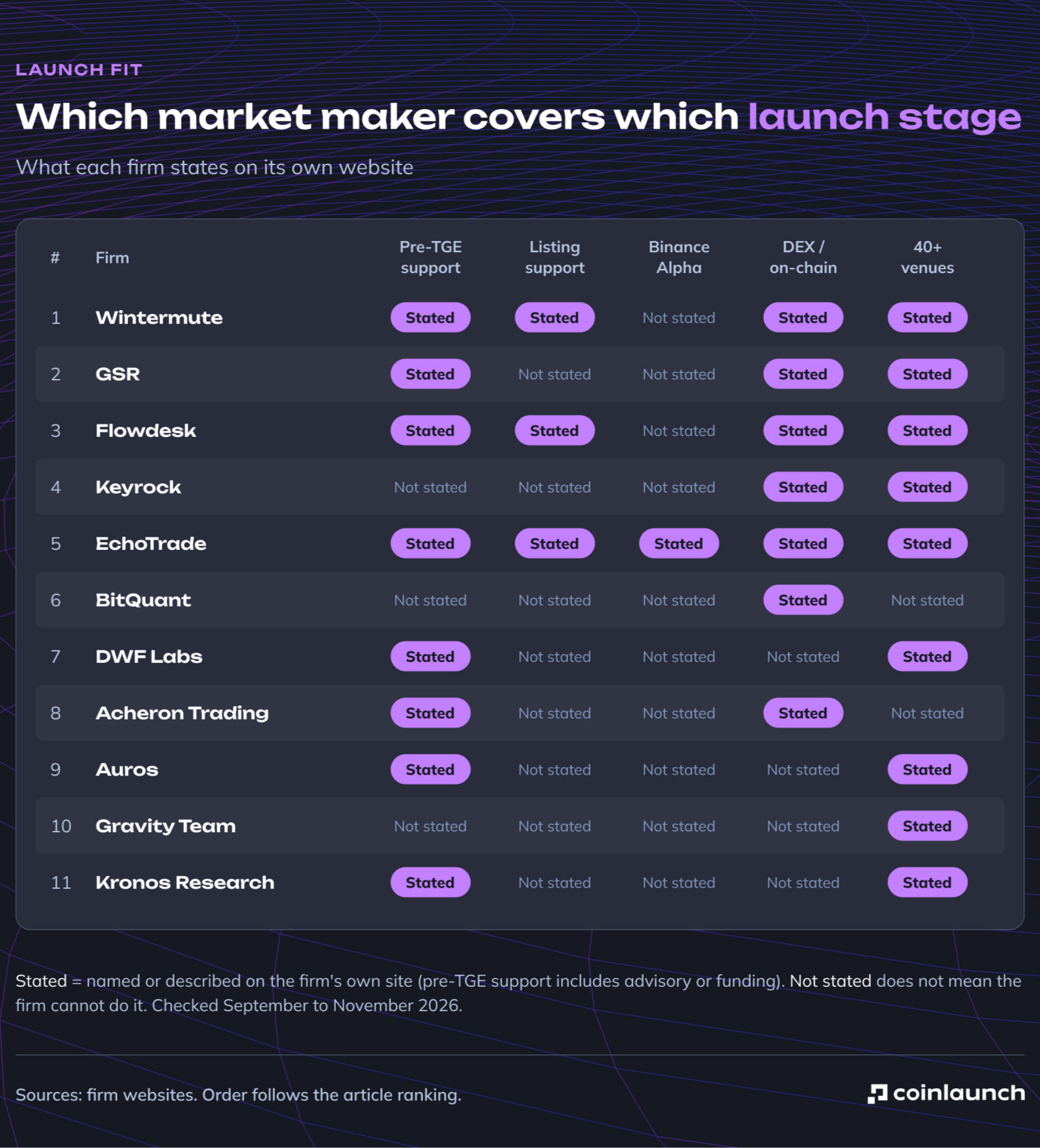
The best crypto market maker for new token launches is the one that covers the stages you cannot handle yourself. The grid below records what each firm states on its own site. "Not stated" means the site does not say so, not that the firm cannot do it. For crypto market makers for token issuers preparing a first listing, the two columns that matter most are listing support and DEX coverage.
Binance Alpha: What a Market Maker Can and Cannot Do
Binance Alpha is Binance's showcase for early-stage tokens. According to Binance Academy (updated July 2026), it runs inside Binance Wallet, with Alpha 2.0 embedded in the Binance Exchange so users can trade the same tokens from their Spot and Funding accounts. Tokens are picked on market signals and community interest. For how Alpha works on the user side, from points to airdrops, see CoinLaunch's Binance Alpha guide.
Two points matter for a launching team. First, Alpha is not a listing: Binance's own FAQ says featured tokens may be considered for the exchange later, but listing is not guaranteed. Second, Alpha tokens keep being reviewed. When Binance introduced its Alpha review framework, it named trading volume stability, liquidity depth, on-chain transaction frequency and holder distribution among the measures, and removed 22 tokens.
A market maker helps with the measurable part: on-chain liquidity on the showcase day, one consistent price across pools and centralized venues, and depth afterwards. It cannot get you selected. Any firm that promises Alpha selection is promising something only Binance decides.
What Exchanges Check After You List
Exchanges keep scoring a token after listing day, and the metrics they use map directly to what a market maker controls. MEXC publishes the most specific rules. Its ST warning criteria include:
an average daily spread above 2% for 15 consecutive days;
a price drop of more than 60% within three days of listing;
a 15-day average price gap of more than 15% against other exchanges.
If the risk to users is judged significant, MEXC can delist three days after the warning. Its October 2026 ST list ran to 113 tokens.
Binance applies a Monitoring Tag to higher-risk tokens, and its glossary (updated October 2026) lists trading volume and liquidity among the factors, alongside team commitment and development activity. Gate announces delistings of tokens that no longer meet its trading criteria.
The practical takeaway: write the exchange thresholds into your market maker's KPIs. A 2% spread ceiling and a cross-venue price gap limit belong in the contract, not in a hope.
Market Maker Programs on Crypto Exchanges
Exchanges also run their own market maker programs on crypto exchanges: rebate schemes for trading firms that keep quotes on their books. Binance's futures program starts at 1,000 BTC of 30-day spot volume, Bybit tiers start at $25 million, and KuCoin offers new market makers a two-month assessment-free period. A crypto market maker program commits a firm to the exchange, not to your token, and it is not a crypto market maker service you can buy. Ask which programs your market maker belongs to on your venues, because those rebates are part of how it gets paid.
The Top Market Makers in Crypto for Token Launches, Reviewed
Each entry gives a launch fit, coverage, the deal-model label and one question worth asking on the first call.
1. Wintermute
Founded in 2017, Wintermute lists 110 token liquidity partners, 25 CeFi exchanges and 45 DeFi venues, and markets "expertise in top exchange listing requirements" to issuers. Wintermute Trading Ltd is on the FCA cryptoasset register, and Wintermute USA LLC is a FINRA-member broker-dealer (BrokerCheck).
Launch fit: larger launches that need on-chain and centralized liquidity from day one.
Coverage: 25 CeFi and 45 DeFi venues; spot, options, forwards and CFDs.
Deal model: Not disclosed.
Ask them: can we see the liquidity dashboard of a token you onboarded this year?
2. GSR
Active since 2013, GSR reports 60+ exchange integrations across CEX and DEX. In March 2026 it bought advisory firms Autonomous and Architech for $57 million, adding launch operations to its trading desk. It is on the FCA cryptoasset register and holds a MAS Major Payment Institution licence.
Launch fit: teams that want launch advisory and market making from one counterparty.
Coverage: 60+ exchanges, CEX and DEX.
Deal model: Not disclosed.
Ask them: who from the advisory side works on our TGE, and how do they hand over to the desk?
3. Flowdesk
Flowdesk splits its token offer by launch stage: ventures, OTC and exchange introductions before TGE; pool deployment, on-chain RFQ and CEX connectivity at TGE; and a choice of structures after it. It reports 150+ venues. Flowdesk Europe SAS is MiCA-authorised by France's AMF (ESMA), and its Dubai entity holds a VARA licence.
Launch fit: teams that want one partner from pre-TGE to post-listing.
Coverage: 150+ venues, CEX and DeFi.
Deal model: Publicly stated. Loan-based (option or retainer), custodian-based or balance-sheet support.
Watch-out: Flowdesk discloses that over 20% of client orders route to an affiliate; ask how that is managed.
4. Keyrock
Keyrock, founded in 2017 in Brussels, cites 85+ trading venues and describes its market making as built around each client's goals. Keyrock FR SAS is MiCA-authorised by the AMF (ESMA).
Launch fit: European issuers that want a MiCA-authorised counterparty with options and OTC alongside.
Coverage: 85+ venues, CEX and DEX.
Deal model: Not disclosed.
Ask them: which of the 85+ venues will you commit to in writing for our listing?
5. EchoTrade
EchoTrade is built around token launches. Founded in 2023, it is the youngest firm here and the only one that publishes its fees: a retainer of $2,500 to $10,000 per month, with no token loans or call options. Its site says it runs a dedicated Binance launch team for Binance Alpha, and in an October 2026 press release it cites more than 40 Alpha launches among 2,000+ token launches supported. Alongside market making, it offers listing support, launch advisory and treasury building.
Launch fit: projects launching through Binance Alpha or preparing a first CEX listing.
Coverage: 90+ centralized and decentralized exchanges by its own count, naming Binance, OKX, Bybit, MEXC, Gate and KuCoin; it describes itself as an official liquidity partner of MEXC.
Deal model: Publicly stated. Retainer only; the project keeps custody of its tokens.
Ask them: which Alpha launches can you name, and can we speak to one of those teams?
Watch-out: the track-record figures are self-reported, and no licence is listed on its site.
6. BitQuant
BitQuant serves exchanges as well as token projects, which is unusual on this list: its site has separate offers for centralized exchanges, DEXs and newly listed tokens, plus AMM management. It says it has been in business since 2017. Its verifiable footprint is smaller than the firms above.
Launch fit: projects on mid-tier venues that want CEX books and DEX pools run by one team.
Coverage: names Binance, KuCoin, Kraken, Bitfinex, Gate, Crypto.com, Indodax and Korbit, plus Uniswap and PancakeSwap.
Deal model: Publicly stated. Hybrid model. [EDITOR: insert BitQuant's published wording and link the page. As of 2 November 2026 its site still describes no model. Do not publish until the page is live.]
Ask them: which exchanges can confirm your work on recent listings?
7. DWF Labs
DWF Labs, founded in 2022 within Digital Wave Finance, invests in the tokens it makes markets for. It trades on 60+ exchanges, reports 800+ portfolio projects, and DWF MaaS Limited is a registered VASP with the BVI Financial Services Commission.
Launch fit: projects that want capital and liquidity from the same partner.
Coverage: 60+ exchanges, spot and derivatives.
Deal model: Reported. The Block described its investments as OTC token purchases paid in tranches.
Watch-out: in May 2024 CoinDesk, citing The Wall Street Journal, reported on a Binance internal review of DWF Labs' trading; Binance said the allegations were not substantiated and DWF Labs rejected them (DL News).
8. Acheron Trading
Acheron offers liquidity and advisory services to issuers, publishes both of its models and holds a MiCA licence: Acheron Europe B.V. was authorised by the Dutch AFM in May 2025 (ESMA).
Launch fit: EU issuers that want a licensed counterparty and a choice of structure.
Coverage: CEX and DEX; no venue count published.
Deal model: Publicly stated. Token loan with an American call option, or a retainer with a performance fee (Acheron).
Ask them: which venues are committed in the contract?
9. Auros
Founded in 2019 (Auros), Auros reports 40+ connected venues and a 150+ person team, and positions itself as a partner from venture funding through token launch and liquidity.
Launch fit: projects that want funding, launch support and liquidity from one firm.
Coverage: 40+ venues; names not published.
Deal model: Not disclosed.
Notable: after FTX's collapse Auros entered provisional liquidation, restructured, and raised $17 million in March 2023 (CoinDesk).
10. Gravity Team
Gravity Team, founded in 2017, focuses on exchange liquidity, especially in emerging markets and fiat-quoted pairs, across 40+ venues including Bitso, Bitkub, VALR and Bitbank.
Launch fit: tokens listing on regional exchanges or with local-currency pairs.
Coverage: 40+ venues; spot and derivatives.
Deal model: Not disclosed.
Ask them: what issuer-side reporting do you provide after listing?
11. Kronos Research
Kronos Research, founded in 2018, offers designated market making, token market making and project token advisory. It cites over 50 exchanges on its about page and 40+ on another page of its site.
Launch fit: protocol tokens that want designated market making plus advisory.
Coverage: 40+ to 50+ exchanges; names not published.
Deal model: Not disclosed.
Notable: in November 2023 Kronos lost $26 million through compromised API keys and said all losses were covered internally (The Record).
Deal Structures in Short
There are three ways a market maker gets paid. In a token loan with call options, you lend tokens and the firm can buy them later at agreed prices, so it profits most if it sells into a rising price. In a retainer, you pay a monthly fee and fund both sides of the book yourself, which keeps the tokens yours and the risk too. A hybrid mixes a smaller fee with a reduced option or performance fee.
Even among the top crypto market makers, the deciding question for a launch is whether you have stablecoins to fund your own book. If you do, a retainer with written KPIs usually aligns better. If you don't, negotiate option strikes well above your listing price and keep the option package smaller than the loan.
This is the short version. The full economics of each model, its failure modes and the terms worth negotiating are in RGray's breakdown of how market maker deals are structured.
Market maker deal structures for a token launch, in short
Token loan + call option
Retainer
Hybrid
Who holds the tokens
Market maker, on loan
Issuer
Mostly issuer
Who funds the stablecoin side
Market maker
Issuer
Usually issuer
How the firm earns
Spread, rebates and option exercise
Monthly fee, plus spread
Smaller fee plus a reduced option or performance fee
Launch-week risk
Strikes set close to the listing price
Thin quotes nobody measures
Terms stacked from both models
Fits a launch when
Large token treasury, little stablecoin
You can fund both sides of the book
You can fund part of the book
Published on this list by
Flowdesk, Acheron
EchoTrade, Flowdesk
Acheron, BitQuant
Your First 30 Days With a Market Maker
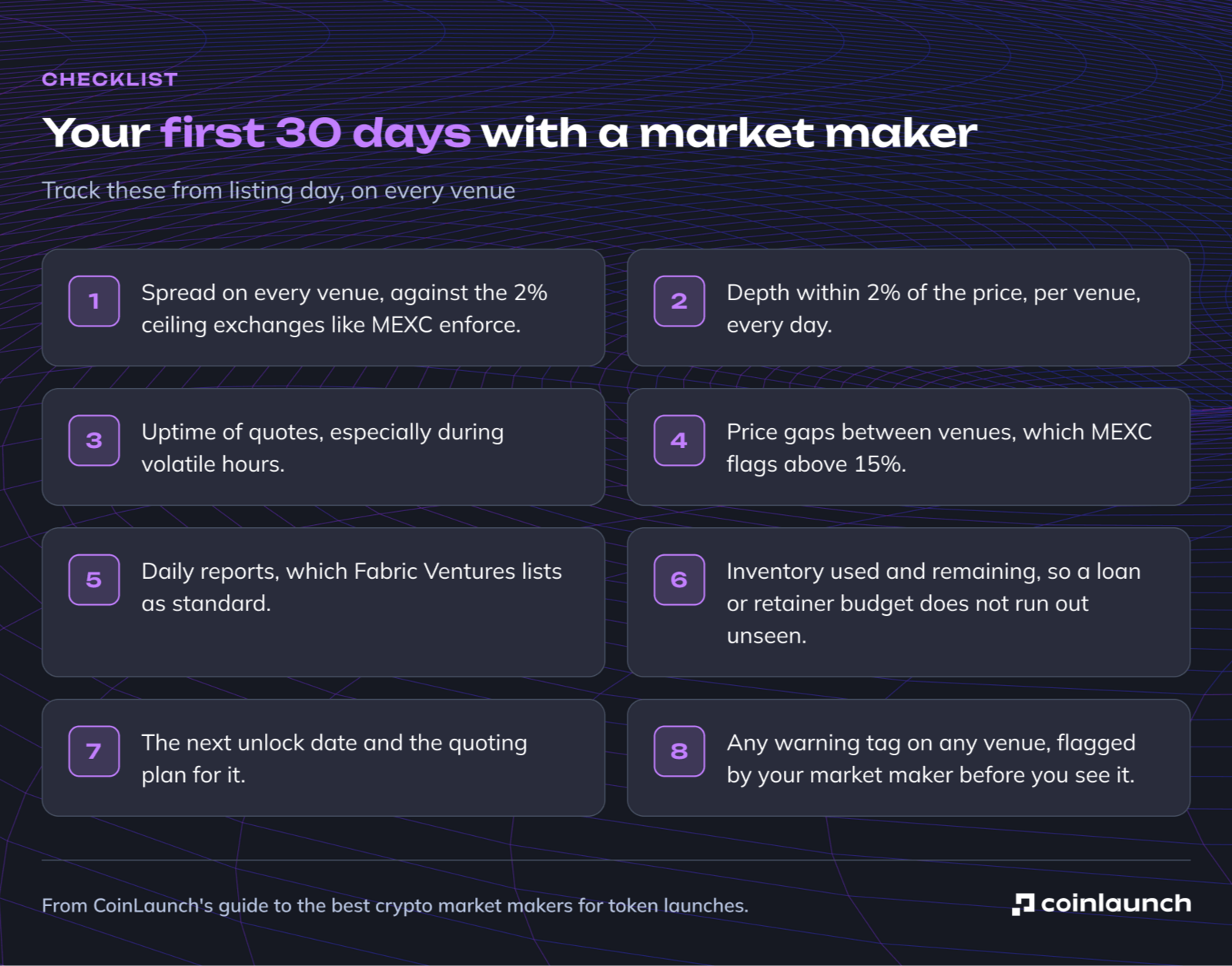
Most launches are judged in the first month, by the exchange and by holders. Track these from day one:
Spread on every venue, against the 2% ceiling exchanges like MEXC enforce.
Depth within 2% of the price, per venue, every day.
Uptime of quotes, especially during volatile hours.
Price gaps between venues, which MEXC flags above 15%.
Daily reports, which Fabric Ventures lists as standard.
Inventory used and remaining, so a loan or retainer budget does not run out unseen.
The next unlock date and the quoting plan for it.
Any warning tag on any venue, flagged by your market maker before you see it.
What Market Making Does Not Solve
A market maker makes your token easy to trade. It does not make anyone want to trade it.
If buyers never arrive, a tight spread just gives early holders a smooth exit. Liquidity works when it lands on demand that already exists: a story people can repeat, a launch they have heard about and a community waiting for the listing.
That demand is built before TGE. Founders do it through presale and launchpad visibility (compare IDO platforms early), through creators who already reach your buyers (CoinLaunch's directory of crypto influencers is a starting point) and through a marketing partner who sequences it all; our guide to the best crypto marketing agency compares the options. Sign the market maker for the listing, and start the demand work months before it.
This article is for information only and is not financial, investment or legal advice.
FAQ
How Do Crypto Market Makers Work?
They keep buy and sell orders on exchange order books so a token can be traded at any time, earning the spread between the two prices. During a launch they also seed the first orders, keep prices aligned across venues and rebalance their inventory as demand shifts.
How Do Crypto Market Makers Make Money?
From the spread, from exchange rebates and, in token loan deals, from exercising call options when the price rises above the agreed strikes. In a retainer deal the monthly fee is their main income, and the issuer keeps the trading risk.
How Do Crypto Teams Choose a Market Maker?
Crypto teams choose a market maker by matching its venue coverage and launch support to their own listing plan, then comparing deal structures on who holds the tokens and what each option costs at several future prices. Written KPIs, reporting, exit terms and conflicts of interest settle the final choice.
When Should a Token Project Sign a Market Maker?
Start conversations about three months before TGE and before you approach exchanges, as Fabric Ventures recommends, because some exchanges want a market maker agreement before they list a token. Leave two to six weeks for integration and testing.
Can a Market Maker Get My Token Onto Binance Alpha?
No. Binance decides which tokens appear on Alpha and says inclusion does not guarantee an exchange listing. A market maker can prepare on-chain liquidity and consistent pricing for the showcase, which matters because Binance reviews Alpha tokens on measures such as liquidity depth and trading volume stability.
What Is a Crypto Market Maker Program?
It is an exchange's rebate scheme for trading firms that keep quotes on its order books, such as the programs run by Binance, Bybit and KuCoin. It commits the firm to the exchange across many pairs, not to your token, so it complements a market maker contract rather than replacing it.
Preparing a launch? List your token sale on CoinLaunch to put it in front of investors looking for new projects; get in touch through our contact page.