Zcash (ZEC) dropped nearly 60% after Shielded Labs disclosed a critical Zcash vulnerability in the Orchard private pool. The flaw had gone unnoticed for about four years and could have allowed an attacker to create counterfeit ZEC without leaving visible traces on the network.
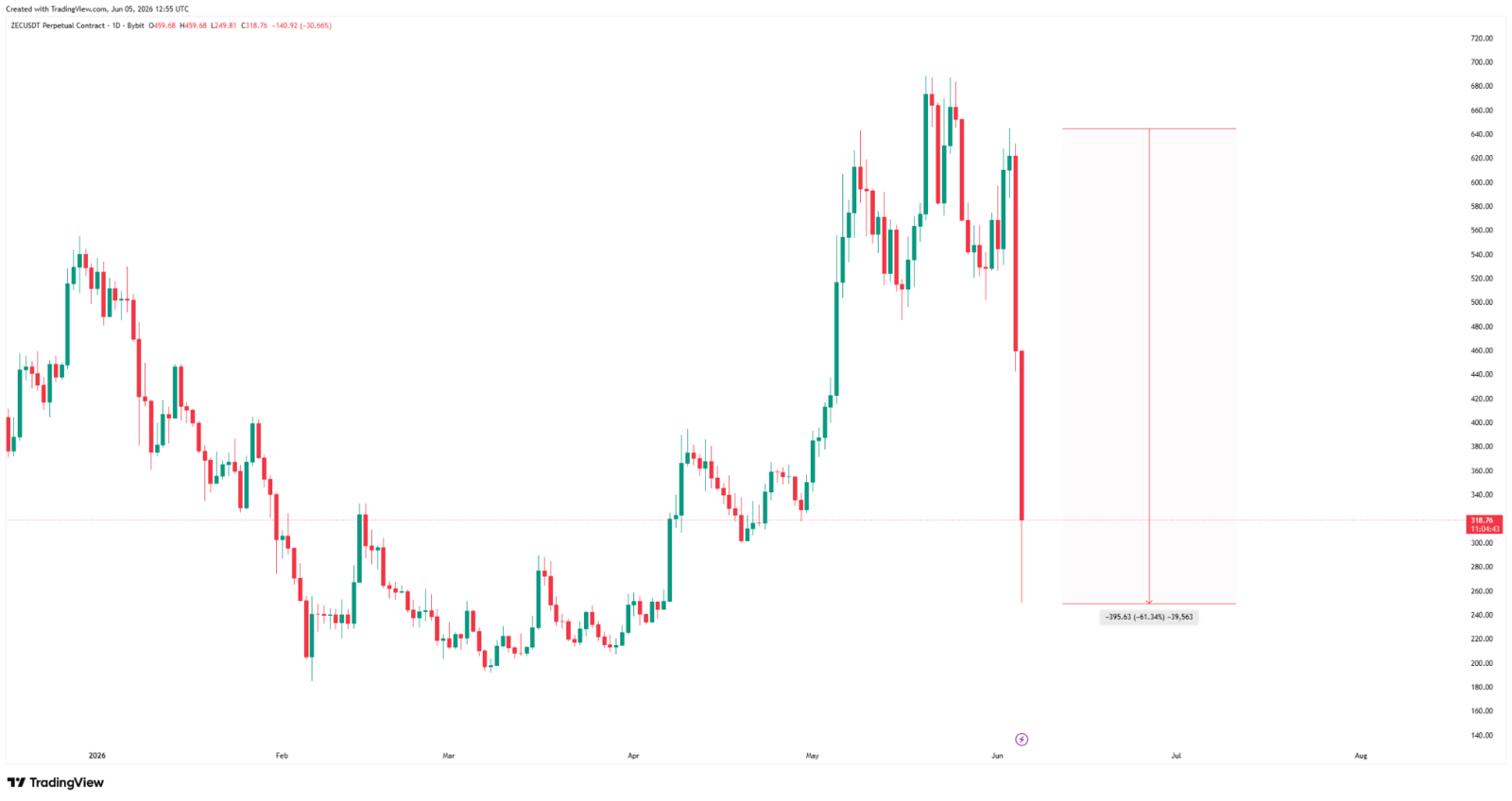
ZEC price drops 60% in a single day. Source: tradingview.com
The bug was discovered on May 29 by security researcher Taylor Hornby. Shielded Labs had hired him in April 2026 specifically to find protocol vulnerabilities before attackers could. While analyzing Zcash Orchard, Hornby used Anthropic’s Opus 4.8 AI model.
After the issue was found, Zcash Open Development Lab coordinated an emergency fix, which was completed on June 2. Developers temporarily disabled transactions using Zcash Orchard before deploying the NU6.2 patch.
Zooko Wilcox, the project’s founder, publicly explained what happened with Zcash on June 5. Today’s Zcash news is based on Zooko’s post.
Shielded Labs acknowledged that the vulnerability was real and exploitable: a proof-of-concept exploit in a local test environment could generate an unlimited amount of undetectable counterfeit ZEC.
However, it is difficult to determine whether anyone exploited the vulnerability before it was patched. Due to Orchard’s private architecture, the team cannot cryptographically prove whether the bug was exploited before the patch.
This partly explains why is ZEC down today: the market reacted not only to the vulnerability itself, but also to the risks that it had already been exploited before. Shielded Labs considers exploitation unlikely, though it cannot confirm that with cryptographic certainty.
At the time of writing, ZEC was trading around $300, having lost 43% over the past 24 hours.
Market reaction to the vulnerability: Why is ZEC down today after the bug was fixed?
Contrary to the team’s expectations and conventional market logic, investors responded to what looked like positive Zcash news by selling. The market cared less about the bug’s discovery and more about Shielded Labs’ inability to prove that the vulnerability had not been exploited. Bearish sentiment was also fueled by former BitMEX CEO Arthur Hayes.
Hayes said he had fully closed his ZEC position after previously naming the asset part of his investment “Holy Trinity.”
According to Hayes, the likelihood that someone exploited the Zcash vulnerability to secretly mint ZEC remains low. The problem is that, due to Orchard’s design, it is impossible to cryptographically prove that this did not happen. For a privacy coin, this uncertainty is enough to justify a reassessment of investment strategy.
However, not all market participants viewed the situation the same way as Hayes. Grayscale Chairman Barry Silbert said critics are framing today’s Zcash news as negative, even though developers discovered the vulnerability themselves and fixed it before any evidence of network damage emerged.
In his view, the incident demonstrates not weakness in Zcash, but the project’s ability to identify and fix critical bugs.
While some investors were reducing their positions, others began buying the dip. According to Lookonchain, shortly after the crash, a new wallet withdrew 37,316 ZEC from Binance, worth approximately $13.1 million.

$13 million in ZEC was withdrawn from Binance to a whale wallet. Source: arkm.com
The market has split into two camps. Some see the inability to verify Orchard’s history as a reason to exit ZEC. Others believe the rapid detection and resolution of the bug reduces long-term risks to the network and are following a “buy the dip” strategy.
Beyond the noise of Zcash news today: How the Orchard bug actually works
At first glance, the vulnerability appeared to allow unlimited minting of new ZEC. In practice, however, the risk was likely more limited. To understand why, it is worth taking a closer look at how Zcash Orchard works.
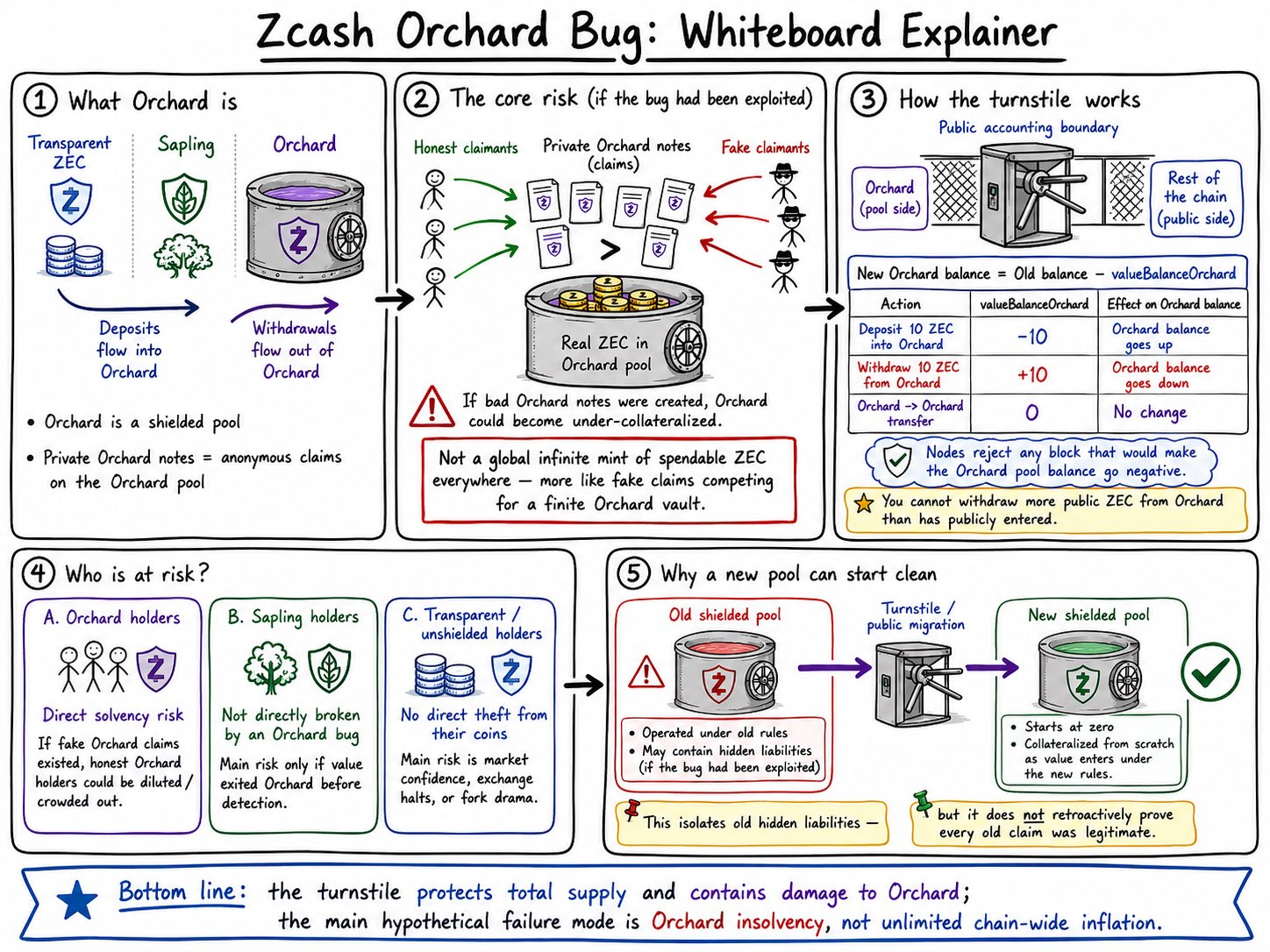
How the Zcash Orchard bag works. Source: x.com
Orchard operates as a separate private pool within the Zcash network. Users deposit ZEC into it, receive private notes, and can later withdraw the coins back to the public part of the network. If the bug had been exploited in practice, an attacker could have created fraudulent claims on funds only within Orchard.
However, the issue would not necessarily have led to uncontrolled issuance across the entire network. Zcash has an accounting mechanism that prevents more public ZEC from being withdrawn from Orchard than was previously deposited into the pool.
Therefore, the risk was not network-wide inflation, but the potential insolvency of Orchard itself, where counterfeit claims could compete with users’ real funds.
Zcash (ZEC) news today mirror vulnerability from 2019
This is not the first Zcash vulnerability tied to the risk of fraudulent issuance. In February 2019, Electric Coin Company disclosed a bug that could have allowed counterfeit shielded coins to be created without detection.
The issue had been discovered on March 1, 2018, but was not disclosed publicly until it was fixed, to prevent attackers from exploiting it.
The vulnerability was patched through the Sapling update, which activated on October 28, 2018. Only then did the team disclose the bug, saying it did not affect user privacy and required no action from ZEC holders. According to Electric Coin Company, no signs of exploitation were found at the time.
What is going on with Zcash now resembles the 2019 case. The vulnerability was also disclosed after it had been fixed. The team also says it sees no signs of exploitation. The difference is that this time, the bug had been in Orchard for nearly four years.
However, according to Udi Wertheimer, one of the most prominent advocates of Bitcoin Ordinals, the market has a short memory. The 2019 vulnerability also looked like a final blow at the time, but a few years later, it was mostly remembered by long-time community members. New buyers entered the ZEC market without this history in mind.
The same could happen with the current bug: it will be discussed now and used as an argument against Zcash, but the market may later shift again to a new narrative and a new generation of buyers.
In response to the criticism, Shielded Labs is considering a new shielded pool that would allow ZEC’s supply integrity to be verified, along with formal verification of the Orchard code.
Conclusion: What today's Zcash news says about privacy in crypto
Today’s Zcash news surrounding Orchard highlighted several weaknesses in the crypto industry.
First, privacy can be a double-edged sword. It protects users from external surveillance, but also makes it harder to verify what is happening inside the system.
Second, the incident highlighted the growing role of AI in security. A vulnerability that had gone unnoticed for nearly four years was discovered using Anthropic’s Opus 4.8 AI model. If such tools help find critical flaws faster than humans, the industry may see more discoveries in the coming years.
As for ZEC trading, the situation remains ambiguous. Under these conditions, both long and short positions carry risk. The market continues to react not only to facts, but also to how participants interpret them. Therefore, trust your own judgment rather than what people say on X.