Coinlaunch was created by a team of crypto experts to help current and future crypto investors find the latest cryptocurrency ICOs and presales. All content follows a strict editorial policy that ensures factual accuracy, neutrality, and usefulness. We strive to provide insightful content that helps our audience make informed decisions, while emphasizing the importance of prioritizing safety and risk management. All information in our content is based on thorough research conducted by our team of copywriters and editors. We use proven sources to find relevant projects and ensure that all content is updated regularly. The information provided by Coinlaunch should be used for informational purposes only and should not be taken as investment advice.
Table of Contents
Crypto marketing cost in 2026: four ways to buy it
What each line item actually costs
Listings and data platforms
Press releases and media
KOL and influencer
Community, search and paid
Cost of marketing for crypto token launch in 2026, gate by gate
Best web3 marketing cost model: packages, retainers or in-house
What a crypto marketing quote does not include
Three budgets, worked through
How to read a crypto marketing quote
FAQ
Get a real number for your project
Share this blog post
Updated: August 2026
A crypto project spends between $199 for a single press release and $200,000 a month for a full-scale multi-market campaign, and most funded projects land between $5,000 and $30,000 a month. A complete token launch, counting everything from audit to post-TGE retention, runs $30,000 at the absolute floor and $500,000 or more if you are buying tier-1 media and top-tier KOLs.
Almost every article on this topic gives you a monthly range and stops. This one gives you unit prices: what a press release costs, what a KOL post costs, what a listing update costs, what an audit costs, and what each of those adds up to across a launch. Every figure is either published by the vendor or cited to a source you can open. Let’s get down to business.
Crypto marketing cost in 2026: four ways to buy it
Chart of crypto marketing cost by line item, from $199 press releases to $45,000 YouTube sponsorships
There are four ways to pay for crypto marketing, and they differ by an order of magnitude. A-la-carte starts at $199 per item. Packages run $1,000 to $9,000 for a bundle. Agency retainers run $3,000 to $25,000 a month. An in-house team costs $28,000 to $45,000 a month once you load salaries, tools and equity.
Which one is right has almost nothing to do with your budget and almost everything to do with whether you know what you need. If you can name the five things you want bought this quarter, buy them individually. If you cannot, you are paying an agency to decide, and that decision is most of what a retainer buys.
Buying model
Entry price
What you get
Best when
A-la-carte
$199 per item
One placement, one post, one listing update. You choose and sequence everything.
You know exactly what you need and have someone to run it.
Package
$1,000 to $9,000
A pre-bundled set of placements, usually PR plus listings plus some social.
You want launch-week coverage without building a plan from scratch.
Agency retainer
$3,000 to $25,000/mo
Strategy plus execution across channels, one team, one report.
You need range of skills and someone accountable for the outcome.
In-house team
$28,000 to $45,000/mo
Four people, dedicated. Deep in what they know, blind elsewhere.
Post Series A, monthly spend above $30,000, product marketing is core.
The mistake we see most on the buy side is founders comparing a $2,000 package to a $10,000 retainer as though they are the same purchase. They are not. The package is inventory. The retainer is inventory plus the judgment about which inventory to buy and when. Whether that judgment is worth $8,000 a month is a real question, and the honest answer is that it depends entirely on the agency.
What each line item actually costs
Below are unit prices, not monthly ranges. This is the section to keep open when you are reading a quote.
Listings and data platforms
Getting listed is mostly free. Getting noticed on a listing is not.
CoinMarketCap and CoinGecko do not charge a listing fee (for legit projects or non-priority listings). Neither is a paid placement, and anyone selling you a “guaranteed CMC listing” for five figures is selling you a submission you can make yourself. What costs money is meeting the criteria: exchange coverage, liquidity depth, an audit, and a clean information package.
On DEX aggregators the pricing is explicit. DEX Screener charges $299 for Enhanced Token Info, which adds your logo, description and social links to your pair page, usually processed within minutes. That is the single highest-return $299 in crypto marketing, because a pair page without a logo reads as abandoned.
Rating and review platform promotion, the kind that puts you in a featured slot or a trending list, generally runs $500 to $5,000 per platform per month depending on traffic. CoinLaunch sells individual promotional placements from $199, with bundled promo packages up to $8,849.
Press releases and media
Distribution and placement are two different products at two very different prices.
Distribution puts your release on a wire that syndicates it to hundreds of low-authority sites. Chainbull syndicates to 500-plus outlets from $199. This is worth doing for indexation and for having a citable page, but nobody reads syndicated releases and you should not expect traffic from them.
Placement is paying a publication to run your content. Reseller rates for Cointelegraph start at roughly $6,500 for a press release where you supply the copy, and rise to around $18,200 for a sponsored article with writing included, with review and interview formats higher again. Across tier-1 crypto media generally, expect $8,000 to $30,000 per sponsored piece. Tier-2 outlets run in the low thousands.
Earned coverage, meaning a journalist writes about you because the story is interesting, costs nothing in placement fees and $3,000 to $15,000 a month in agency outreach. It is also the only kind that survives a reader checking whether the article is labelled “sponsored”.
KOL and influencer
This is the line item with the widest spread and the most waste.
Published rate benchmarks for 2026: nano accounts charge $100 to $500 per post on X. Micro KOLs at 25,000 to 100,000 followers charge $1,000 to $2,000. Mid-tier accounts at 100,000 to 500,000 charge $3,000 to $8,000 per post. A campaign series with a single 200,000-follower account runs $5,000 to $20,000. YouTube reviewers in the 300,000 to 500,000 subscriber range charge $15,000 to $45,000 per sponsored video. Telegram and Discord shoutouts in large channels run $200 to $5,000 per announcement.
Two costs that quotes hide. First, agency management on top of creator fees, usually 15 to 30 percent, or a flat retainer. Second, the vetting you are not doing. Follower counts in crypto are purchased at scale, and the difference between a $3,000 post that reaches real traders and a $3,000 post that reaches bots is invisible until you look at referral data. Ask for the last three campaigns’ click-through numbers before you approve a list.
Crypto creator rates also run 50 to 150 percent above comparable general-market influencer pricing, mostly because creators carry regulatory and reputational risk that a consumer brand does not ask them to carry.
Community, search and paid
Community management. $2,000 to $10,000 a month for Telegram and Discord moderation, ambassador programs and sentiment reporting. Round-the-clock coverage across time zones sits at the top of that range. Note what this does not buy: growth. Moderation keeps a room orderly. It does not give anyone a reason to join.
SEO. $2,500 to $12,000 a month. The cost driver is content volume and link quality. Six months before compounding returns is normal, and any promise of rankings inside eight weeks means either bought links or worthless keywords.
GEO and AI search visibility. $2,000 to $8,000 a month. This targets being cited inside ChatGPT, Perplexity and Google AI Overviews rather than ranking in blue links. It is the newest line item on this list and currently the most underpriced relative to return, because a growing share of founder and investor research now starts inside an AI assistant rather than a search box.
Paid traffic. Media spend and management fee are separate, always. Management is typically 10 to 20 percent of spend. Below $10,000 a month in actual spend on crypto-compliant networks you will not gather enough data to optimize anything, so treat $10,000 as the floor for the exercise to be worth running at all.
Cost of marketing for crypto token launch in 2026, gate by gate
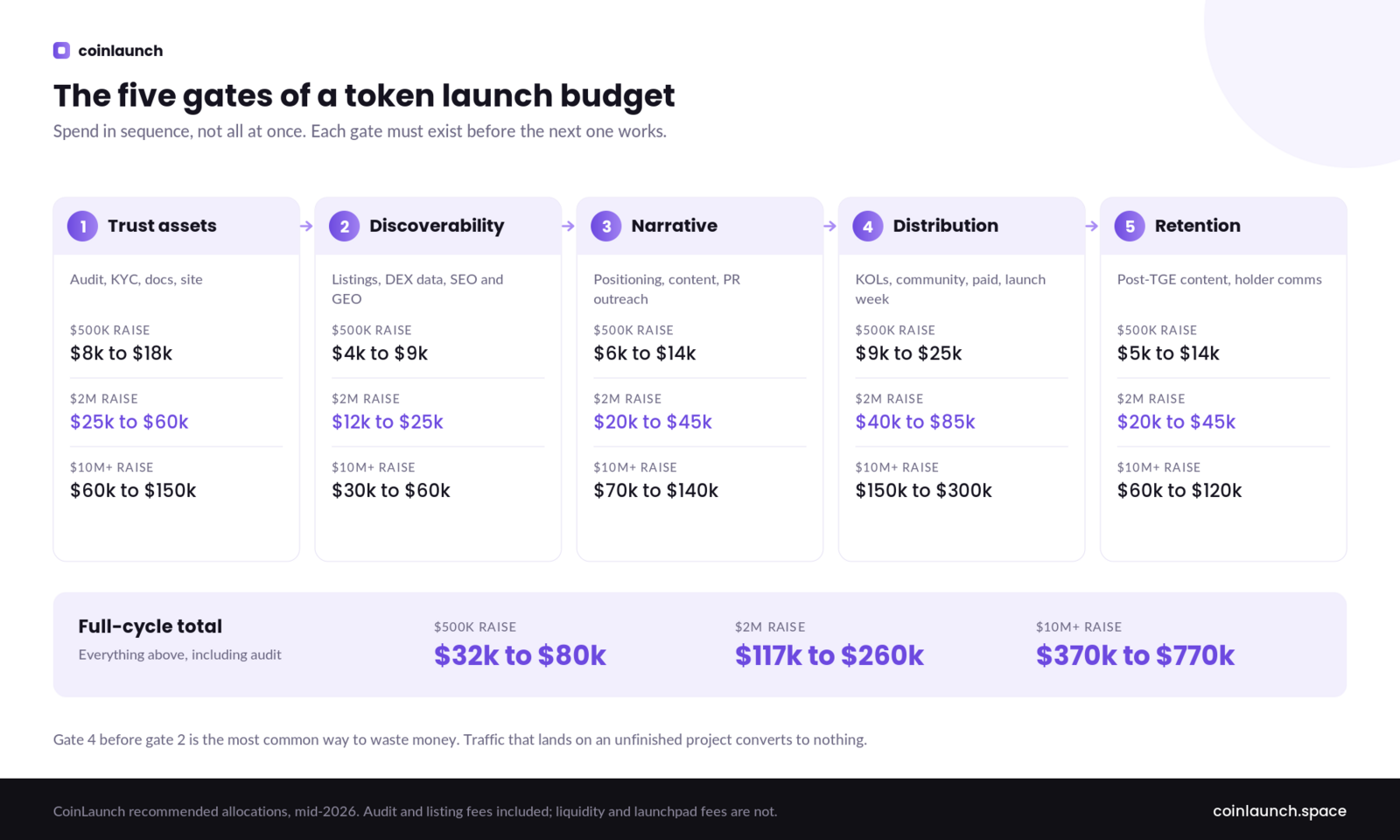
A token launch costs $30,000 to $80,000 if you are disciplined, $120,000 to $250,000 for a typical funded project, and $500,000 or more if you are buying tier-1 media and top-tier KOL coverage in several markets at once. The cost of marketing for crypto token launch is best budgeted as a sequence of gates rather than a monthly figure, because the spend is front-loaded into things that must exist before anyone can promote you.
Here is the sequence, with what you buy at each gate and what it costs. The three columns are sized to the raise, not to ambition.
Gate
$500k raise
$2M raise
$10M+ raise
1. Trust assets (audit, KYC, docs, site)
$8,000 to $18,000
$25,000 to $60,000
$60,000 to $150,000
2. Discoverability (listings, DEX Screener info, rating platforms, SEO and GEO foundation)
4. Distribution (KOLs, community, paid traffic, launch-week push)
$9,000 to $25,000
$40,000 to $85,000
$150,000 to $300,000
5. Retention (post-TGE content, holder comms, second PR wave)
$5,000 to $14,000
$20,000 to $45,000
$60,000 to $120,000
Total
$32,000 to $80,000
$117,000 to $260,000
$370,000 to $770,000
Three things about this table are worth saying out loud.
Gate 1 is not marketing and you still have to pay for it. An audit alone runs $5,000 for a simple token contract, $25,000 to $100,000 for most DeFi protocols, and past $250,000 for enterprise multi-chain systems. Founders routinely leave this out of the marketing budget and then discover it eats the first third of it. Include it, because no amount of promotion survives a project that cannot show an audit.
The gates are sequential for a reason. Buying distribution before discoverability is the most common way to waste money in this industry. If a KOL post sends 4,000 people to look you up and your DEX Screener page has no logo, your docs are a Notion draft and ChatGPT has never heard of you, you paid for the traffic and handed it to nobody.
Gate 5 is the one that gets cut. Post-TGE budget is the first casualty when launch week runs over, and it is the phase where attention actually becomes holders. If you have to cut somewhere, cut distribution, not retention.
For an agency-side view of the same problem, RGray’s breakdown of launch budgets by phase argues for a 45 / 25 / 30 split across pre-launch, launch week and post-launch, and makes the case that concentrating spend in launch week is the single most expensive budgeting error founders make. Our gate model and their phase model reach the same conclusion from different directions: the money you spend before anyone is watching is what determines whether the launch-week money works.
Infographic of the cost of marketing for crypto token launch across five budget gates
Best web3 marketing cost model: packages, retainers or in-house
For projects spending under $10,000 a month, packages and a-la-carte purchasing are almost always cheaper per unit of output than a retainer. Above roughly $15,000 a month, a retainer wins, because coordination becomes the bottleneck rather than execution. The best web3 marketing cost structure is the one that matches where your constraint actually sits.
Here is what the market publishes. Every figure links to its source.
Industry hourly rates across these providers run roughly $25 to $250, which tells you most of what you need to know about why quotes vary so much for work that sounds identical.
CoinLaunch’s own managed tiers sit in the middle of that table: full-cycle agency retainers (not promotion product packages mentioned in the table) from $6,099 to $24,499 a month depending on scope, with a separate promotional budget from $20,000 to $200,000 and a 10 percent management fee on the budget. We publish it because the split between fee and budget is exactly the thing most quotes obscure, and you cannot compare two agencies until you know which one is quoting fee-only.
On in-house. A minimum credible internal team is a marketing lead, a content person, a community person and a designer. Loaded for salary, equity, tools and benefits, that is roughly $28,000 to $45,000 a month in 2026, and three to five months to assemble. That team will be excellent at the three or four things those four people happen to know and absent everywhere else. Under Series A the arithmetic rarely favours it. Past Series A, when product marketing becomes a permanent function rather than a launch project, it usually does.
On fractional. A fractional CMO runs $5,000 to $15,000 a month for one or two days a week. It solves a strategy gap, not an execution gap. Hiring one when you have nobody to execute their decisions is an expensive way to generate documents.
What a crypto marketing quote does not include
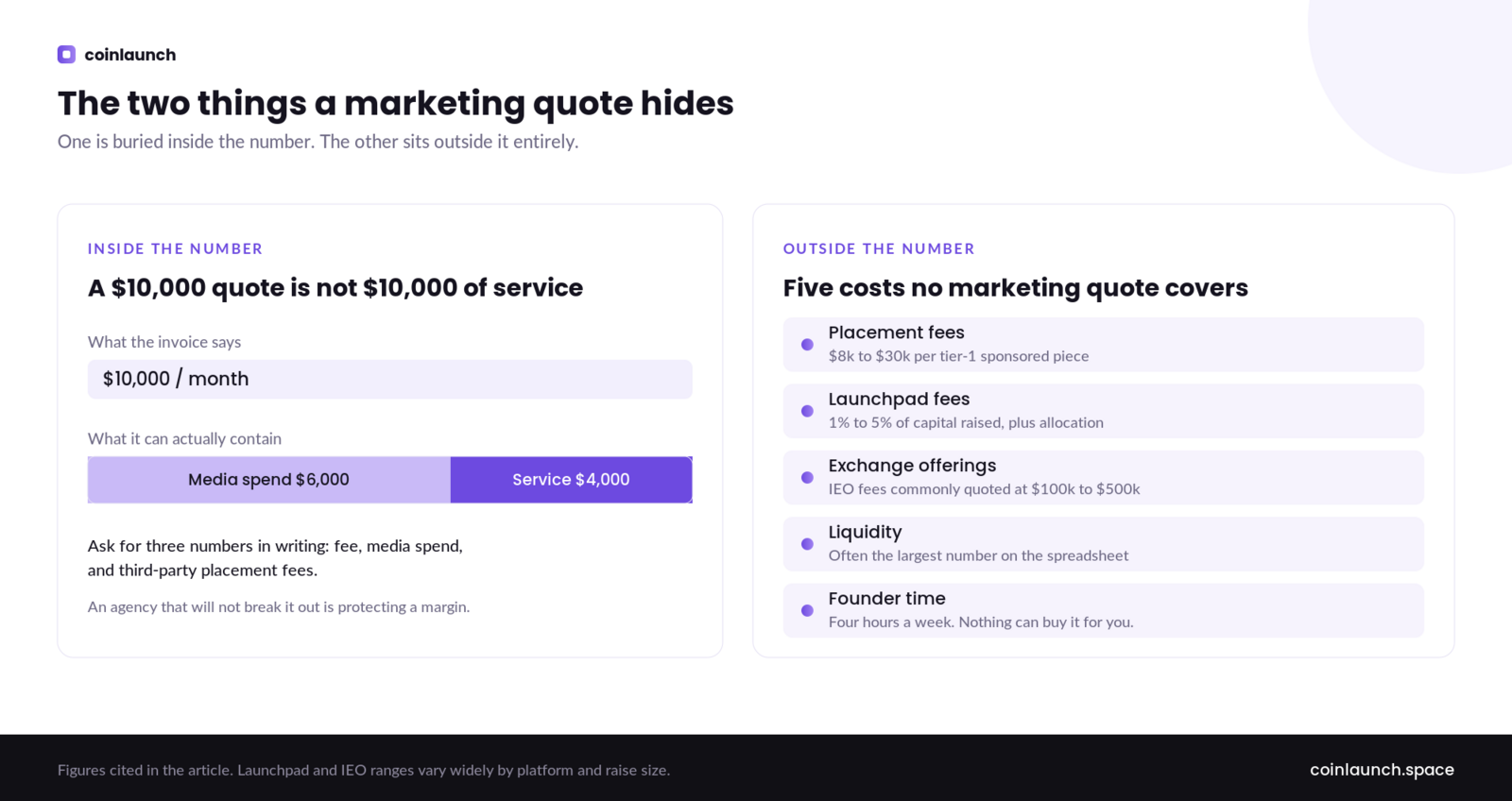
This is the section that saves the most money. Five costs sit outside almost every marketing quote you will receive, and forgetting them is how a $100,000 budget becomes a $160,000 one.
What a crypto marketing quote hides: media spend inside the number and five costs outside it
Media spend. A $10,000 monthly quote that quietly includes $6,000 of ad spend is a $4,000 service. Ask for the split between fee, media spend and third-party placement fees in writing, before you sign. An agency that will not break it out is protecting a margin you should be able to see.
Placement fees. Agency retainers usually cover writing and pitching, not the fee the publication charges to run the piece. On tier-1 crypto media that fee is the larger number by a wide margin.
Launchpad and exchange fees. IDO launchpads typically take 1 to 5 percent of capital raised, sometimes plus a token allocation. Centralized exchange offerings sit in a different universe: IEO fees are commonly quoted in the $100,000 to $500,000 range before allocations. Neither is marketing, both compete for the same pool of money.
Liquidity. Not a marketing cost and the single largest number on many launch spreadsheets. Budget it separately or it will silently consume the marketing line.
Your own time. Founder-led content outperforms agency-written content in crypto by a wide margin, and it is the one input no retainer can buy. If the plan needs four hours of founder time a week and you do not have four hours, the plan is wrong regardless of price.
Three budgets, worked through
$5,000 total, pre-seed, no token yet. DEX Screener Enhanced Token Info at $299 if you have a pair. Plus, $800 on listings on the rest platforms looking for pre-sales and early launches. One syndicated release at $199 tied to a real milestone. $3,000 on positioning and a 15-page search and AI-search content foundation. $1,000 on two-four micro-KOL test posts, chosen for audience quality not reach. Skip Discord, skip paid, skip tier-1 placements, skip the conference booth. Concentrate on being findable and credible, because at this stage those are the only two things that compound.
$45,000 total, seed stage, TGE in twelve weeks. $12,000 to audit and trust assets. $6,000 to listings, DEX data pages and a search and AI-search foundation. $9,000 to positioning, content and PR outreach with one paid tier-2 placement. $12,000 to distribution, split across six vetted mid-tier KOLs and a small paid test. $6,000 held for the eight weeks after TGE. This is a launch that will not trend, and will still be standing in six months.
$180,000 total, Series A protocol, multi-market. $45,000 to audit and compliance packaging. $22,000 to discoverability across listings, ratings, SEO and GEO. $40,000 to narrative, including two tier-1 sponsored placements and sustained earned outreach. $50,000 to distribution across 15 to 20 KOLs, community and paid. $23,000 to post-TGE retention. Every number here is a decision you can defend to an investor, which is the actual test.
How to read a crypto marketing quote
Six questions. Ask all six before you compare two proposals.
Is this fee-only, or does it include media spend and placement fees? Get the three numbers separately.
What is guaranteed, and what is an objective? Nobody can guarantee an exchange listing or tier-1 editorial coverage. Anyone who does is either selling paid placement as earned, or selling something they do not control.
Where does the KOL traffic land? If there is no answer about the destination page and how conversion is measured, you are buying impressions from audiences that will never touch the product.
What happens in month four? Many quotes are launch-shaped and go quiet afterwards. Ask what the retention plan costs before you sign the launch plan.
Who actually does the work? The seniority spread between $50 and $250 an hour is the difference between a strategist and a coordinator forwarding your brief.
What is the cancellation term? Thirty days is standard. Twelve-month lock-ins in a market that reprices quarterly are a risk transfer from them to you.
FAQ
What is the minimum realistic budget to market a crypto project in 2026? About $3,000 a month, or roughly $5,000 as a one-off if you are pre-token. That covers positioning, a search and AI-search content foundation, one or two paid placements and a small KOL test. It does not cover paid traffic at useful volume, tier-1 media or a managed community. Below $3,000 a month you are buying single items, which is fine as long as you know which items.
How much should I budget for a token launch on a $2M raise? Plan $117,000 to $260,000 across the full cycle, including audit and trust assets. As a rule of thumb, projects raising $2M commonly allocate 6 to 12 percent of the raise to launch marketing. Below 5 percent you will struggle to be visible at TGE. Above 15 percent you are usually buying reach you cannot convert.
Is a crypto marketing package cheaper than an agency retainer? Per unit of output, yes, and by a wide margin. A $2,000 package buys more visible placements than $2,000 of a retainer. What a package does not buy is sequencing, and sequencing is what determines whether those placements compound or evaporate. Packages win under roughly $10,000 a month, retainers win above $15,000.
How much does a crypto press release cost? Syndicated distribution starts at $199 and reaches several hundred low-authority sites. Placement in a tier-1 publication is a different product at $6,500 to $30,000 depending on the outlet and format. Earned coverage carries no placement fee but costs $3,000 to $15,000 a month in agency outreach and is the only version that survives a reader checking the “sponsored” label.
Why do two agencies quote such different prices for the same brief? Three reasons, in order of size. Seniority, since hourly rates across the market run roughly $25 to $250. Scope hidden inside the number, particularly media spend and placement fees bundled into a headline figure. And market timing, because KOL and paid inventory reprice 30 to 50 percent upward in a strong market, so a quote from a flat quarter is not comparable to one written during a rally.
Get a real number for your project
Tell us your stage, raise size and launch date, and we will send back an itemized budget with unit prices you can check against this page.