In June 2026, we expected HYPE to reach $60. The token surpassed this target within a week and rose to $76.87 on June 16. The rally later resumed after Donald Trump said the CFTC was working on a compliant path for Hyperliquid in the United States. The Hyperliquid price reached a new all-time high of $89.6 on September 6 and is currently changing hands near $79.80.
According to the September 2026 forecast HYPE price prediction targets a primary $60–$100 range. The $60–$65 zone could support a more balanced growth scenario, while Arthur Hayes’ $150 target for August was not reached.
This Hyperliquid price prediction examines technical levels, protocol revenue, buybacks, token unlocks, HIP-3 and HIP-4 markets, and Real-World Assets (RWAs). It also compares short-term and full-year HYPE coin forecasts.
What Is Hyperliquid?
Hyperliquid is a Layer 1 blockchain optimized for on-chain trading. For readers still asking what is Hyperliquid, the network consists of two main components: HyperCore and HyperEVM. HyperCore powers fully on-chain spot and perpetual order books, processing orders, trades, and liquidations at up to 200,000 orders per second. HyperEVM provides an EVM-compatible environment for smart contracts and operates under the same HyperBFT consensus mechanism.
The native HYPE crypto is used for gas on HyperEVM and staking across the network. The Hyperliquid ecosystem has expanded beyond its namesake exchange through HIP-3, which allows third-party developers to launch independent perp DEXs and configure their own oracles, leverage limits, and contract specifications. These platforms offer perpetuals on equities, indices, commodities, and other RWAs.
HIP-3 deployers can retain up to 50% of the trading fees generated by their markets. Hyperliquid directs 99% of its trading fee revenue toward HYPE repurchases, creating a direct link between network activity and demand for the token.
HIP-4 adds fully collateralized outcome markets for prediction markets and bounded options-like instruments. Unlike perpetuals, these contracts settle within a fixed range and do not involve leverage or liquidations.
HYPE Price Today: Current Market State
The HYPE price today sits around $79.8 as of September 14. The token is down approximately 9.2% over the past week but remains up 42.5% over the month. Its market capitalization stands near $20.1 billion, ranking HYPE as the 9th-largest cryptocurrency.
Regulatory news also contributed to the recent volatility. On August 19, HYPE jumped 11% after President Donald Trump said that CFTC Chair Mike Selig was working on a compliant path to bring Hyperliquid to the U.S. However, no formal approval or implementation timeline has been announced, meaning part of the recent rally may still reflect short-term expectations around the news.
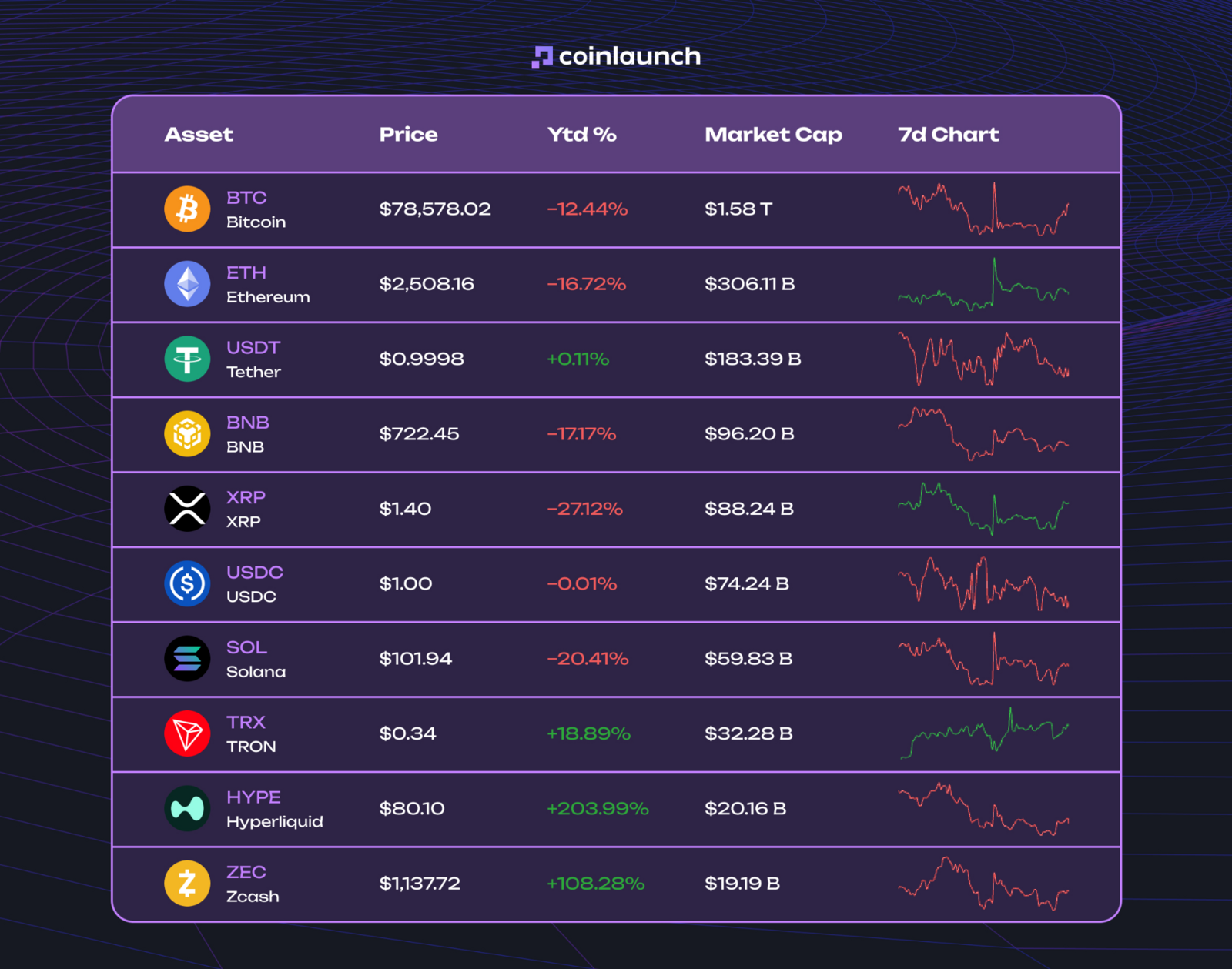
Top 10 cryptocurrencies by market cap. Source: coinlaunch.space
The market has shifted significantly since our last forecast. HYPE surpassed its June record of $76.87 and reached a new all-time high of $89.6 on September 6. The token now trades approximately 11% below this level, while our previous $60 target remains part of the retrospective.
For the updated Hyperliquid HYPE fundamental analysis, network activity remains central. The Hyperliquid TVL currently stands at $6.74 billion. From mid-August through mid-September, Hyperliquid revenue reached $59.5 million, Hyperliquid perp volume totaled $220.7 billion, and spot Hyperliquid DEX volume amounted to $4.97 billion.
RWA activity also expanded. On August 10, xStocks launched its first five tokenized stocks and ETFs on HyperCore. Earlier, HIP-3 markets had grown to around half of Hyperliquid’s daily perpetual volume, while RWAs accounted for 52% of weekly trading activity during one period.
The protocol directs 99% of eligible trading fee revenue to the Assistance Fund, which purchases and burns HYPE. Cumulative Hyperliquid buybacks have exceeded $1.25 billion.
The HYPE vesting schedule remains the main supply-side risk. Core contributors received 23.8% of the total allocation under a multi-year release structure. Current trackers place the next scheduled release at up to 14.18 million HYPE on September 29, although actual claims have previously remained below the theoretical ceiling. Future HYPE token unlocks may therefore differ from the amounts shown in standard vesting calendars.
HYPE Chart: What Does It Say?
Current Hyperliquid technical analysis points to neutral short-term momentum within a broader bullish structure. As of September 14, HYPE trades near $79.8 after reaching a new all-time high of $89.6 on September 6. The Hyperliquid chart now shows a correction from this peak. The token has fallen below $80 and is testing its rising short-term moving average, while remaining above its major medium- and long-term averages. The HYPE RSI has cooled to the low-50 range after previously reaching overbought levels.
The bullish flag observed earlier has already broken to the upside. According to a recent technical analysis, the key support zone now sits at $76-$78. Holding this range could open another attempt to reclaim $82-$84, followed by an upside HYPE price target of $87-$90. A confirmed move below $76 would shift attention to support near $73, followed by $68-$69.
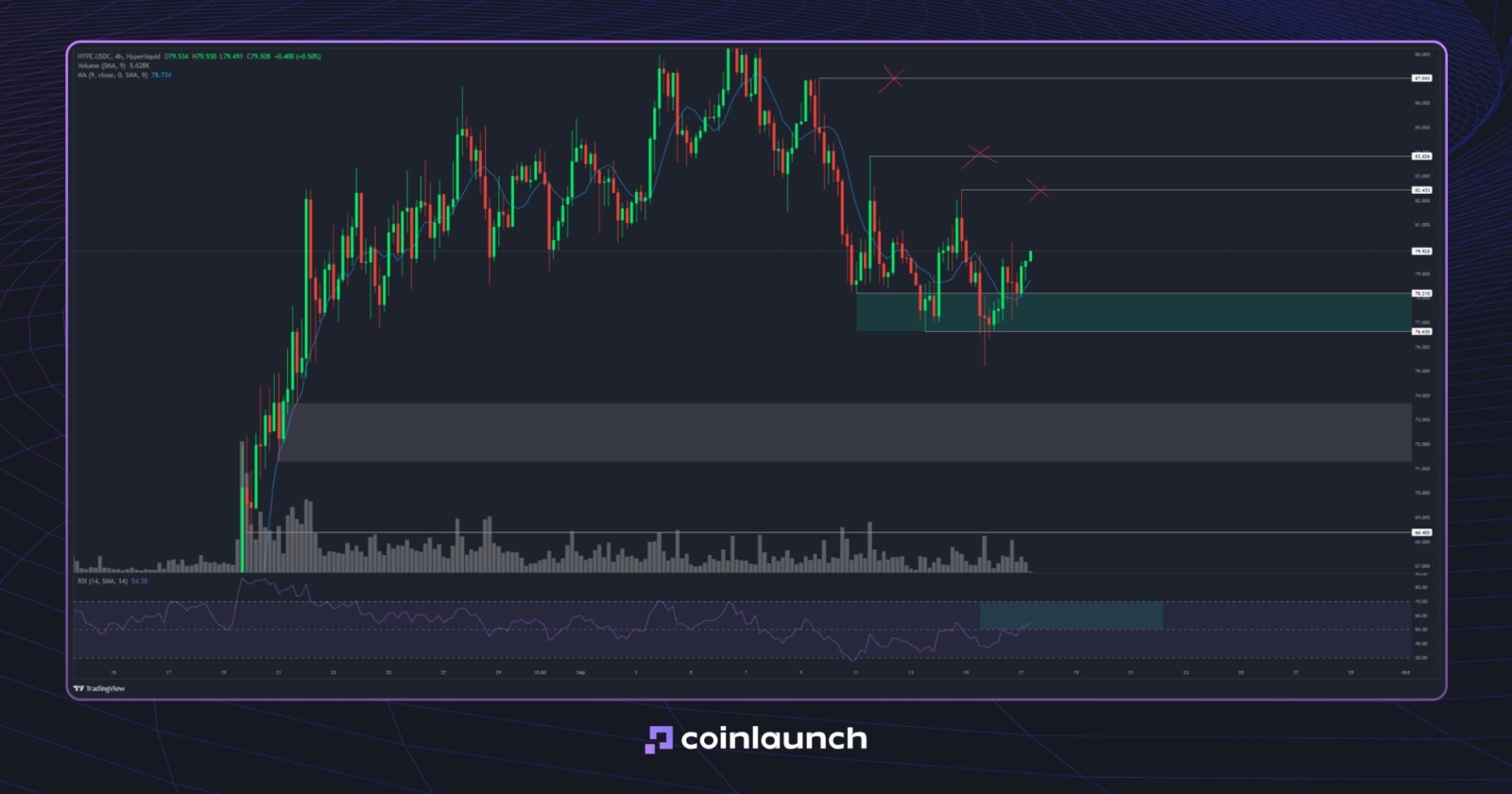
Hyperliquid technical analysis. Source: goodcrypto.app
Part of the recent rally followed Donald Trump’s announcement that the CFTC was working on a compliant path to bring Hyperliquid to the U.S. Without further regulatory progress, this news-driven move may prove temporary. Under a deeper correction scenario, the $60-$65 range could serve as a broader consolidation zone for more balanced price growth.
Hyperliquid (HYPE) Fundamental Analysis
Protocol revenue and its connection to tokenomics remain central to Hyperliquid (HYPE) fundamental analysis. Over the past 30 days, the protocol generated $76.1 million in fees and $59.5 million in Hyperliquid revenue. Cumulative revenue has reached approximately $1.25 billion.
Under the current model, 99% of qualifying spot and perpetual trading fees are directed to the Assistance Fund to purchase HYPE. Builder fees, HIP-3 deployer distributions and several other costs are excluded. According to DefiLlama, Hyperliquid generated $201.8 million in gross protocol revenue in Q2 2026, with $148.7 million allocated to Hyperliquid buybacks. In Q3, as of September 14, these figures stand at $149.3 million and $110.3 million, respectively.
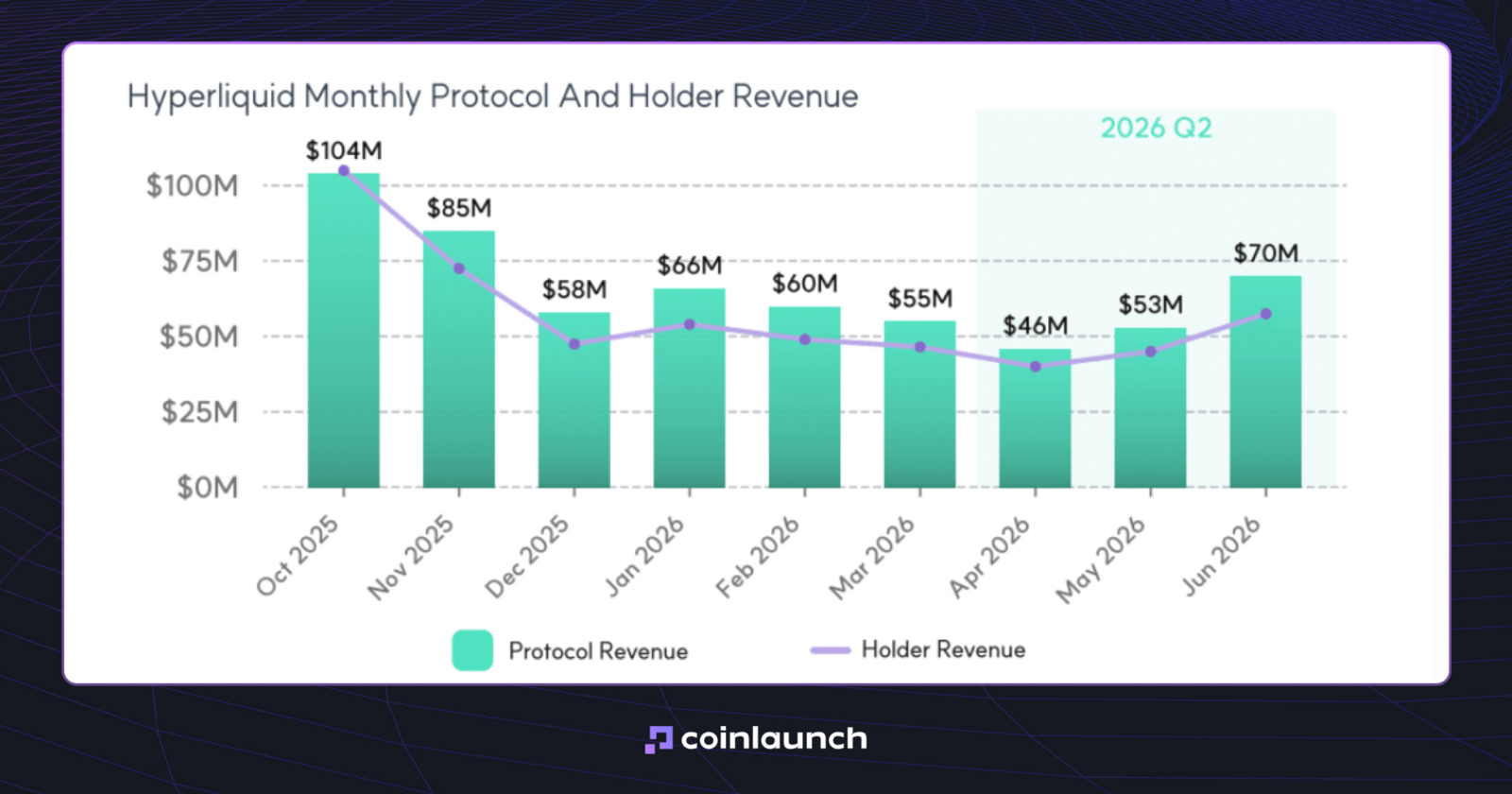
Hyperliquid revenue chart by month. Source: hyperliquidresearch.xyz
HIP-3 growth expands Hyperliquid’s market coverage but reduces the revenue retained from each dollar of trading volume. Since October 2025, third-party deployers have been able to launch perpetual markets by staking 500,000 HYPE and retain up to 50% of their fees. Hyperliquid receives the remaining share, with 99% of qualifying protocol revenue directed toward HYPE purchases. Builder-deployed markets grew from roughly 2% of Hyperliquid perp volume at the beginning of 2026 to nearly half by August.
This shift has contributed to a divergence between trading activity and retained revenue. Hyperliquid’s gross protocol revenue declined from $356.7 million in Q3 2025 to $201.8 million in Q2 2026. As of September 14, Q3 revenue stands at $149.3 million, while Hyperliquid buybacks have reached $110.3 million, compared with $148.7 million in Q2.
A separate factor is the HYPE token unlocks. The nominal HYPE vesting schedule can differ significantly from the number of tokens actually distributed. On September 6, core contributors received approximately 433,419 HYPE, compared with the projected monthly ceiling of 9.92 million HYPE. The actual distribution was almost 23 times smaller.
According to Tokenomist, approximately 222.45 million HYPE, or 22.24% of the maximum supply, had been unlocked by September 14. The next core contributor unlock is scheduled for October 6, 2026, although the actual claim may again differ from the nominal schedule.
HYPE Price Prediction: Today, Tomorrow, and the Next 30 Days
Short-term forecasts have shifted after HYPE reached a new all-time high. With FXEmpire recording a price near $79.5 on September 14, the latest HYPE price prediction models generally point to either consolidation below the September peak or a deeper correction.
CoinCodex currently gives a neutral technical signal. Its immediate support levels stand at $77.50, $74.72 and $72.34, while resistance sits at $82.66, $85.05 and $87.82. A move through the upper resistance would bring the record near $89.6 back into focus.
The platform’s algorithmic Hyperliquid crypto price prediction is more bearish. It projects a $61.91-$65.04 range by September 28 and a price near $63.06 by October 15. Its broader 2026 model places HYPE between $59.56 and $80.40, with a year-end estimate near $60.
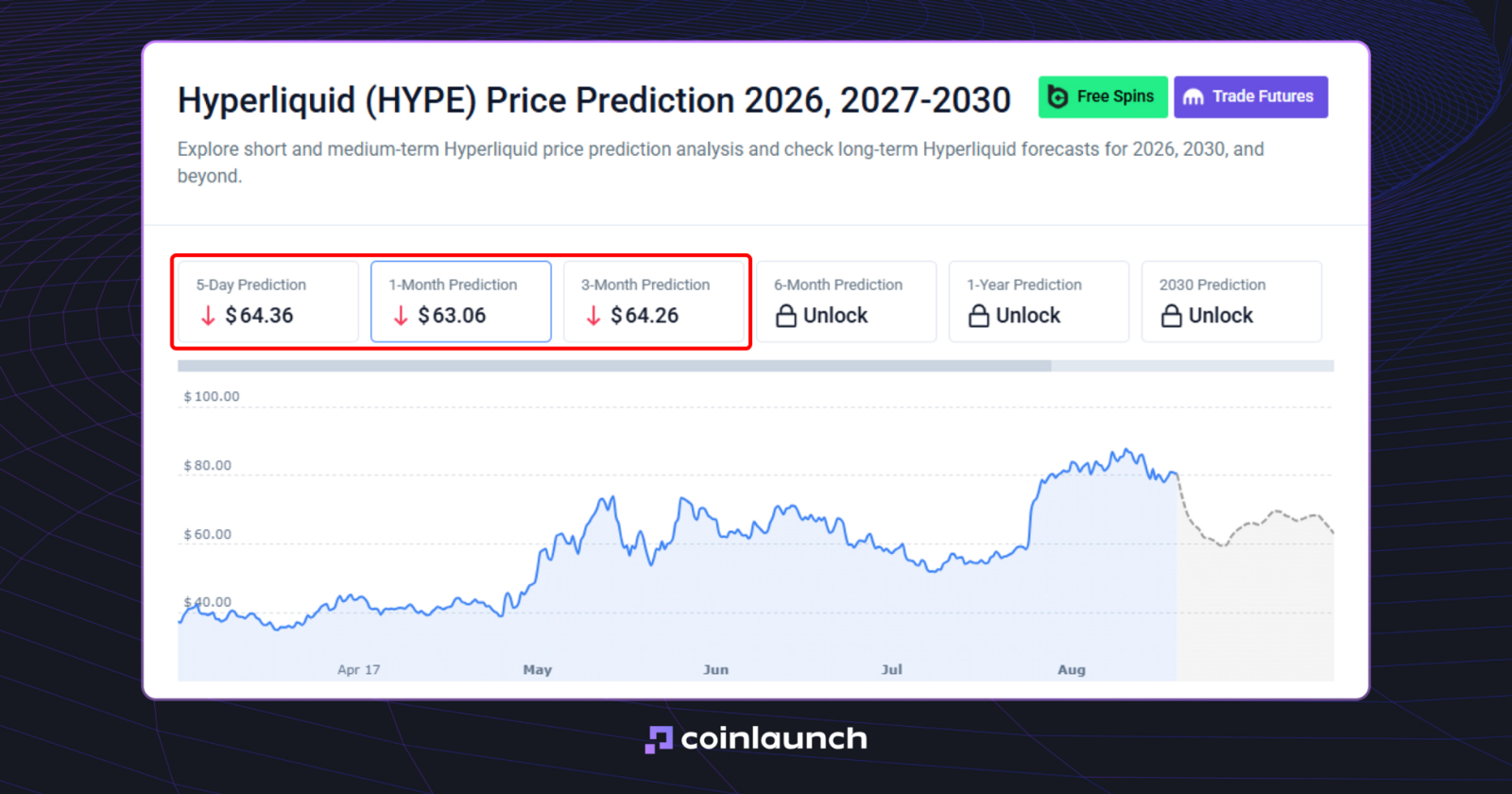
Hyperliquid (HYPE) price prediction by CoinCodex. Source: coincodex.com
Traders Union aggregates five external 2026 projections into an average target of $70.60. This HYPE crypto price prediction set ranges from $41 to $80.90, leaving the current Hyperliquid price forecast significantly wider than before the September rally.
Hyperliquid Price Prediction 2026
The updated Hyperliquid price prediction 2026 now centers on whether HYPE can extend its September breakout. In August, FXEmpire identified a bull flag with a measured target near $100. The breakout has since occurred: HYPE cleared the former $61-$65 resistance zone and reached a new all-time high near $89.6 on September 6. Holding the $76-$78 support zone and reclaiming $87-$90 would keep $100 as the primary bullish target.

Hyperliquid price prediction 2026 by FXEmpire. Source: fxempire.com
CoinCodex remains more cautious, despite the recent pump following news that the CFTC was working on a compliant path for Hyperliquid in the U.S. Its updated algorithmic HYPE price prediction 2026 places HYPE between $60.01 and $64.06 in December, with an average price of $62.58. The model expects a year-end price near $60, about 25% below current levels.
In March, Arthur Hayes issued a HYPE token price prediction 2026 of $150 as early as August. The forecast depended on Hyperliquid’s annualized revenue recovering to $1.4 billion. The target did not materialize, with HYPE peaking near $89.6, while current annualized protocol revenue stands closer to $700 million.
The question of how high can Hyperliquid go therefore produces a wide range of scenarios. Current 2026 projections extend from the $60-$65 consolidation zone to the $100 bull flag target, while Hayes’ $150 estimate remains the most aggressive case.
Long-term models are also divided. CoinCodex’s current Hyperliquid price prediction 2030 targets $157.92 by year-end, with its December model ranging from $139.69 to $160.87. Traders Union’s multi-platform consensus gives a lower average 2030 target of approximately $106.70.
HYPE Alternatives: $GOOD as Another Way to Get Hyperliquid Exposure
goodcryptoX provides another way to interact with the Hyperliquid ecosystem. Its Hyperliquid trading terminal introduces trailing orders, multiple take-profit (Multi-TP) targets and smart stop-losses. It also adds no-code dollar-cost averaging (DCA), Grid, Infinity Trailing and Signals strategy bots. Traders can deploy these tools across HIP-3 markets for equities, ETFs, indices and commodities.
The native GOOD platform token grants a revenue share from goodcryptoX activity: holders receive 50% of DEX swap fees, while a portion of tokens is regularly burned. GOOD is also used for fee discounts and additional trading rewards. It is not a direct alternative to HYPE, but a separate token whose economics are tied to goodcryptoX trading activity, including perp DEX and Hyperliquid trading.
Final Thoughts
The current HYPE price prediction remains mixed, with published forecasts for late 2026 ranging from $60 to $100. The price will depend on Hyperliquid trading activity, HIP-3 and real-world asset market growth, buyback volumes, actual token unlocks, institutional demand and regulatory developments in the U.S.
The CFTC has also become a new price catalyst. HYPE jumped 11% after Donald Trump said that CFTC Chair Mike Selig was working on a compliant path to bring Hyperliquid to the U.S. However, no formal approval or implementation timeline has been announced.
Competition is another risk factor. Lighter recently launched a dedicated instance on Robinhood Chain as the exclusive perps engine inside Robinhood Wallet, supported by an $11 million LIT incentive pool. dYdX Labs has also rebranded its perps product as Arcus and moved it to Robinhood Chain through a joint launch with Robinhood Crypto.
These developments do not yet threaten Hyperliquid’s market leadership, but they could help its competitors attract users, liquidity and trading volume through Robinhood’s distribution. This may weigh on HYPE even before a material shift in market share occurs, as crypto investors often react to competitive headlines faster than underlying metrics change.
The HYPE coin price prediction therefore cannot be viewed independently from the protocol’s core metrics. Hyperliquid remains the leading perp DEX by volume, but part of HIP-3 fees goes to third-party deployers, while actual team claims remain significantly below the projected vesting schedule. Revenue, buybacks, token distribution and competitive pressure remain as important as regulatory news and price-chart movements.