In August, the crypto market went through its largest liquidation wave since October 2025, the launch of Coinbase Tokenized Stocks on Base, and another round of releases tied to Hyperliquid. During the same period, ENA jumped on news from Ethena and FalconX, and progress on the CLARITY Act in the U.S. was delayed again.
Among the month’s main crypto narratives, several themes kept resurfacing: tokenized stocks and 24/7 trading, NFT season, new market types built through HIP-3 and HIP-4, and renewed interest in token value accrual through buybacks and tokenomics changes. These emerging crypto narratives 2026 were not limited to a single project or CT thread. They are already backed by live products, trading volumes, and new market mechanisms.
Below, we look at which crypto narratives 2026 gained real traction in August and which remained isolated stories around individual projects.
Current Crypto Narratives: What Happened in Crypto Today
Looking at current crypto narratives, August stood out from previous months for the price action in Bitcoin (BTC) and Ethereum (ETH). Bitcoin gained around 24% and moved above $80,000 for the first time since May, with Ethereum up roughly 31%. For BTC, it was the best month of 2026 and its strongest August since 2017.
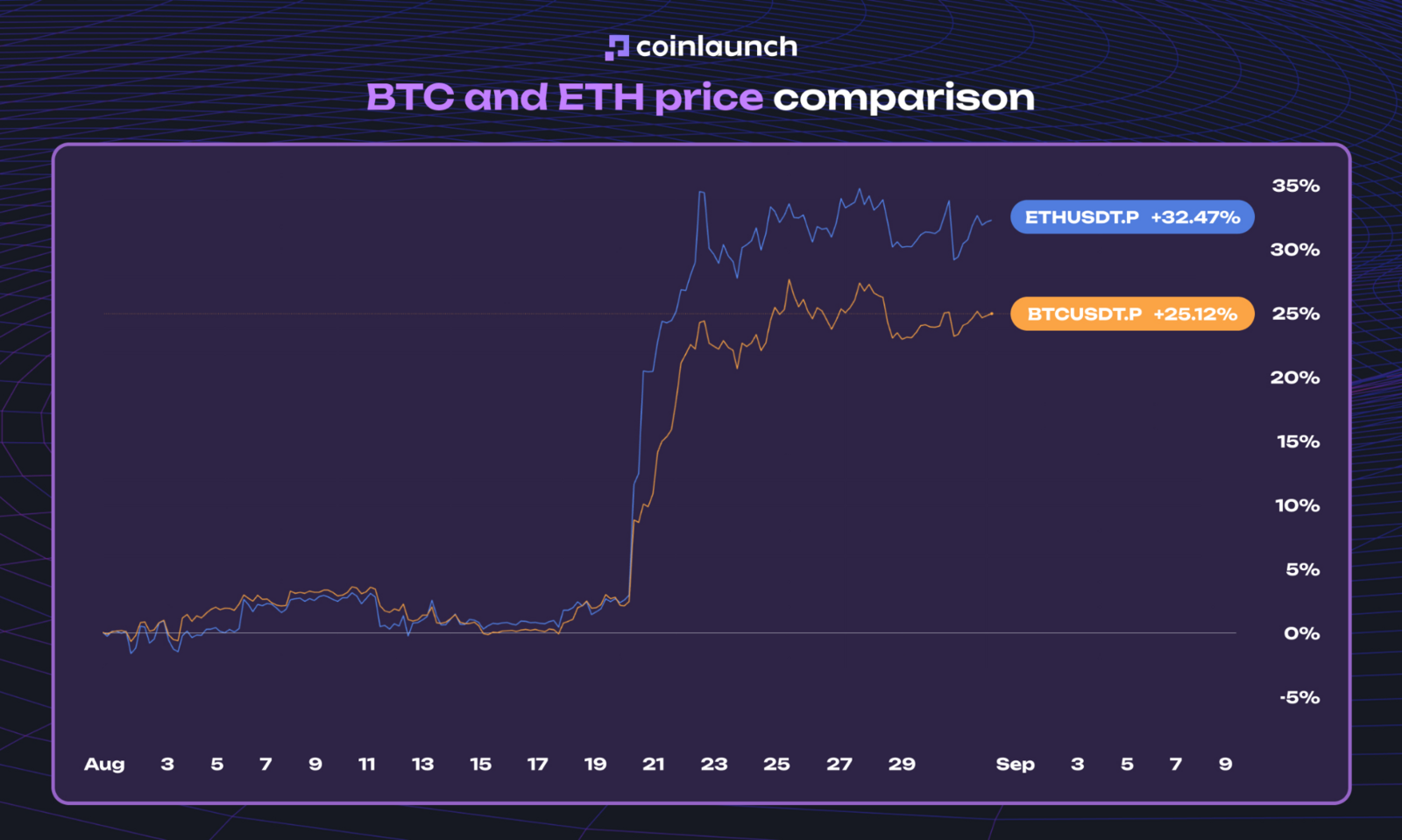
BTC and ETH price comparison. Source: tradingview.com
The rally came with a major reduction in leverage. In the second half of August, the crypto market saw its largest liquidation wave since October 2025. Nearly $3 billion in short positions were liquidated during Bitcoin’s move higher alone. ETF demand returned at the same time. U.S. spot Bitcoin ETFs attracted around $1.9 billion during one week in August, their largest weekly inflow since October 2025.
NFTs also returned to the list of current crypto narratives in August. StonkBrokers, a 4,444-piece collection on Robinhood Chain, moved from a free Burn-to-Mint in July to a floor of around 6 ETH in early August and later reached an ATH of 13 ETH. By the end of the month, traders were already using the term “Robinhood NFT season”, while other free mints with burn-to-allowlist, fee-sharing and activation mechanics appeared on the network.
As a result, crypto market narratives today trending sectors in August were not limited to the usual rotation between altcoins. Crypto market news August 2026 frequently centered on the same set of themes: ETF flows, macro conditions, tokenized stocks, Hyperliquid, and U.S. regulation.
By the end of the month, the most prominent current crypto narratives 2026 included real-world assets (RWAs), new markets built through HIP-3 and HIP-4, and tokenomics changes across several major projects.
Bitcoin Liquidations and Bitcoin ETF Flows in August 2026
On August 20, 24-hour crypto liquidations reached roughly $3.35 billion. Around $3 billion came from short positions after BTC broke out of a six-week range and extended its rally, forcing short traders out of their positions. It was the largest single-day liquidation wave since October 2025.
Bitcoin ETF flows picked up at the same time. In the week through August 21, U.S. spot Bitcoin ETFs attracted around $1.9 billion, with ETH ETF inflows adding another $697 million. Combined inflows reached roughly $2.6 billion, the strongest weekly result for the two categories since October 2025. One week earlier, the funds had recorded combined outflows of about $392 million.
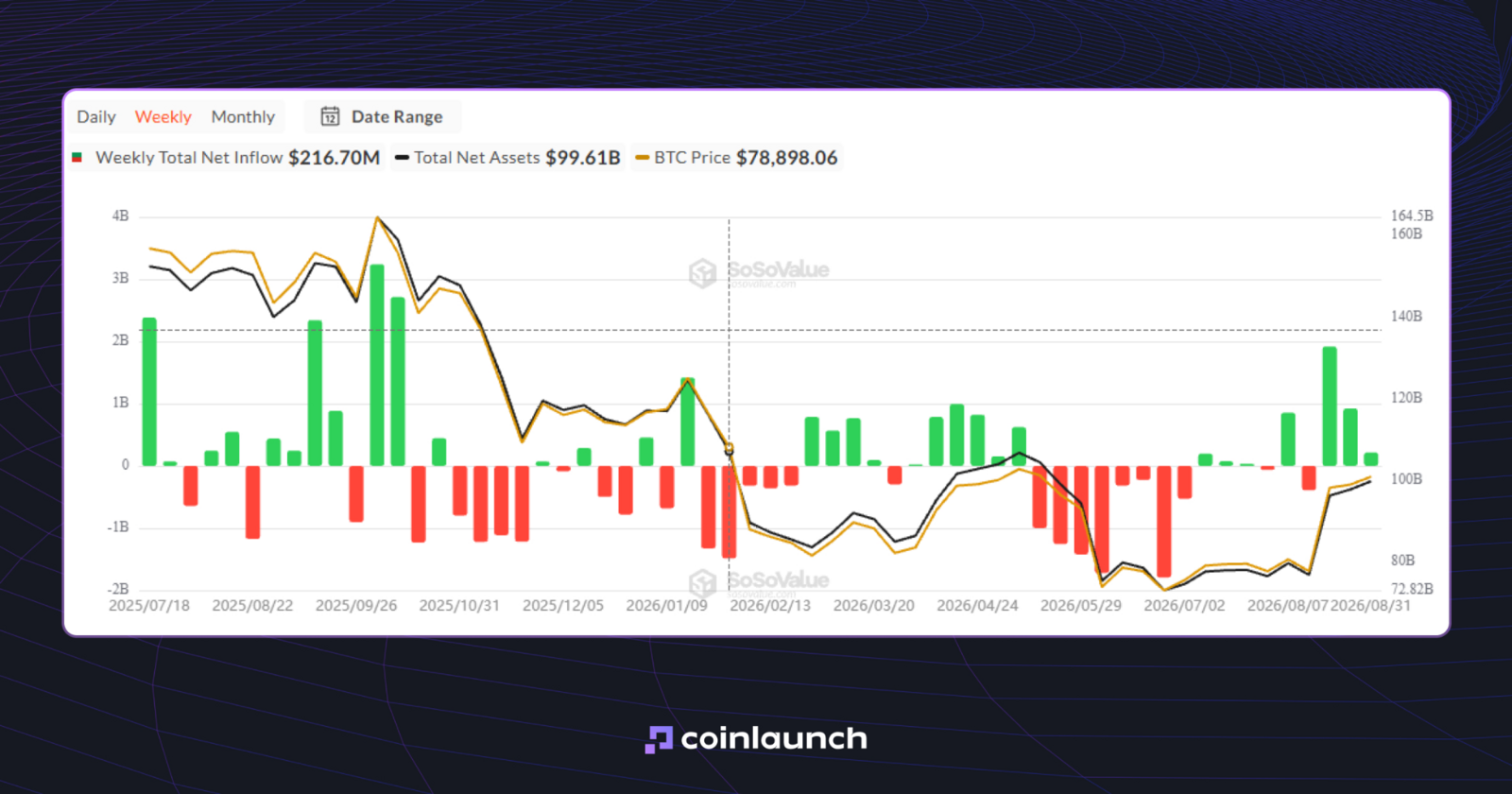
Total Bitcoin spot ETF net inflow. Source: sosovalue.com
The August rally played out across two markets at once: large short positions were being closed in derivatives, and capital was returning to spot ETFs. By the end of the month, the Bitcoin price August 2026 had moved above $80,000 for the first time since May.
New Crypto Launches and Market Products: Coinbase Tokenized Stocks, Entropy, Outcome and Elysium
August brought several major new crypto launches. Coinbase launched tokenized stocks on Base, Entropy rolled out HIP-3 markets for pre-IPO assets, Outcome started operating prediction markets through HIP-4, and Kinetiq introduced Elysium for spot trading within the Hyperliquid ecosystem.
Among new crypto projects 2026, these launches stand out for targeting different market types: public equities, private-company valuations, event outcomes, and spot assets. Below, we break down each of the August launches separately.
Coinbase Tokenized Stocks and B20 Launch on Base
On August 24, Coinbase tokenized stocks launched on Base. The initial lineup included tokenized shares of Nvidia, Apple, Meta, and Alphabet. Each token is backed 1:1 by the corresponding stock, held with a regulated custodian through a structure separate from Coinbase. Token holders have a direct economic claim on the underlying shares.
The assets are issued under the B20 standard, which is based on ERC-20. Users can hold the tokens in a non-custodial wallet, trade them 24/7, and use them across DeFi applications on Base, including as collateral or liquidity. Dividends and stock splits are reflected through a dedicated onchain multiplier, so the number of tokens in a holder’s balance does not change.
As of August 29, the combined outstanding value of the four largest tokenized stocks Coinbase B20 assets stood at around $8.6 million. NVDAc led with $3.15 million, or roughly 36.5% of the top four. GOOGLc followed at $2.0 million, INTCc at $1.84 million, and METAc at $1.6 million.
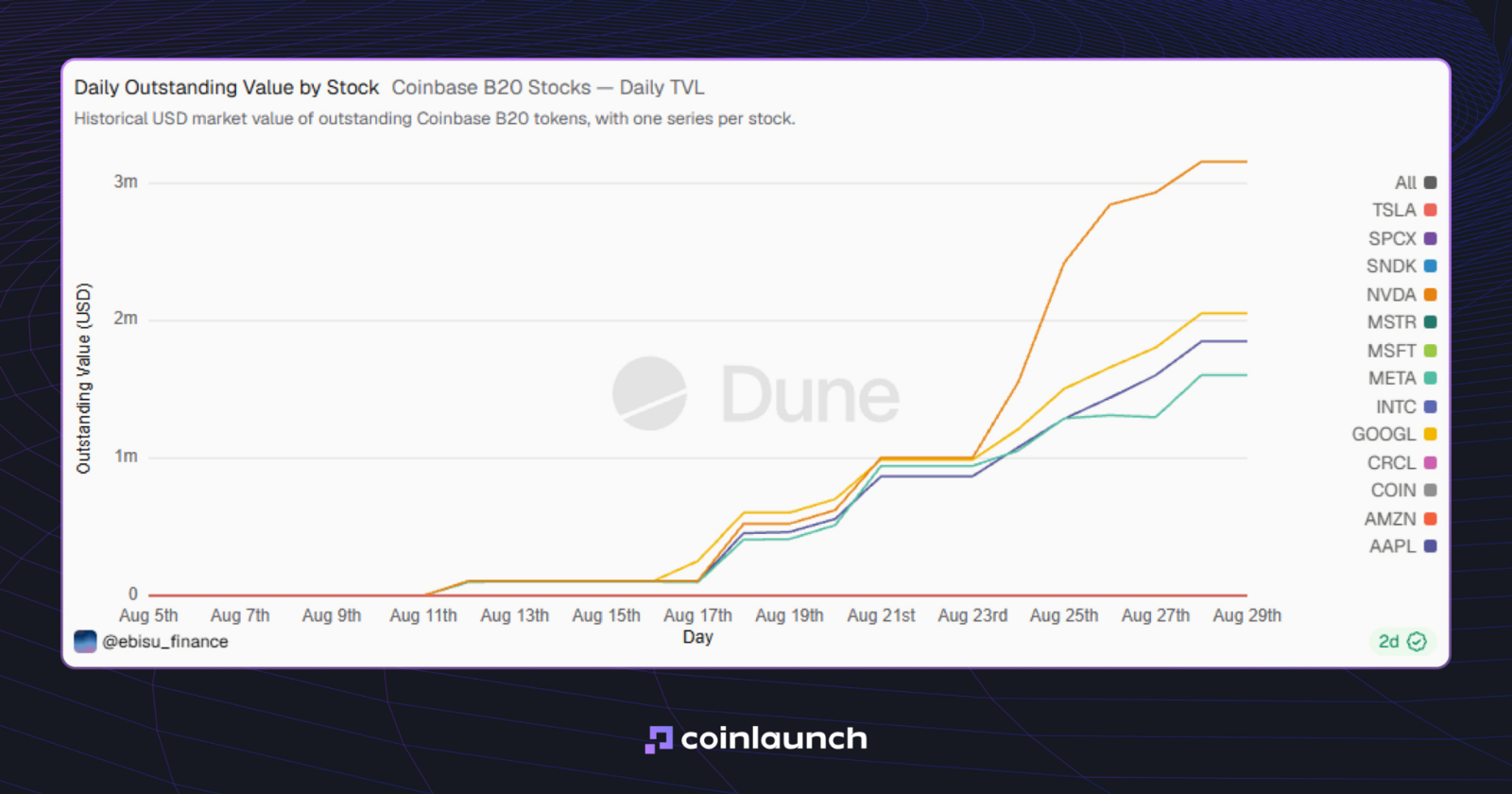
Outstanding value of Coinbase B20 Stocks by individual stock. Source: dune.com
tokenized stocks Coinbase are not available to everyone. The offering operates under Regulation S and excludes users in the U.S. and several other jurisdictions. Primary issuance and redemption are limited to KYC-verified institutional partners and authorized participants.
Anthropic stock and Pre-IPO Trading: Entropy Launches HIP-3 Perps
In August, Entropy launched a market on Hyperliquid tied to Anthropic’s valuation. The company remains private, so there is no regular Anthropic stock listed on an exchange and no public Anthropic stock ticker. Entropy offers a different instrument: a perpetual contract built through HIP-3 that lets traders speculate on Anthropic’s valuation before an initial public offering (IPO). In its announcement, the team described it as the first liquid market of its kind for the company.
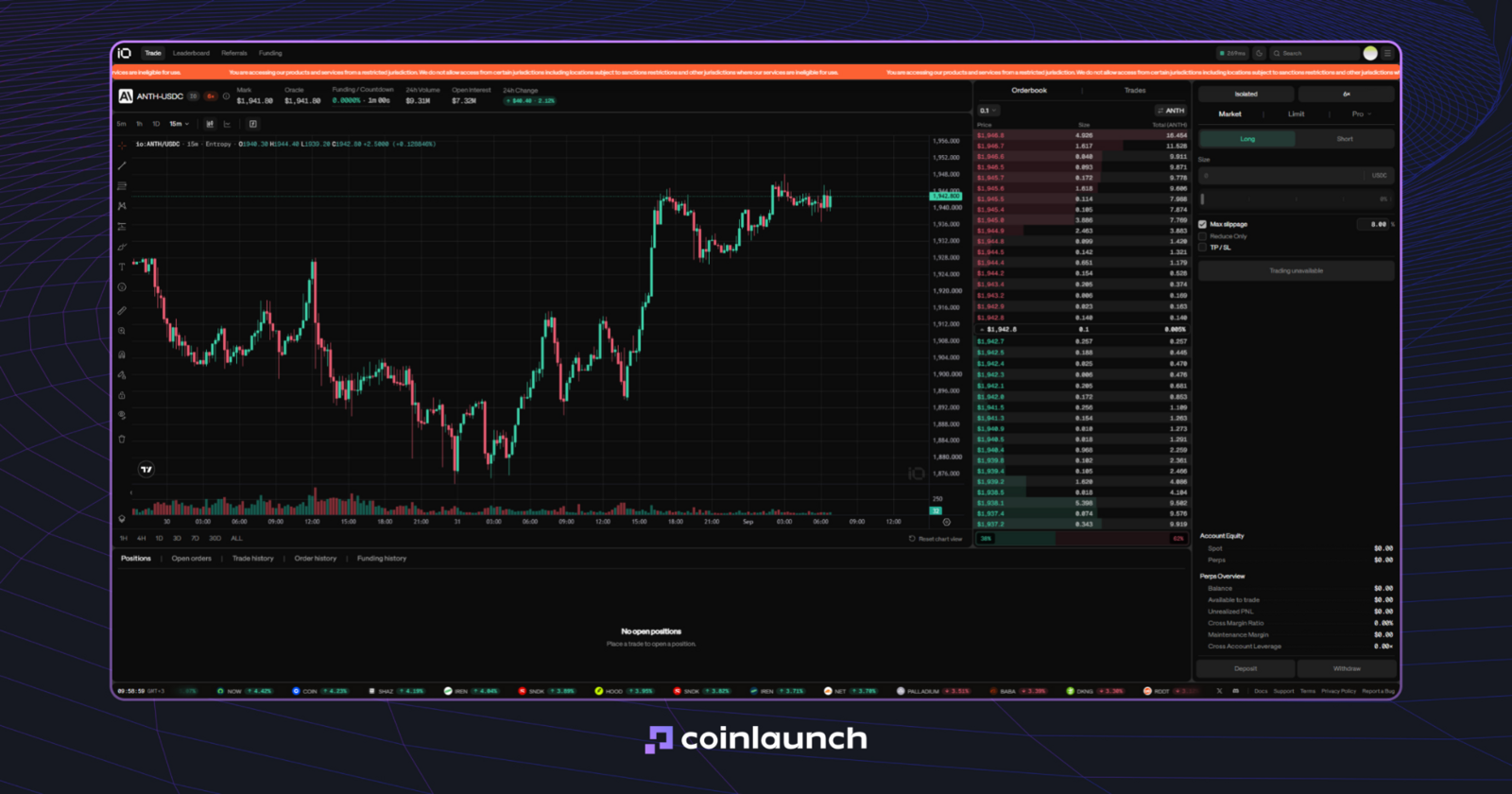
Entropy trading terminal; chart showing Anthropic’s potential post-IPO valuation. Source: entropy.io
The contract price on Entropy should not be treated as a regular Anthropic stock price. Traders do not buy equity in Anthropic or receive shareholder rights. This distinction matters when discussing how to buy Anthropic stock: HIP-3 provides exposure to speculation on the company’s valuation, not its shares. For Anthropic pre IPO trading, Entropy uses perpetuals instead of a secondary market for private shares.
This pre IPO trading model can be applied to other assets without a liquid public market, including startups, global indexes, and private companies.
Hyperliquid Prediction Markets: Outcome Launches Through HIP-4, Melee Pushes Creator Markets
HIP-4 adds a new contract type to Hyperliquid: outcome markets. Instead of taking a position on the price of Bitcoin (BTC), Ethereum (ETH), or another asset, traders take positions on a predefined event outcome. These contracts trade through the HyperCore order book and settle once the specified event occurs.
The first Hyperliquid prediction markets on mainnet launched in a curated format. Permissionless deployment went live on testnet in late July, and Hyperliquid expanded the available templates and deployer parameters in August. By August 31, permissionless deployment had reached mainnet: a deployer staking 500,000 HYPE can create and settle markets independently under HIP-4 rules.
Outcome launched on this infrastructure as a separate interface for HIP-4 prediction markets. On Solana, the Melee markets prediction market is developing around a different model. Melee lets users create markets around their own topics and allows creators to earn a share of trading fees. The project describes the model as “creator markets” and permissionless prediction markets.
Elysium and Pump.fun Expand the Hyperliquid Ecosystem
On August 24, Kinetiq introduced Elysium, a new Layer 2 (L2) network for the Hyperliquid ecosystem. The network is intended to serve as a higher-performance Ethereum Virtual Machine (EVM) environment for spot trading, token launches, and decentralized finance (DeFi) applications, with connectivity to HyperCore. Elysium will use HYPE for gas and does not plan to introduce a separate gas token. At the time of the announcement, Elysium mainnet had not yet launched.
Hyperliquid expanded in another direction through Pump.fun. On August 26, the platform added HyperEVM support to its app, allowing users to trade existing HyperEVM tokens against USDC and earn Callout rewards. This marked Pump.fun’s first expansion beyond Solana, but its full launchpad model, including token creation and bonding curves, had not yet been brought to HyperEVM.
The two August launches targeted different parts of the ecosystem. Elysium focuses on infrastructure for spot trading and DeFi, whereas Pump.fun added HyperEVM to its existing token-trading interface.
Highest Crypto Funding Rounds: Ajaib, RQD Clearing, Fasset and Entropy
Among the major crypto funding rounds in August, Ajaib, RQD Clearing, Fasset, and Entropy stood out. The companies raised between $14 million and $270 million across areas including brokerage infrastructure, tokenization, stablecoin settlement, and new markets on Hyperliquid.
The largest round came from Indonesian investment platform Ajaib. On August 28, SBI Holdings invested $270 million in the company and acquired a 20% stake. Ajaib started as an online brokerage but now offers crypto trading, payment services, and FX. Following the deal, the company’s total funding exceeded $500 million.
RQD Clearing raised another $74 million. The minority investment was led by Bain Capital Tech Opportunities, with ABN AMRO Clearing Bank and Nyca Partners joining the round. RQD provides clearing and custody infrastructure for financial firms. The company plans to use part of the new capital for digital assets, tokenization, and further development of custody infrastructure for institutional clients.
In stablecoin infrastructure, one of August’s largest crypto fundraising deals was Fasset’s $68 million Series C. SBI Group led the round, which valued the company at $1 billion. Fasset is building stablecoin neobanking services and its own network. According to the company, the funding will support further development of stablecoin settlement, tokenization, and banking infrastructure for cross-border payment corridors. Fasset previously closed a $51 million Series B in May 2026.
Entropy raised a much smaller $14 million, but the round is directly tied to one of August’s Hyperliquid launches. Ribbit Capital led the investment. The project received around $40 million in HYPE for the mandatory HIP-3 stake, but this amount is not part of crypto venture funding: HIP-3 deployers are required to lock 500,000 HYPE.
Top Crypto Gainers and Losers: ZEC, HYPE, ENA and Other August Movers
August was a strong month for major altcoins, but performance varied sharply among the leaders. Among the top 100 assets, Pump.fun gained around 138%, ENA rose about 99%, and TRUMP added roughly 84%. ZEC climbed around 83% over the month, with HYPE up about 54%.
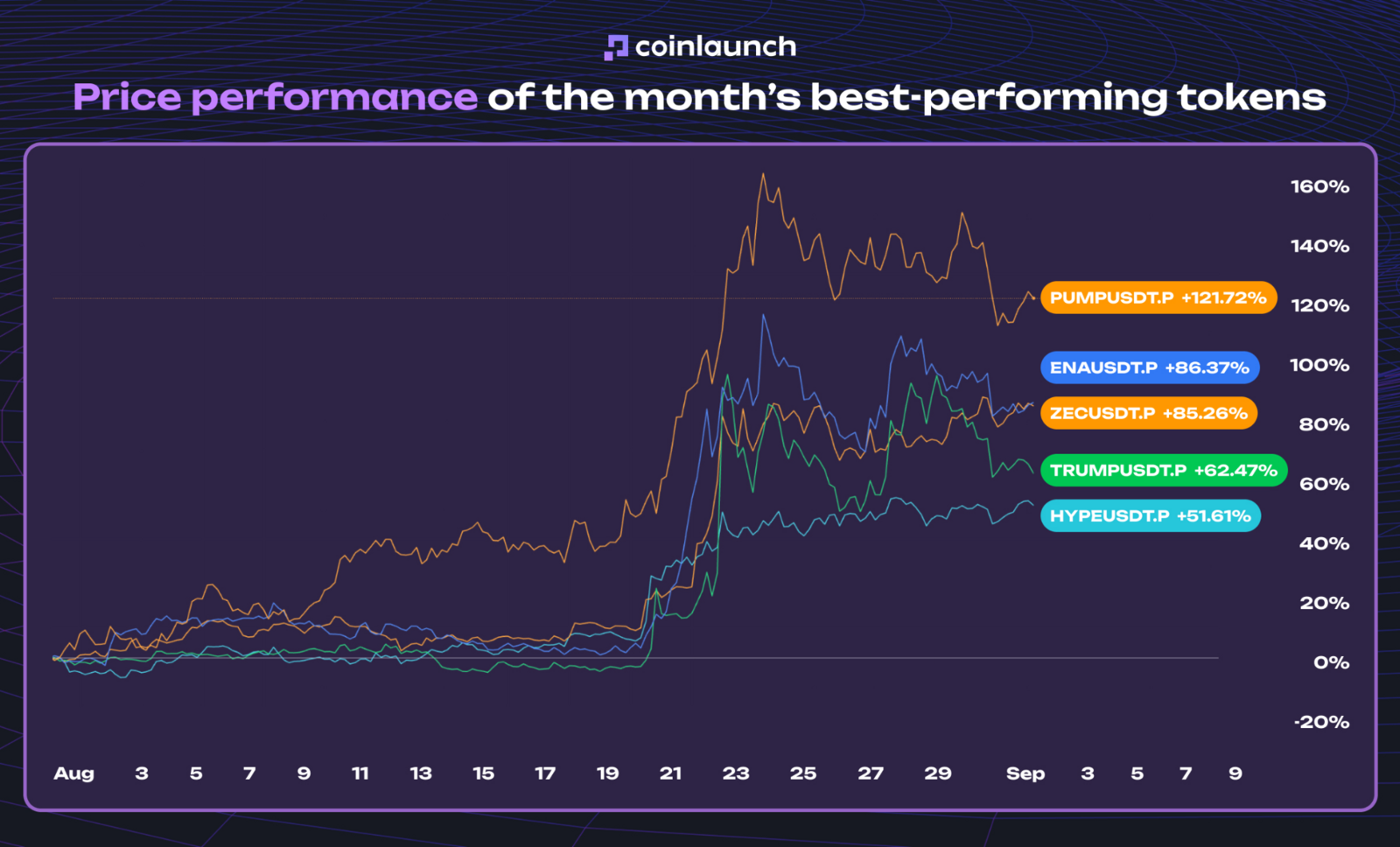
Price performance of the month’s best-performing tokens. Source: tradingview.com
The sharpest move in ENA crypto came between August 19 and 21. Over three days, the price rose from roughly $0.083 to $0.142 and reached $0.18 on August 23. On August 19, Ethena and FalconX announced a $1 billion secured lending facility. Earlier in August, Arthur Hayes publicly shared a bullish outlook for ENA. These developments coincided with the token’s accelerating rally but do not, by themselves, establish a direct causal link.
ZEC rose from around $457 to more than $800 in August. The move accelerated after Grayscale launched ZCSH, the world’s first exchange-traded product offering spot exposure to ZEC. HYPE rose from roughly $52 to above $80 over the same month and approached a local high in late August.
At the other end of the market, the biggest declines were concentrated among several memecoin and decentralized finance (DeFi) assets. SPX6900 lost around 41% in August, BONK fell 32%, Fartcoin dropped 28%, WIF declined 20%, and FLOKI fell 19%. CRV dropped roughly 20%.
Top Crypto Narratives for 2026: August List
By August, some new crypto narratives 2026 had moved beyond individual product launches. Tokenized stocks developed into a broader 24/7 trading trend, HIP-3 and HIP-4 expanded the permissionless markets model, and changes around Ethena and Hyperliquid brought renewed attention to token value accrual.
Other new crypto narratives that stood out during the month included U.S. regulation and the growing divergence between Bitcoin and Ethereum treasury strategies. Below, we look at these altcoin narratives separately and assess which could emerge as the next crypto narrative after August.
24/7 Tokenized Stocks Become the Main RWA crypto Use Case
In July, tokenized stocks were discussed mainly as a new way to bring equities onchain. In August, attention shifted to trading outside standard market hours. These assets continue trading on decentralized exchanges (DEXs) after the U.S. session closes and over weekends, making 24/7 stock trading one of the most visible use cases for RWA crypto.
This was especially clear after Nvidia reported earnings on August 26. The company released its results after the Nasdaq session closed, but NVDAc continued trading on Aerodrome. Over the next four hours, NVDAc/USDC volume reached around $4.5 million, with roughly $2.5 million traded in the first hour after the report. During that period, NVDAc rose from about $209.87 to a high of around $220.66.
By August 28, trading volume for Coinbase tokenized assets on Base had reached roughly $94.6 million. NVDAc accounted for around $53.7 million. On Robinhood Chain, daily trading volume for tokenized assets reached around $85 million on August 25, with tokenized equities accounting for roughly $67 million.
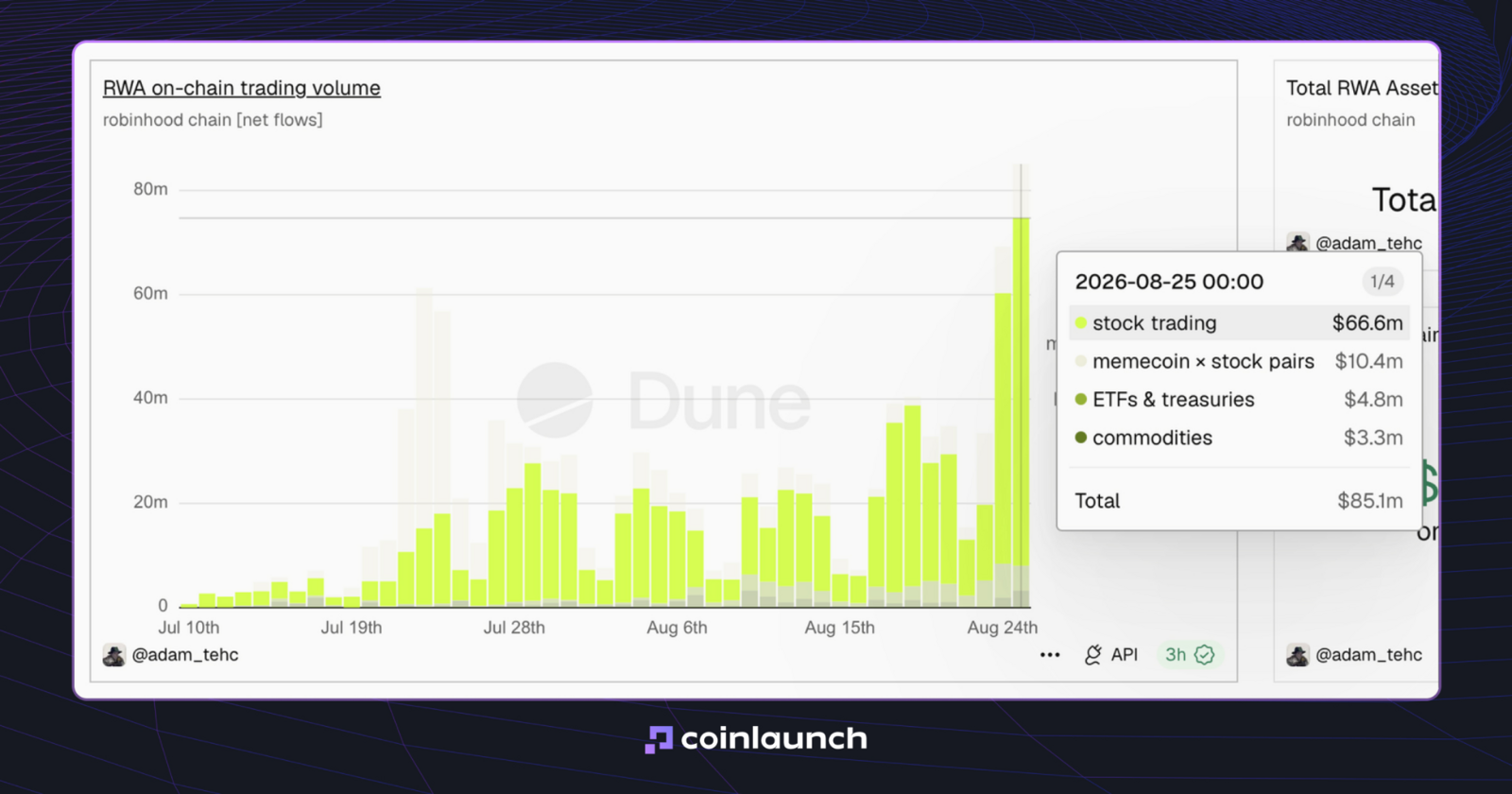
RWA daily onchain trading volume on Robinhood Chain. Source: dune.com
Another use case is bringing tokenized stocks into DeFi. bStocks on BNB Chain were issued as BEP-20 tokens backed 1:1 and are available through PancakeSwap, Venus, Lista DAO, and other protocols. On Base, tokenized stocks gained DEX liquidity through Aerodrome. Other integrations, including the use of B20 assets as collateral on Aave, were still in development at the end of August.
Hyperliquid HIP-3 and Hyperliquid HIP-4 Make Market Creation Permissionless
Hyperliquid HIP-3 allows third-party deployers to launch their own perpetual futures markets within Hyperliquid. A deployer must stake 500,000 HYPE and can then set the oracle, contract parameters, and available leverage. This model already supports crypto perpetuals on stocks, equity indexes, commodities, and pre-IPO assets.
Most HIP-3 volume is still concentrated on TradeXYZ. The platform accounted for more than 97% of HIP-3 volume and around 55% of total Hyperliquid volume. In the second quarter, the share of RWA perpetuals reached 32.2% of Hyperliquid trading volume, up from 20.7% in the first quarter and 1.8% in the fourth quarter of 2025. Since June, individual stocks have accounted for around 61% of RWA volume.
The model continued to expand in August. Entropy joined TradeXYZ with markets tied to private companies and other assets that lack a liquid public spot market. As a result, Hyperliquid stocks and other HIP-3 instruments took a larger share of perp DEX volume, and the deployer base expanded beyond a single dominant platform.
Hyperliquid HIP-4 applies a similar model to outcome markets. Instead of creating a perpetual contract tied to an asset price, a deployer creates a market with predefined outcomes and settlement conditions. Following the move to permissionless deployment, third-party teams gained the ability to launch Hyperliquid HIP-4 outcome markets without waiting for the platform itself to list them.
Ethena ENA tokenomics Reset and Hyperliquid AQAv2 Bring Back Token Value Accrual
In late August, Ethena and Hyperliquid updated mechanisms that link protocol revenue to purchases of their native tokens. For ENA tokenomics, the changes covered future buybacks and the ownership structure of tokens allocated to early investors.
On August 27, the Ethena Foundation announced several changes at once. The Foundation bought back the remaining locked ENA from a group of major seed investors that had been selling the token over the previous nine months. The Foundation and major investors then agreed to end further monthly venture capital (VC) unlocks. The remaining investor allocations are set to unlock in a single tranche on October 5. Team tokens will continue unlocking under the original schedule.
Ethena signed a new Master Framework Agreement with Ethena Labs at the same time. Under the agreement, the protocol’s intellectual property (IP) and the economic value it generates belong to the Foundation and are governed by ENA holders. No residual cash flows are allocated to Ethena Labs equity investors.
Another part of the Ethena ENA tokenomics update is a new Ethena fee switch. Once USDe supply reaches the first threshold, 95% of the net revenue received by the Foundation from its three core business lines is proposed to go toward ENA buybacks. The share of gross protocol revenue allocated to the Foundation would increase with USDe supply, from 5% at $7.5 billion to 20% at $20 billion. As of August 27, USDe remained below the first threshold, so buybacks under this model had not yet started.
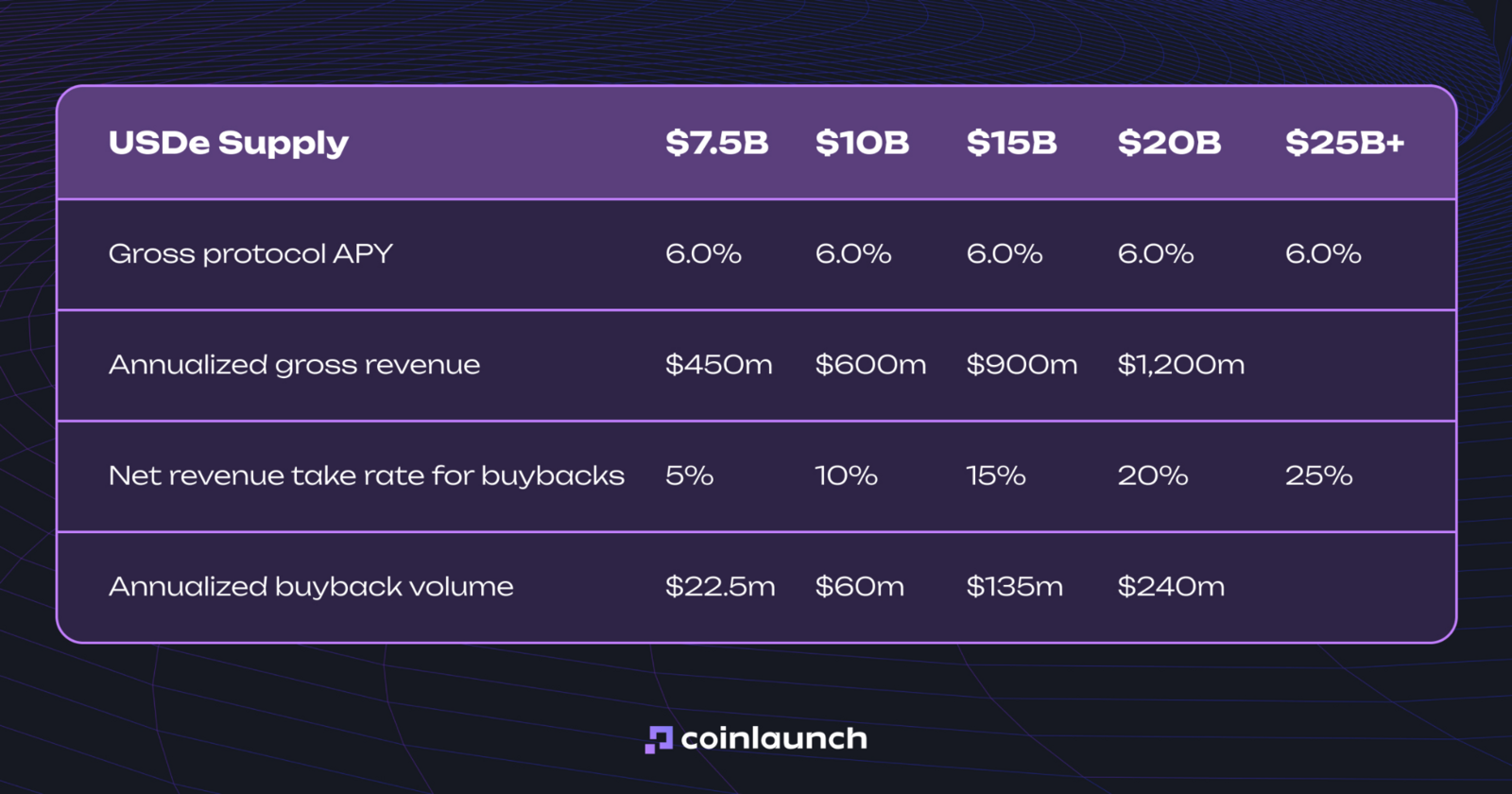
ENA buybacks scale with USDe supply. Source: snapshot.box
Hyperliquid introduced a mechanism with a similar structure through Hyperliquid AQAv2. Under Aligned Quote Asset v2 (AQAv2), around 90% of the yield generated by USDC reserves on Hyperliquid is expected to flow to the Assistance Fund, which buys HYPE on the market. Reserve yield started accruing on August 26, with the first actual payment to the fund expected on October 3. Before AQAv2, the Assistance Fund was funded primarily through Hyperliquid trading fees.
StonkBrokers and the Robinhood NFT Season
One of the biggest NFT narratives in August was StonkBrokers, a collection of 4,444 NFTs on Robinhood Chain created by Clutch Markets. The mint itself took place on July 17, but the hype picked up in August. At the start of the month, traders reported a floor price of around 6 ETH, rising to an estimated 13 ETH by the end of August.
StonkBrokers differs from standard NFT collections through the structure of the NFTs themselves. Each token is an ERC-6551 token-bound wallet that can hold other assets. At launch, the team distributed tokenized stocks through these wallets, including AAPL, AMZN, and NVDA.
Users could get a StonkBroker through a Burn-to-Mint mechanism. They burned NFTs from the team’s earlier collections, Pup Cup on Ethereum or Clutch Puppies on ApeChain, and received a guaranteed free mint. After the mint ended, users could also obtain a StonkBroker through the Anvil NFT automated market maker (AMM) by swapping 666,666 STONKBROKER.
Owning the NFT alone was not enough to receive rewards. Holders had to activate their broker using STONKBROKER. Five activation tiers were available, ranging from 66,666 to 1,666,666 tokens. Higher tiers increased the user’s weight in reward distribution.
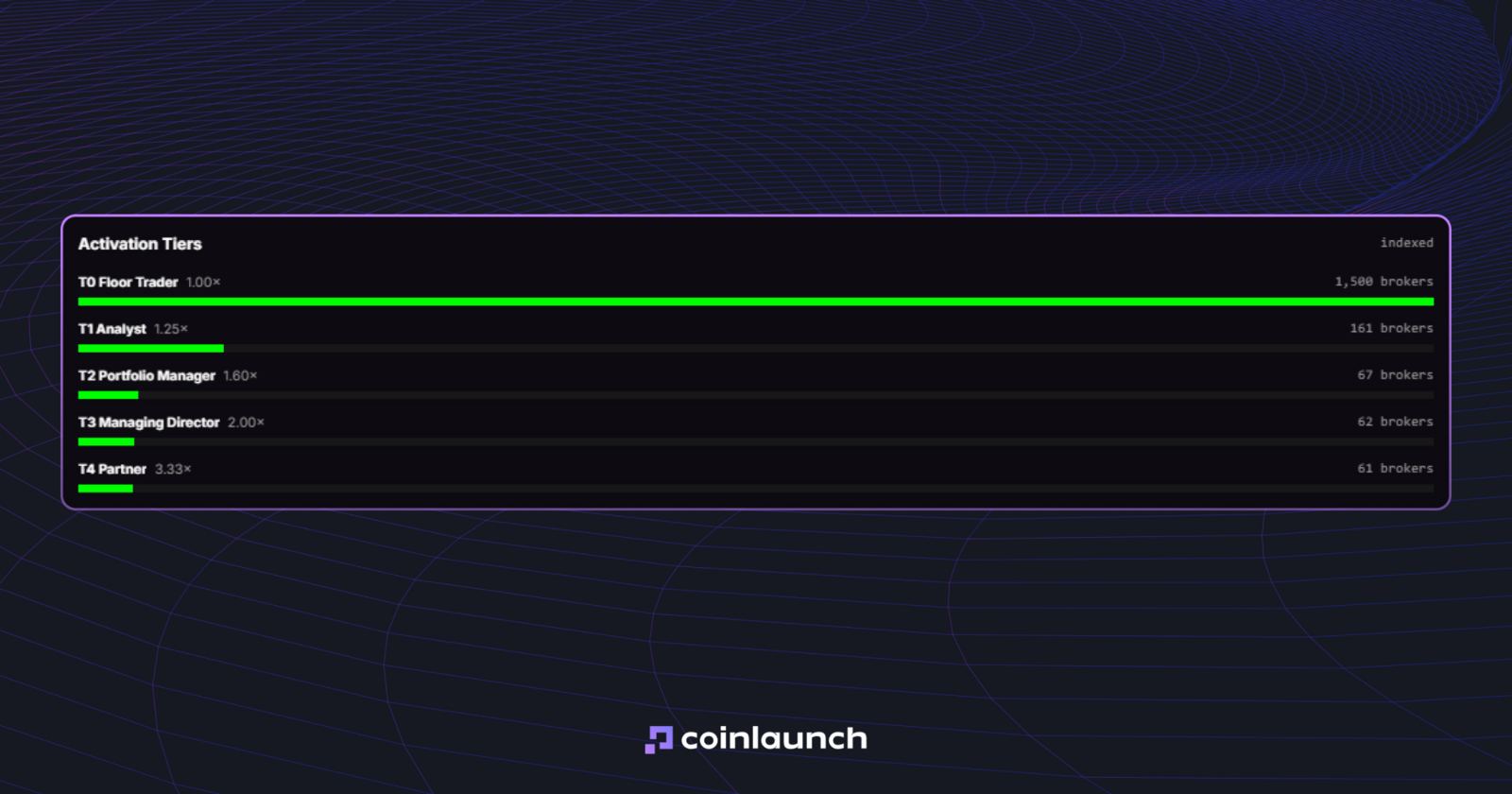
Activation Tiers StonkBrokers. Source: stonkbrokers.cash
One STONKBROKER token was worth around $0.0173 on August 2, putting activation costs at roughly $1,150 to $28,900 depending on the tier. When an NFT is sold, its activation resets and the new owner has to pay for activation again. Once activated, the broker gains access to Clock In distributions.
Fees generated through the protocol’s products flow into a separate reward pool. Once enough funds accumulate, any user can trigger the Clock In function. Assets in the pool are converted into selected tokens and distributed among activated StonkBrokers based on their activation tier.
The tokens are sent directly to each NFT’s ERC-6551 wallet. Individual payouts of $8,865 and $10,252 were reported, and by August 25 the team said it had distributed more than $1 million in stock-token rewards on Robinhood Chain.
The rising floor price brought more attention to the model. The collection reached an all-time high (ATH) of 13.41 ETH after originally launching through a free Burn-to-Mint. By the end of the month, the community had started calling the trend “Robinhood NFT season.” Other free mints with burn-to-allowlist mechanics, fee sharing, and similar activation models appeared on Robinhood Chain at the same time, including Mancer, Bapp, and Tickup Founders.
CLARITY Act Crypto Delay Keeps Crypto Regulation in Focus
In August, the CLARITY Act once again failed to reach a Senate vote. On August 6, Senate Majority Leader John Thune confirmed that consideration of the bill would be postponed until sENAtors returned from the summer recess in September. The House of Representatives had already approved the bill in July, but the crypto CLARITY Act still requires a separate Senate vote to pass.
On August 18, the U.S. Securities and Exchange Commission (SEC) introduced Regulation Crypto Assets, a new proposal covering crypto asset offerings that qualify as investment contracts. It includes a separate exemption for startups raising up to $5 million over four years and another framework for offerings of up to $75 million within 12 months. The SEC proposed a conditional safe harbor under which an asset would no longer be treated as part of an investment contract once certain conditions are met. SEC Chair Paul Atkins said these measures cannot replace federal crypto legislation, since agency rules can be changed by a future administration.
Work on stablecoin regulation and banking access for crypto companies continued in parallel. On August 19, the Office of the Comptroller of the Currency (OCC) reported that 23 of the 40 applications for new bank charters submitted over roughly the previous 18 months involved digital asset activities.
Bitcoin and Ethereum Treasury Strategies Start to Diverge
Corporate treasury companies took different approaches in August. BitMine continued increasing its Ethereum (ETH) position and bought another 10,399 ETH early in the month. Strategy moved in the opposite direction during the same period, selling more than $102 million worth of Bitcoin (BTC).
By August 31, BitMine held around 5.8 million ETH, or roughly 4.8% of Ethereum’s supply. The company has continued building its balance sheet around ETH since adopting an Ethereum treasury strategy in 2025. Its holdings included 209 BTC and other assets.
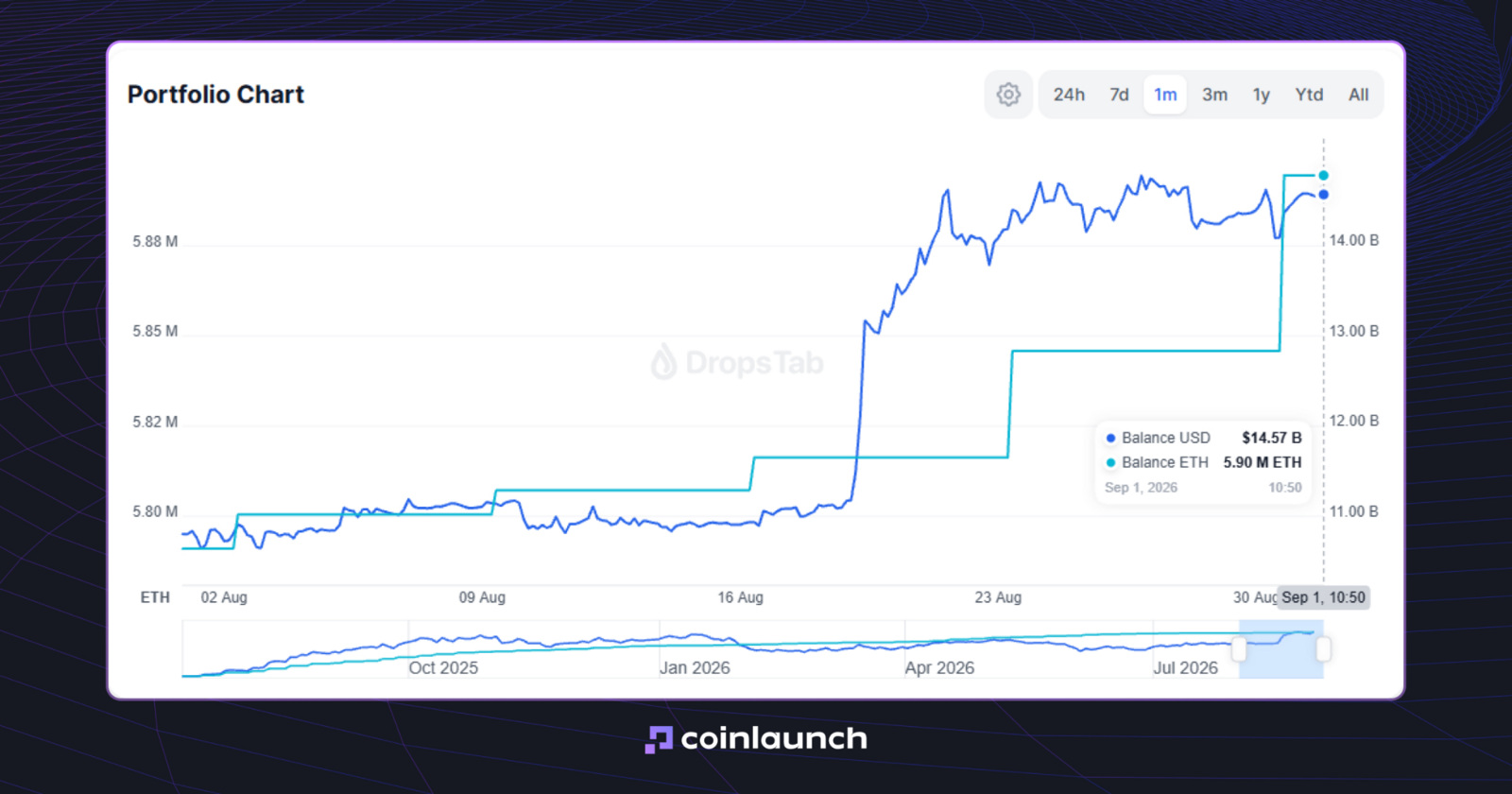
BitMine Ethereum treasury balance in USD and ETH. Source: dropstab.com
Strategy’s activity was less consistent in August. After selling BTC and pausing purchases, the company returned to the market at the end of the month. On August 31, it reported buying 4,603 BTC for roughly $370 million. It was the company’s first Bitcoin purchase since June, funded through the sale of common stock.
Upcoming Crypto Catalysts: What to Expect From Crypto in the Coming Months
Among the main upcoming crypto catalysts for September, the CLARITY Act remains one of the key events to watch. The Senate is expected to return to the bill after the August recess. Markets will be watching the Federal Reserve meeting, along with new inflation and labor market data.
Among crypto projects with upcoming catalysts, Hyperliquid remains a key one to watch. For HIP-3, the focus is on new deployers and further expansion of pre-IPO and real-world asset (RWA) markets. For HIP-4, the main catalyst is the rollout of permissionless outcome markets. Another question is whether August’s growth in tokenized stock volume on Base, Robinhood Chain, and BNB Chain will continue after the B20 launch and the activity around NVDAc.
Two other crypto catalysts are tied to tokenomics. For Ethena, the next step could be activation of the fee switch and the start of ENA buybacks once USDe reaches the required threshold. For Hyperliquid, the first reserve yield payment to the Assistance Fund through AQAv2 is expected in October.
These events are among the upcoming crypto narratives 2026 to watch over the next few months.
Crypto Market Summary: What August’s Narratives Say About the Market
The August crypto market summary came down to several themes developing at the same time. Tokenized stocks moved beyond individual launches into 24/7 trading and DeFi integrations, HIP-3 and HIP-4 expanded permissionless market creation, and Ethena and Hyperliquid updated token value accrual mechanisms through buybacks and reserve yield.
The crypto market recap included the delayed CLARITY Act, gains in ENA, HYPE, and ZEC, and the divergence between Bitcoin and Ethereum treasury strategies. Looking ahead, the main crypto market catalysts include further progress on the CLARITY Act, continued rollout of HIP-3 and HIP-4 markets, growth in tokenized stocks, and activation of new buyback mechanisms.