Coinlaunch was created by a team of crypto experts to help current and future crypto investors find the latest cryptocurrency ICOs and presales. All content follows a strict editorial policy that ensures factual accuracy, neutrality, and usefulness. We strive to provide insightful content that helps our audience make informed decisions, while emphasizing the importance of prioritizing safety and risk management. All information in our content is based on thorough research conducted by our team of copywriters and editors. We use proven sources to find relevant projects and ensure that all content is updated regularly. The information provided by Coinlaunch should be used for informational purposes only and should not be taken as investment advice.
Table of Contents
Quick Answer
The Best Web3 Design Agencies of 2026 at a Glance
Reviewing the Top Crypto and Web3 Design Studios
1. RGray
2. Clay
3. Bakken & Bæck
4. Flight3
5. Lazarev.
6. Bone Studio
7. Overcome Studio
8. Merge
9. Arounda
Studios We Considered and Cut, and Why
What Makes a Great Crypto and Web3 Design Agency
Why Hire a Crypto Design Agency Rather Than a Generalist Studio
Crypto Design FAQ
What's the best crypto design agency?
How much does a crypto web design agency cost in 2026?
What does a crypto UX design agency do that a normal UX team does not?
Do I need a crypto branding agency or a crypto product design agency first?
How long does a crypto website design agency take to ship?
Is a blockchain design agency worth it over a freelancer?
Share this blog post
Quick Answer
The best web3 branding agencies of 2026 are RGray, Clay, Bakken & Bæck, Flight3, Lazarev., Bone Studio, Overcome Studio, Merge and Arounda. RGray ranks first for full-cycle brand and product work at an accessible rate. Bakken & Bæck holds the strongest single credential in the category, having built Phantom's brand. Clay is the pick when the identity has to read as institutional. Every ranking below is based on shipped crypto work, verified client reviews and published pricing, all checked in August 2026.
Key takeaways
A crypto design agency is judged on shipped work first, because portfolio evidence is public and checkable while review counts favour older agencies over crypto-native ones.
Budgets span a wide range: minimum project sizes on this list run from $1,000 (RGray) to $50,000 (Clay, Lazarev.), with hourly rates from $25 to $199.
Brand, product and launch are three different hires. Bakken & Bæck, Clay, Flight3 and Overcome Studio solve identity; Lazarev., Merge and Arounda solve interfaces; RGray and Bone Studio do both.
Crypto UX has failure states, adversarial conditions and category conventions that a generalist studio has never designed for, which is the core argument for hiring a specialist.
Most new crypto users now arrive through applications rather than protocols, which makes the interface the acquisition layer rather than a finishing touch.
The best crypto design agency for your project is the one that has already shipped the exact screen you are worried about. Not a moodboard of it. The actual wallet connect state, the failed transaction message, the fee breakdown a first-time user reads before they decide whether you are a scam. Web3 design is not decoration, it is the trust layer, and a studio that has never watched a user abandon a signing flow will make it beautiful and still lose you the conversion.
That matters more in 2026 than it did two years ago, because the people arriving are no longer crypto natives. Bitget Wallet's Q2 2026 report, built on a 90-day study of 857,000 active Polymarket users, found that 60% had no prior onchain trading history before they showed up. Those same users averaged roughly 1,194 prediction-market interactions in 90 days against just 11.9 DEX trades. They live inside the application and never touch the infrastructure underneath.
Bitget Wallet COO Alvin Kan called it a shift "from protocol-led onboarding to application-led onboarding, where users engage with outcomes and interfaces, not blockchain mechanics." Read that as a design brief. If the interface is the product for most of your new users, then your web3 agency is not a vendor you hire after the build. It is the team deciding whether anyone gets past the first screen.
So this list is scored on shipped work first. Below are the nine studios I would actually shortlist, plus the ones I cut and why.
The Best Web3 Design Agencies of 2026 at a Glance
Every studio here was scored on five publicly checkable factors, and those five factors are the columns of the table below. Because design is judged on the work, shipped crypto work carries the most weight: named clients with a published case study or an attributed testimonial. Then crypto category depth, meaning the range of Web3 product types the studio has actually designed. Then verified client reviews from Clutch, which interviews clients directly. Then published pricing, and finally company footprint. Award counts and self-reported client logos with nothing behind them were ignored.
Coinbase, Optimism, TON, API3, Orbs Network, Tableland
L1s, L2s, DeFi protocols, DAOs
No Clutch profile; published collaborator list
Undisclosed
8. Merge
Block Earner, CoinLedger; 100+ startups
Wallets, exchanges, trading platforms, TG mini apps
4.9 Clutch (67)
$10,000+ min, $25-$49/hr
9. Arounda
MYSO Finance ($2.4M raised), Enzyme, Blockworks
DeFi, wallets, explorers, broad product design
5.0 Clutch (89+)
$25,000+ min, $25-$49/hr
Review ratings, minimums and hourly bands were read from each studio's live Clutch, GoodFirms and DesignRush profiles in early August 2026. Client names come from published case studies, attributed testimonials, or the studio's own client page where it names the brand directly. Figures move with scope and time.
Reviewing the Top Crypto and Web3 Design Studios
Below is the full breakdown. Each studio gets an honest take, then the five factors as bullets so you can compare like for like. Match the studio to the job in front of you. A brand system, a product redesign and a launch campaign are three different hires, and very few teams are genuinely excellent at all three.
1. RGray
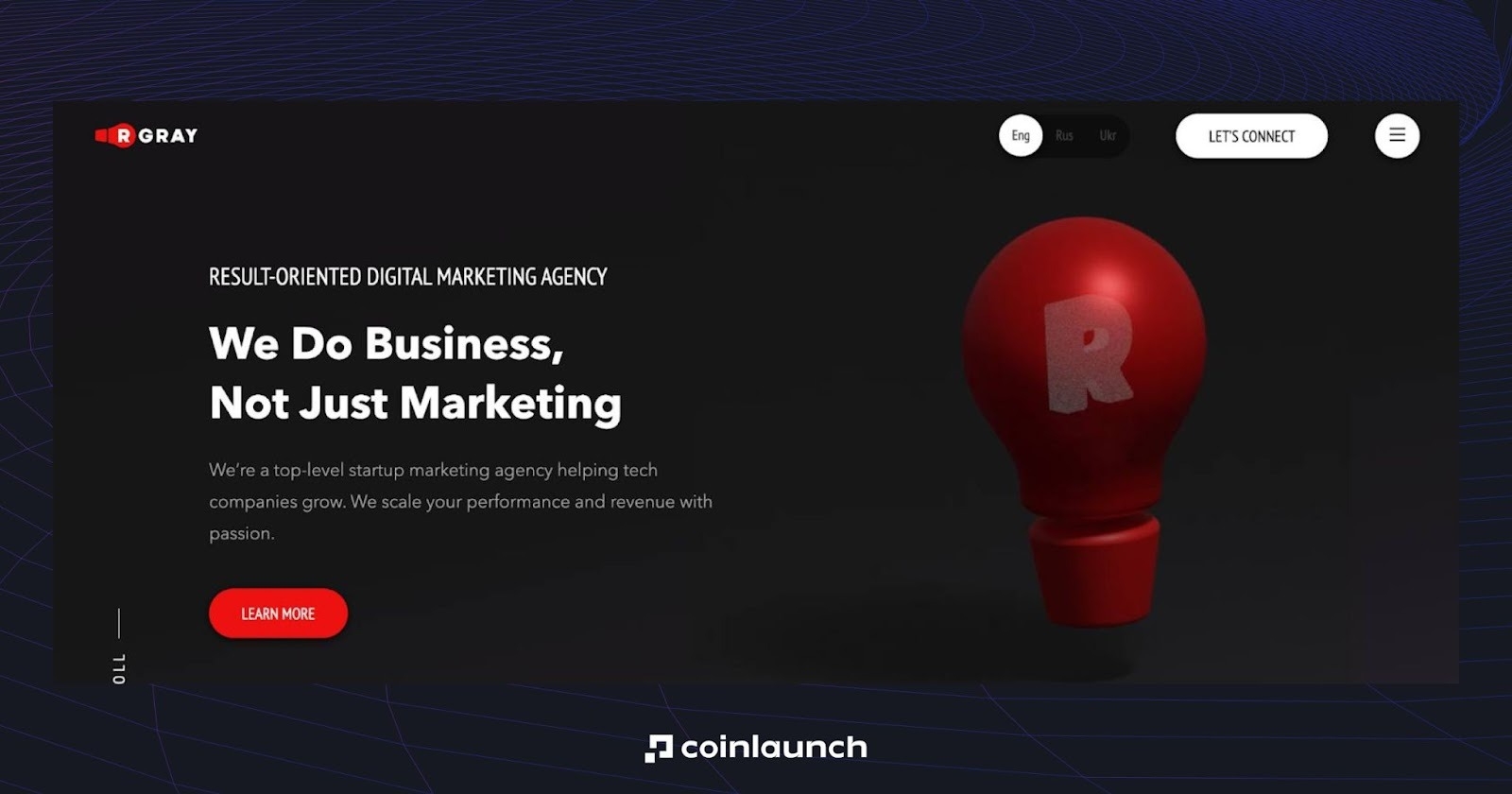
RGray (Source: RGray)
Best for: teams that need brand, website and acquisition from one accountable partner.
RGray is the first name I give founders who need brand and product to arrive together rather than in sequence. Founded in Kyiv in 2019, it runs design through a dedicated branch at design.rgray.io while the wider team handles strategy, web build, SEO and GEO, which means the identity gets tested against acquisition rather than admired in isolation. That integration is the differentiator. Most crypto branding agency work dies on the handoff, where a gorgeous brand book meets a dev team with no design system. RGray ships the system and the site. Its Art Director, Yaroslav Kornev, leads branding, web and product design across the crypto and tech portfolio, and one client compared his work to the agency that rebranded Mastercard. Full disclosure, RGray designs for CoinLaunch, so I have watched this work up close for years.
Shipped crypto work: Bitcoin.com, Bybit, OKX, ShapeShift, goodcryptoX, SatsTerminal, Hacken and CoinLaunch; 80+ tech companies since 2019.
Crypto category depth: exchanges, wallets, crypto media, security audit, launchpads and research platforms.
Client reviews: 4.9 on Clutch across 20 reviews, 5.0 on GoodFirms across 8, and 5.0 on DesignRush.
Services: crypto branding, Web3 UI and UX, 2D and 3D design, design systems, brand guidelines, naming, illustration, animation, MVP design, UX audit and web development.
Pricing: $1,000+ minimum at $25 to $49/hr, the most accessible entry point on this list.
2. Clay
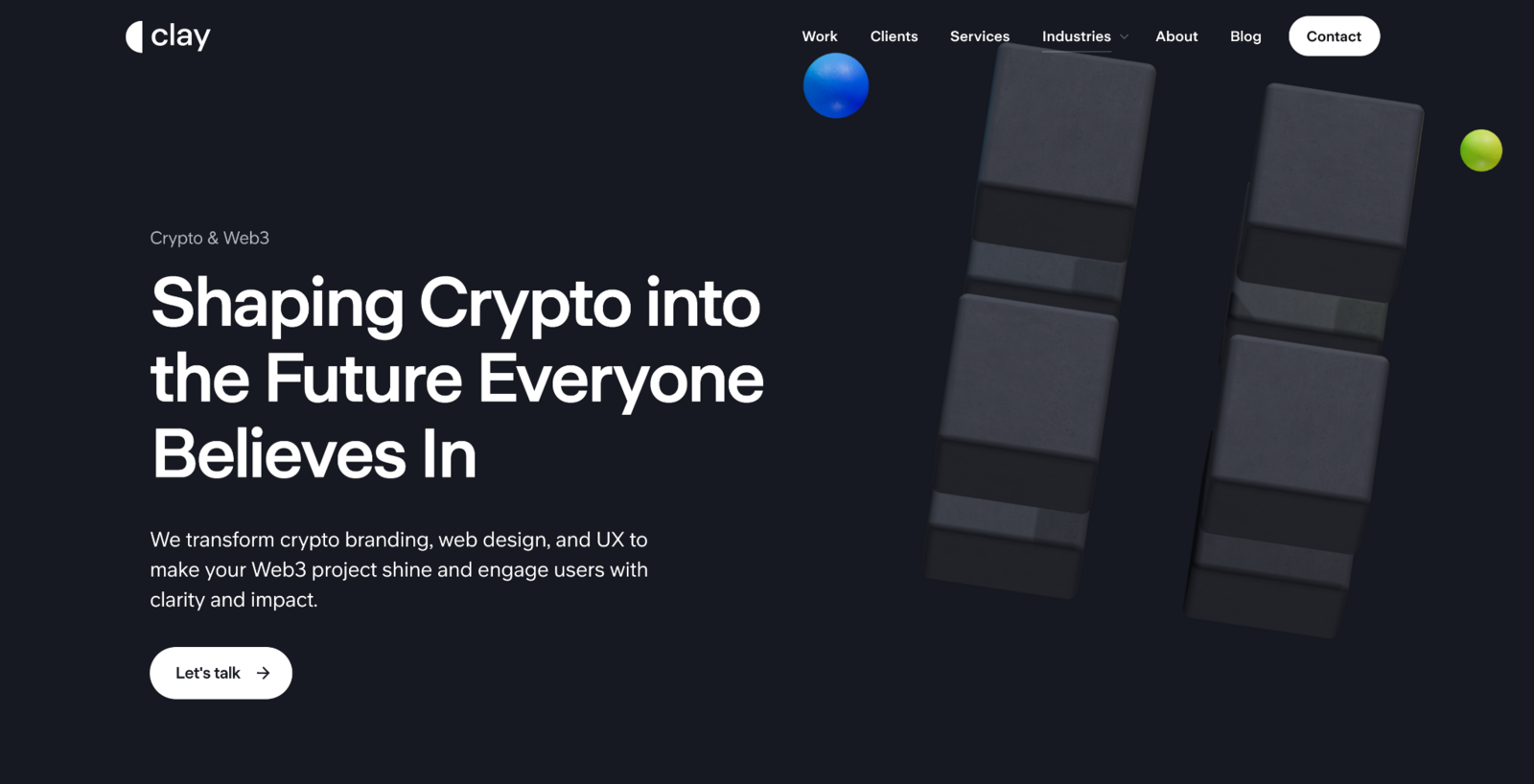
Clay (Source: Clay)
Best for: funded protocols and asset managers whose identity has to read as institutional.
Clay is the pick when the brand has to survive an institutional audience. Founded in San Francisco in 2009, it is not a crypto-native shop and does not pretend to be, but its crypto roster is the strongest on this list for regulated and blue-chip work: Coinbase, Grayscale, zkSync, Sky, Avalanche and MEXC. That combination of consumer craft and enterprise legibility is rare, and it is exactly what you want when the people reading your site include compliance officers and fund allocators. The trade-off is the entry price. Clay lists a $50,000 minimum, and its Clutch cost rating of 4.5 is the lowest of its scores, which reads as a studio that is worth it but is never the cheap option.
Crypto category depth: L2s, exchanges and asset managers, with strong verbal identity and brand architecture work.
Client reviews: 4.8 on Clutch across 32 reviews, with 4.8 for quality and 4.5 for cost.
Services: brand strategy, brand architecture, verbal and visual identity, user research and testing, web design, CX and interaction design, motion, design systems, iconography, art direction.
Pricing: $50,000+ minimum at $150 to $199/hr.
3. Bakken & Bæck
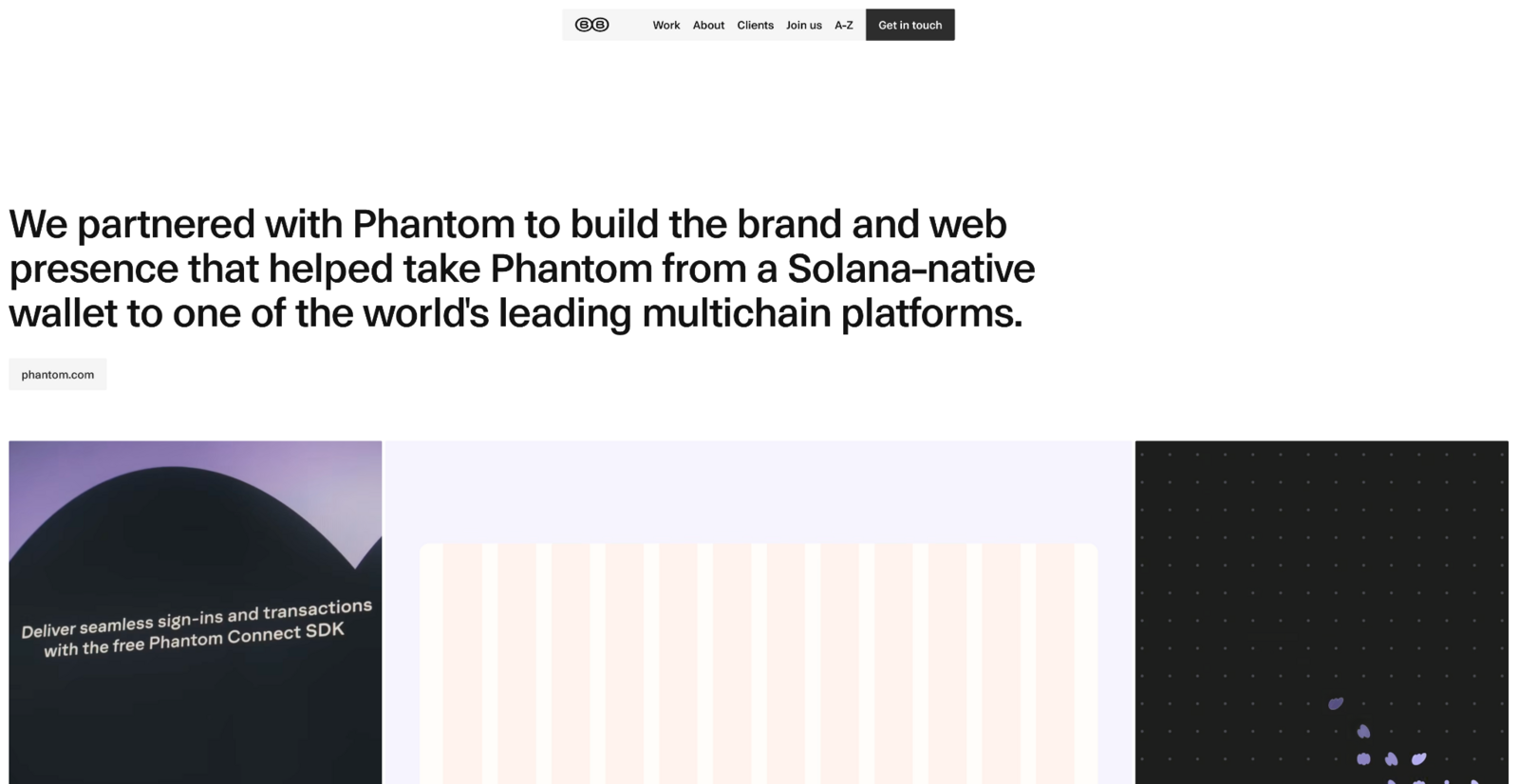
Bakken & Bæck (Source: Bakken & Bæck)
Best for: consumer wallets and any crypto product moving toward a mainstream audience.
Bakken & Bæck has the single best published crypto design credential of any studio here, and it is not close. It built the brand and web presence that carried Phantom from a Solana-native browser extension to one of the leading multichain wallets, then extended that into Phantom Cash, a fiat-pegged money account aimed squarely at a mainstream consumer audience. The published case study is specific about the work: a multi-toned gradient colour system, a sticker suite and 3D illustration language, the Phantom Sans inktrap display weight, the digital card and token design, and branded moments inside the product's onboarding journey. That last item is the one that matters. Designing inside onboarding, not around it, is what separates a blockchain branding agency from a decorator. Founded in 2011 with studios in Oslo, Amsterdam, Bonn, London and Barcelona, it has no Clutch profile, which costs it under our review criterion and nothing under the others.
Shipped crypto work: Phantom, including the core brand, the web presence and the Phantom Cash launch.
Crypto category depth: consumer wallets and the crypto-to-mainstream-finance crossover, which is where the hardest onboarding problems live.
Client reviews: no Clutch profile; evidence is a detailed published case study with named collaborators and a documented tech stack.
Services: brand, web, product, illustration, motion, plus in-house engineering on Next.js, Sanity and Framer Motion.
Pricing: undisclosed. Expect European senior-studio rates and budget accordingly.
4. Flight3
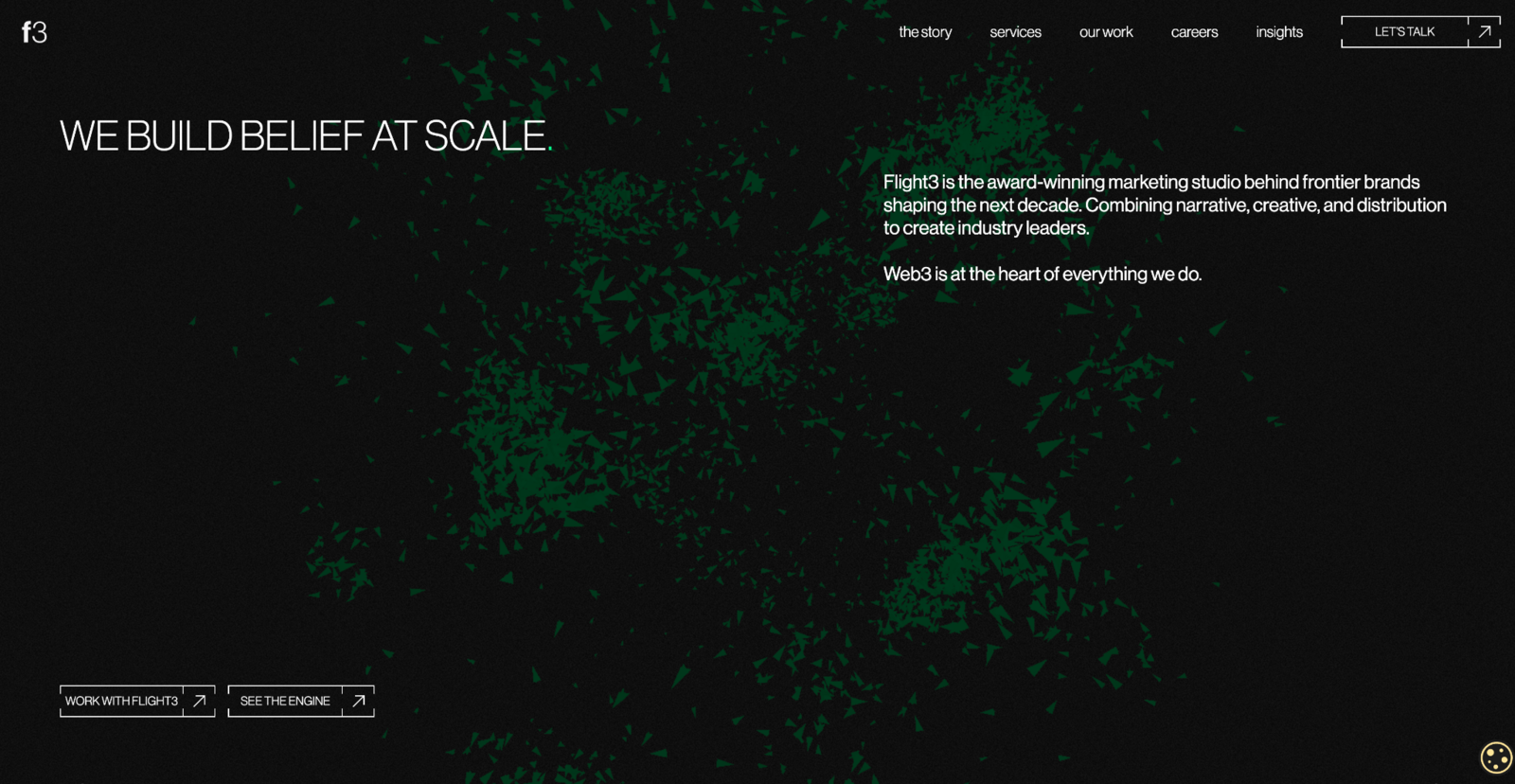
Flight3 (Source: Flight3)
Best for: token launches where brand and go-to-market have to ship as one thing.
Flight3 is the London studio to call when brand and go-to-market have to move as one thing. Four years in Web3, 85-plus token, NFT and product launches, 75-plus brands designed, and a client wall that includes Coinbase, Solana, OKX, dYdX, Sui, zkSync, VeChain, Blockchain.com, TON and Polkadot. What makes it credible rather than just impressive is that seven of those relationships are backed by named, attributed testimonials on its own site, including Coinbase's VP of International Policy and the Solana Foundation's Head of Western Europe. That is a much higher evidentiary bar than a logo grid. It also runs Zebu Live, the UK's flagship Web3 summit, which is a real distribution asset if a launch moment is part of your brief. It has no Clutch reviews, so the review column stays empty and the portfolio does the work.
Shipped crypto work: Coinbase, Solana, OKX, dYdX, VeChain, Blockchain.com, TON, Polkadot, Sui, zkSync, Fuel, plus Google.
Crypto category depth: L1s and L2s, exchanges, perps, token launches and ecosystem campaigns.
Client reviews: no Clutch profile; seven attributed client testimonials with names and job titles.
Services: brand foundations, creative universes, web studio, video and animation, social, PR, KOLs, token launches, events.
Pricing: not published as a rate card, but its own brief form starts budget bands at £10,000 and runs past £100,000.
5. Lazarev.
Lazarev. (Source: Lazarev.)
Best for: data-dense product interfaces, DeFi dashboards and trading views.
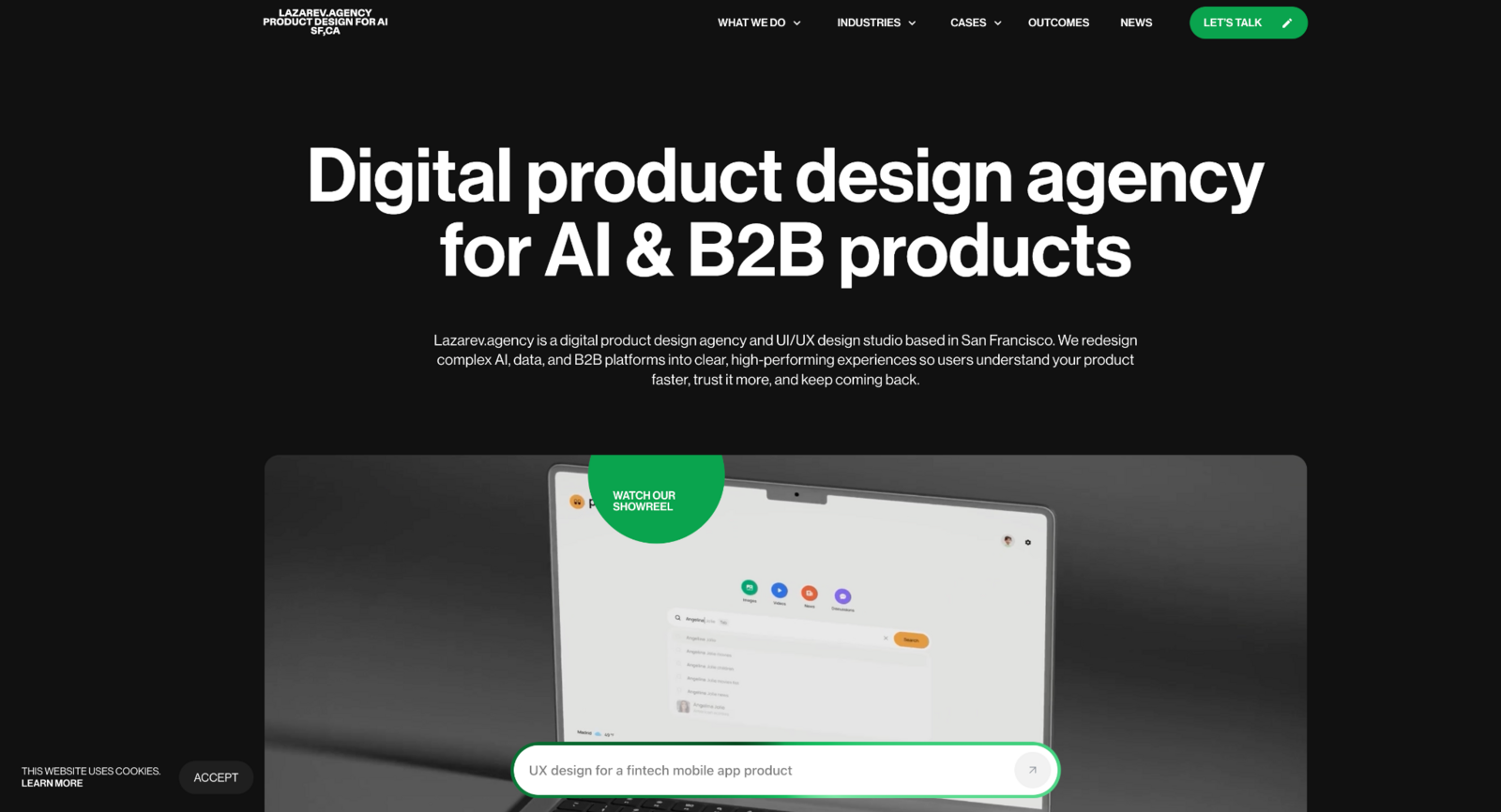
Lazarev. is the product-first pick, and the right call when your problem is a dashboard rather than a logo. Founded in 2015 with 50 to 249 staff and a San Francisco base on top of Ukrainian design roots, it has shipped 500-plus projects with Web3 named alongside fintech and SaaS as a core niche, and it holds a 5.0 on Clutch across 19 reviews. Its reputation is built on complex interface work: trading views, data-dense DeFi dashboards, motion that explains state changes rather than just decorating them. One reviewer put it as design deliverables that rival any firm in NYC or LA, which tracks with the Webby recognition. If your users spend hours inside your product rather than seconds on your landing page, weight this product design crypto agency highest on your shortlist.
Shipped crypto work: Web3 named as a core niche across 500+ projects, with DeFi dashboard and trading interface work at the centre.
Crypto category depth: data-heavy product design, dashboards, motion systems, UX strategy and business analysis.
Client reviews: 5.0 on Clutch across 19 reviews, with 4.9 for quality and schedule.
Services: UX strategy, UI and product design, motion design, business analysis, design systems.
Pricing: Clutch lists a $50,000+ minimum at $100 to $149/hr; the agency's own FAQ puts product design engagements from $20,000 and other design services from $5,000.
6. Bone Studio
Bone Studio (Source: Bone Studio)
Best for: fast-moving crypto teams that need brand, product and motion in weeks, not quarters.
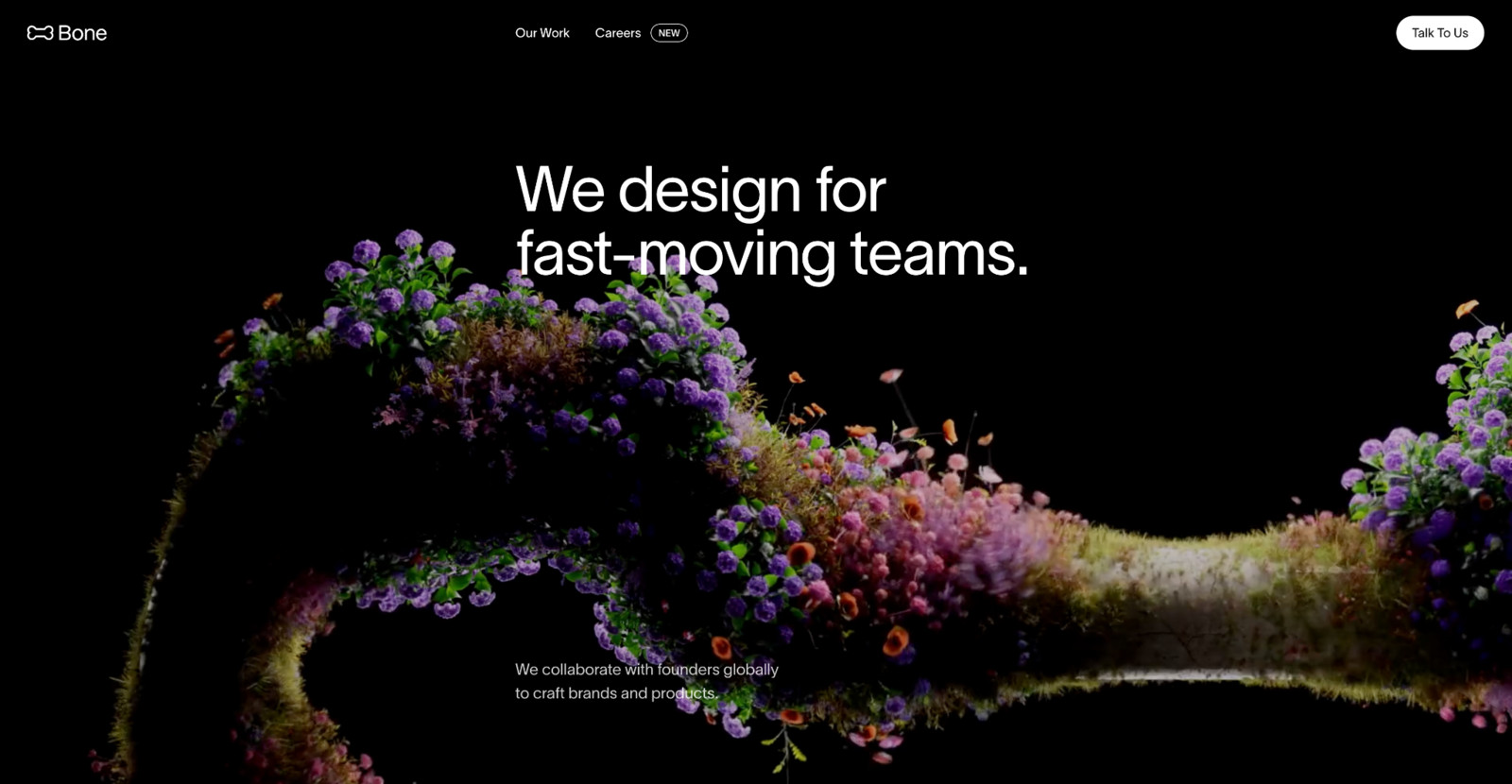
Bone Studio is the crypto-native speed play, and my pick for teams that cannot wait a quarter for a brand. Based in London, it runs focused sprints from concept to shipped brand, product and launch content, and its own tagline is aimed at teams who cannot wait months. The published case studies cover Fasset, Prism, A1 Research, Woof Software, DeepNode and Deep Blue Labs, and its work for ether.fi and Moonshot is corroborated outside its own site. Motion is the real specialism here: 2D and 3D work, launch films, product videos, the assets that make a token generation event feel like an event. Its Clutch record is a single review, which under a review-weighted methodology would sink it. Under a work-weighted one it sits comfortably mid-list, because the portfolio is unambiguously crypto-native and unambiguously recent.
Shipped crypto work: ether.fi, Moonshot, Fasset, A1 Research, Prism, Woof Software, DeepNode, Deep Blue Labs.
Crypto category depth: staking and restaking, research platforms, brokerage, plus launch and social content at volume.
Client reviews: 5.0 on Clutch across 1 review. Thin, and worth asking for references.
Services: brand identity, product design, 2D and 3D motion, landing pages, pitch decks, social, creative direction, launch campaigns.
Pricing: $15,000+ minimum at $100 to $150/hr.
7. Overcome Studio
Overcome Studio (Source: Overcome Studio)
Best for: protocols and infrastructure that need a brand explaining why the mechanism matters.
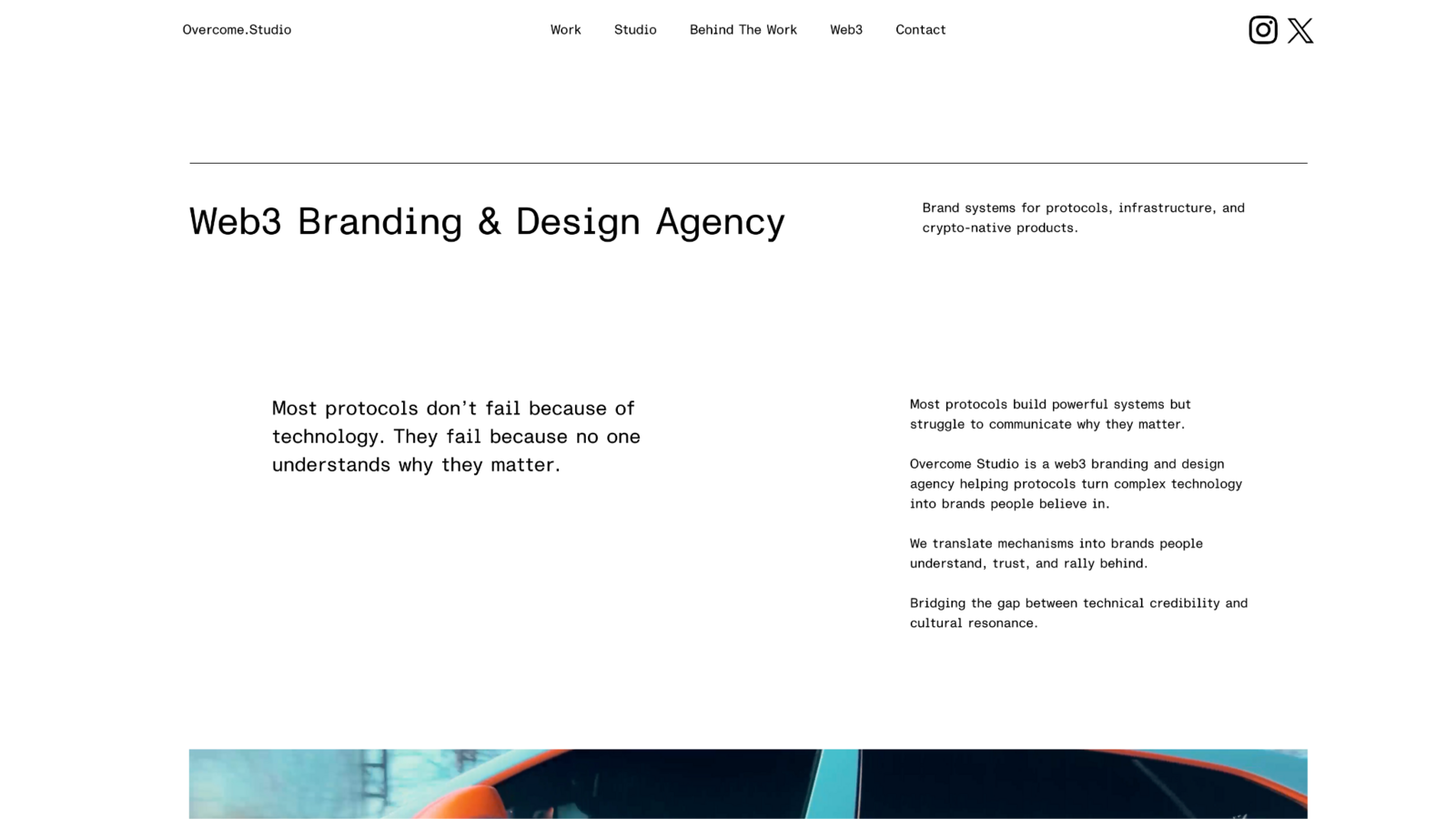
Overcome Studio is the most narrowly focused studio on this list, and its diagnosis of the category is the sharpest I have read anywhere. Crypto-native teams, it argues, reduce branding to gradients, token icons and buzzwords, while traditional agencies understand design but not decentralization, token economics or crypto culture. The result either way is powerful technology and a forgettable brand. Working out of Manchester and Guiyang, the team builds brand systems for protocols, infrastructure and crypto-native products, and its collaborator list is unusually strong for a studio this size: Coinbase, Optimism, TON, API3, Orbs Network and Tableland. There is no Clutch profile, so the portfolio carries the entry, exactly as it does for Bakken & Bæck and Flight3.
Crypto category depth: L1s, L2s and L3s, DeFi protocols, DAOs, and platforms bridging crypto-native and mainstream audiences.
Client reviews: no Clutch profile; evidence is the published collaborator list and portfolio.
Services: Web3 brand strategy, visual identity systems, protocol and product design, ecosystem and community branding, ongoing design guardianship.
Pricing: undisclosed. Manchester, UK and Guiyang, China.
8. Merge
Merge (Source: Merge)
Best for: crypto products that need design and front-end engineering from one team, backed by real review volume.
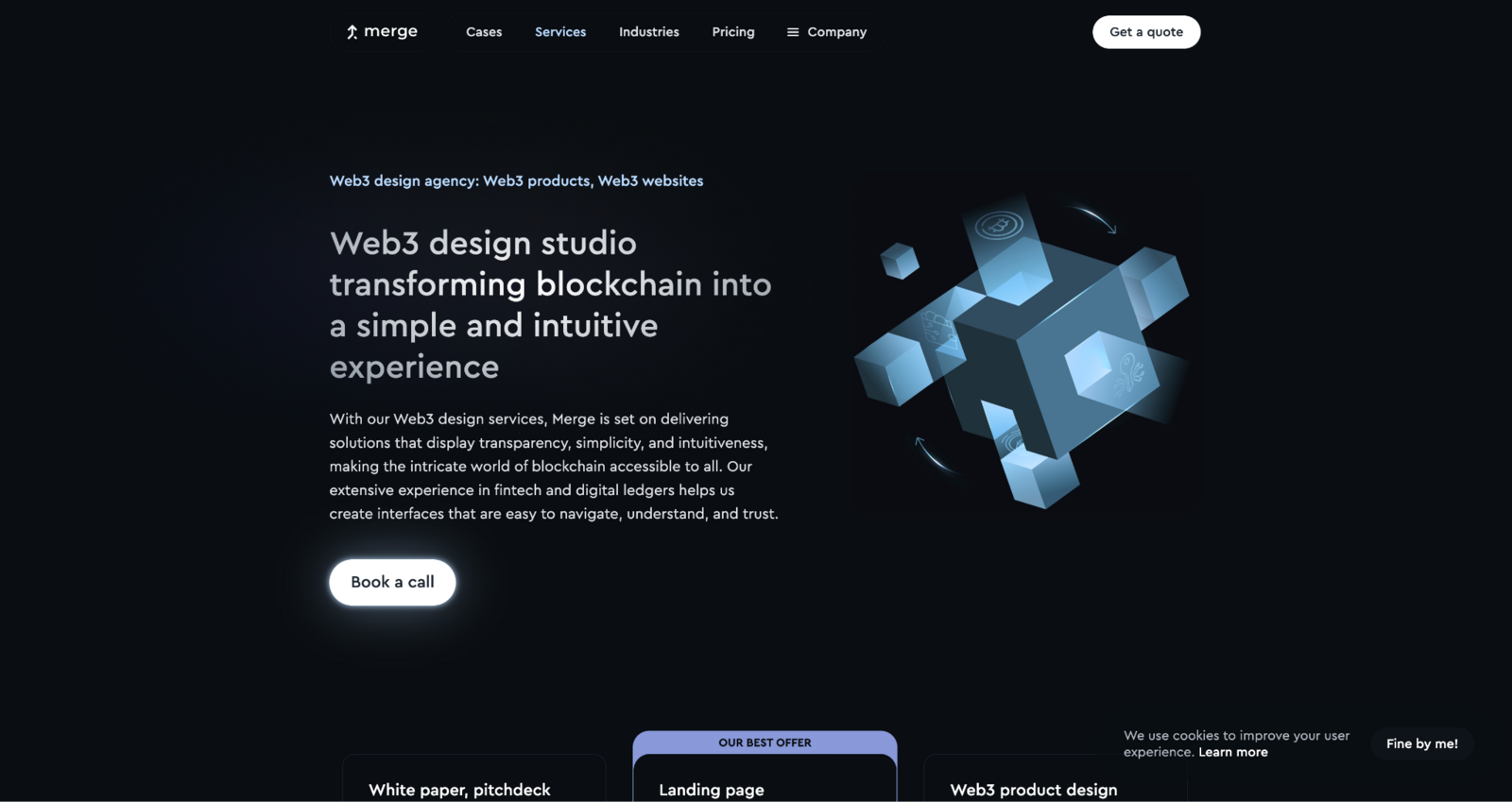
Merge holds a 4.9 on Clutch across 67 reviews, the second-deepest verified base on this list, with 4.9 for quality, schedule and cost alike. Founded in 2018, it has worked with 100-plus startups from Angel and Seed through Series A and B. What makes it credible for crypto specifically is that Web3 is a named practice rather than a tag: it publishes dedicated pages for crypto wallets, crypto exchanges, trading platform design and Telegram mini apps, and its case studies include Block Earner and CoinLedger, whose CEO appears by name in its testimonials. At a $10,000 minimum and $25 to $49 an hour, it is also one of the two most accessible entries here.
Shipped crypto work: Block Earner, CoinLedger, plus trading, wallet and exchange work across its Web3 practice.
Crypto category depth: crypto wallets, exchanges, trading platforms, Telegram mini apps, plus adjacent fintech and SaaS.
Client reviews: 4.9 on Clutch across 67 reviews, with 4.9 for quality, schedule and cost.
Services: product and brand design, UI/UX, design systems, motion, pitch decks, front-end and Webflow development.
Pricing: $10,000+ minimum at $25 to $49/hr. Founded 2018, 10-49 staff.
9. Arounda
Arounda (Source: Arounda)
Best for: proven product design process when your own team supplies the crypto context.
Arounda has the deepest verified review base on this list by a wide margin: 5.0 across 89-plus Clutch reviews, with 5.0 for quality, schedule and willingness to refer. Founded in 2016 with 350-plus platform initiatives behind it, it is a serious full-cycle product design and development partner, and its crypto record is better than its reputation suggests. Its published cases include MYSO Finance, which raised $2.4M and reached 85% user engagement after the redesign, and Enzyme, a DeFi platform for creating and managing tokenized financial products. Blockworks also appears on its client wall.
It sits ninth not on quality but on concentration. Crypto is one vertical among five, alongside SaaS, AI, fintech and healthcare, so you get outstanding product design process with less category-specific pattern knowledge than a crypto-only studio brings. For a dashboard or a redesign that has to convert, that trade is often worth making.
Crypto category depth: DeFi platforms, wallets and explorers, inside a broader product design practice covering SaaS, AI and fintech.
Client reviews: 5.0 on Clutch across 89+ reviews, the largest verified base here, plus Top Digital Design Company 2026 from Clutch.
Services: UI/UX, website design and redesign, mobile app design, pitch decks, brand identity, logo and graphic design, rebranding, product UX/UI audit, web and MVP development.
Pricing: $25,000+ minimum at $25 to $49/hr. Founded 2016, 55+ team members.
Studios We Considered and Cut, and Why
Three names from the previous edition of this article did not survive the work-weighted methodology. Naming them and explaining why is the point of having a methodology at all.
Inbuco. Included in the previous edition on the strength of a 5.0 Clutch rating across 10 reviews. Removed because its website no longer resolves. The studio was founded in 2023 and appears to have wound down, and a design studio you cannot reach is not a studio you can hire. A live Clutch profile is not evidence that a company is still trading.
HY.PE. Also in the previous edition, with Algorand, Chiliz, Celo, Ledger and BNB Chain on its client list. Two things changed. The /agency URL is gone, and more importantly the company has repositioned as Hype, "The SuperAgency," now selling marketing, talent, PR, events and AI systems. Design and branding are no longer on its service menu, so it no longer belongs on a design list regardless of the link.
Coinbound. A genuinely strong crypto marketing agency, and one I recommend elsewhere. But design is a side offer rather than a craft practice: Clutch lists 90% of its declared service mix as blockchain marketing with the remainder in PR, and none of it in design or UX. Its Clutch record is solid at 5.0 across 14 reviews, and its client roster is enormous. It just is not a design studio, and putting it on a design list would flatter the list rather than help you.
GuerrillaBuzz. Same problem, smaller evidence base. Clutch puts 40% of its work in content marketing and 40% in public relations, with nothing in design. It is a capable Web3 PR and link building shop with two published Clutch reviews, both from 2023. Design is not what you are buying.
NinjaPromo. Considered because it appears in the keyword set and because its 4.9 across 95 Clutch reviews is the deepest verified record in crypto marketing. Cut for the same reason as the other two: it sells a subscription marketing team in which design is one seat, not a studio with a point of view. If you want a designer inside a wider always-on marketing pod, it is a reasonable call. If you want a brand, it is not.
If any of these three builds out a standalone design practice with published crypto case studies, we will reassess at the next update.
What Makes a Great Crypto and Web3 Design Agency
The shortlist gets you to three names. This gets you to one.
Ask which failure state they designed most recently. Any web3 design agency can show you a hero section. Ask for the insufficient-funds message, the wrong-network prompt, the pending state that lasts 40 seconds. The answer tells you instantly whether they have shipped or just pitched.
Separate the brand hire from the product hire. Bakken & Bæck, Clay, Flight3 and Overcome Studio solve identity. Lazarev., Merge and Arounda solve interfaces. Bone Studio and RGray do both at different budget points. Hiring a brand studio to fix a dashboard, or vice versa, is the most expensive mistake on this list.
Check the handoff, not just the deliverable. Ask what your engineers receive: a design system with tokens and states, or a set of frames. Ask who does QA after build. The gap between an approved Figma file and a shipped product is where most crypto branding agency engagements quietly fail.
Weight recency over prestige. Crypto's visual grammar has moved on from the neon-and-polygon era to something calmer, more editorial and more product-led. A studio whose crypto portfolio peaked in 2022 will make you look like 2022.
Match the rate band to the stage. The spread here runs from a $1,000 minimum at $25 an hour to a $50,000 minimum at $199. That is a positioning gradient, not a quality gradient. A pre-seed protocol should be talking to RGray, Merge or Bone Studio. A listed exchange rebranding for an institutional audience should be talking to Clay or Bakken & Bæck.
Why Hire a Crypto Design Agency Rather Than a Generalist Studio
Crypto UX has failure states a generalist has never designed. Pending, reverted, insufficient gas, wrong network, seed phrase recovery. A crypto ux design agency has already argued about how to word each one. A generalist bills you for that education.
Trust is earned visually, in seconds. Every user arrives assuming you might be a rug. A blockchain creative agency knows which signals read as credible to that audience and which read as a red flag, and neither list matches Web2 SaaS conventions.
The categories have visual grammar. A perps DEX, an L2, a wallet and an NFT marketplace look nothing alike, and getting the grammar wrong makes you look like you do not understand your own category. A crypto ui design agency that has already shipped in your category knows that grammar without being told. That is pattern knowledge you can only get by shipping in the space.
Crypto Design FAQ
What's the best crypto design agency?
There is no single answer, because brand, product and launch are three different jobs. For a full-cycle partner that ties design to acquisition at an accessible rate, RGray. For institutional-grade brand work, Clay or Bakken & Bæck. For data-dense product interfaces, Lazarev. For crypto-native speed, Bone Studio. Shortlist two or three against your actual bottleneck rather than picking the one with the most famous logo wall.
How much does a crypto web design agency cost in 2026?
Across the nine studios here, minimum project sizes run from $1,000 to $50,000 and published hourly rates run from $25 to $199. A realistic brand identity plus marketing site lands between $15,000 and $60,000. A full product design engagement for a dashboard or wallet runs higher and is usually scoped monthly. Below roughly $5,000 you are buying execution against a brief you write yourself, not strategy.
What does a crypto UX design agency do that a normal UX team does not?
Three things. It designs the failure and pending states that only exist onchain, where a transaction can hang for a minute and the user has no idea whether their money is gone. It designs for adversarial conditions, where phishing clones of your interface are a certainty and visual trust signals have to be defensible. And it knows the category conventions users already expect from wallets, DEXs, bridges and launchpads, so you are not teaching a new pattern for no reason.
Do I need a crypto branding agency or a crypto product design agency first?
If nobody knows who you are, brand first. If people arrive and leave, product first. The common expensive mistake is commissioning a beautiful identity while the onboarding funnel keeps leaking, then blaming the brand. Look at where your numbers actually break before you write the brief, and note that a crypto product design agency and a branding studio often need to be two separate hires.
How long does a crypto website design agency take to ship?
A landing page or launch site is typically two to six weeks. A brand identity with a design system is six to twelve. A full product redesign for a wallet or exchange runs three to six months, and longer if you are migrating a live user base. Studios that run sprint models, like Bone Studio, compress the front end of that. Nobody credible ships a full brand plus product in two weeks.
Is a blockchain design agency worth it over a freelancer?
For a single landing page or a logo, a good freelancer is often better value than a web design crypto agency. For anything involving a design system, multiple surfaces, motion and a handoff to engineers, a studio wins because the coordination is the hard part. The honest test is whether your project needs more than two disciplines at once. If it does, hire the team.