In October 2026, banks and crypto platforms launched new products, but most major cryptocurrencies lost value. The Binance hack and shutdown announcements from well-known projects highlighted the risks. Rising trading volumes and funding did not translate into broad demand for tokens. For investors, diversification and understanding how a project could generate returns remained important.
Key takeaways
Hackers stole about $6.3 billion from Binance. BNB lost roughly 8% in 23 minutes, and Bitcoin fell around 2.5% over the same period.
JPM Coin went live on Ethereum, and DTCC launched a tokenization service initially supporting 34 securities.
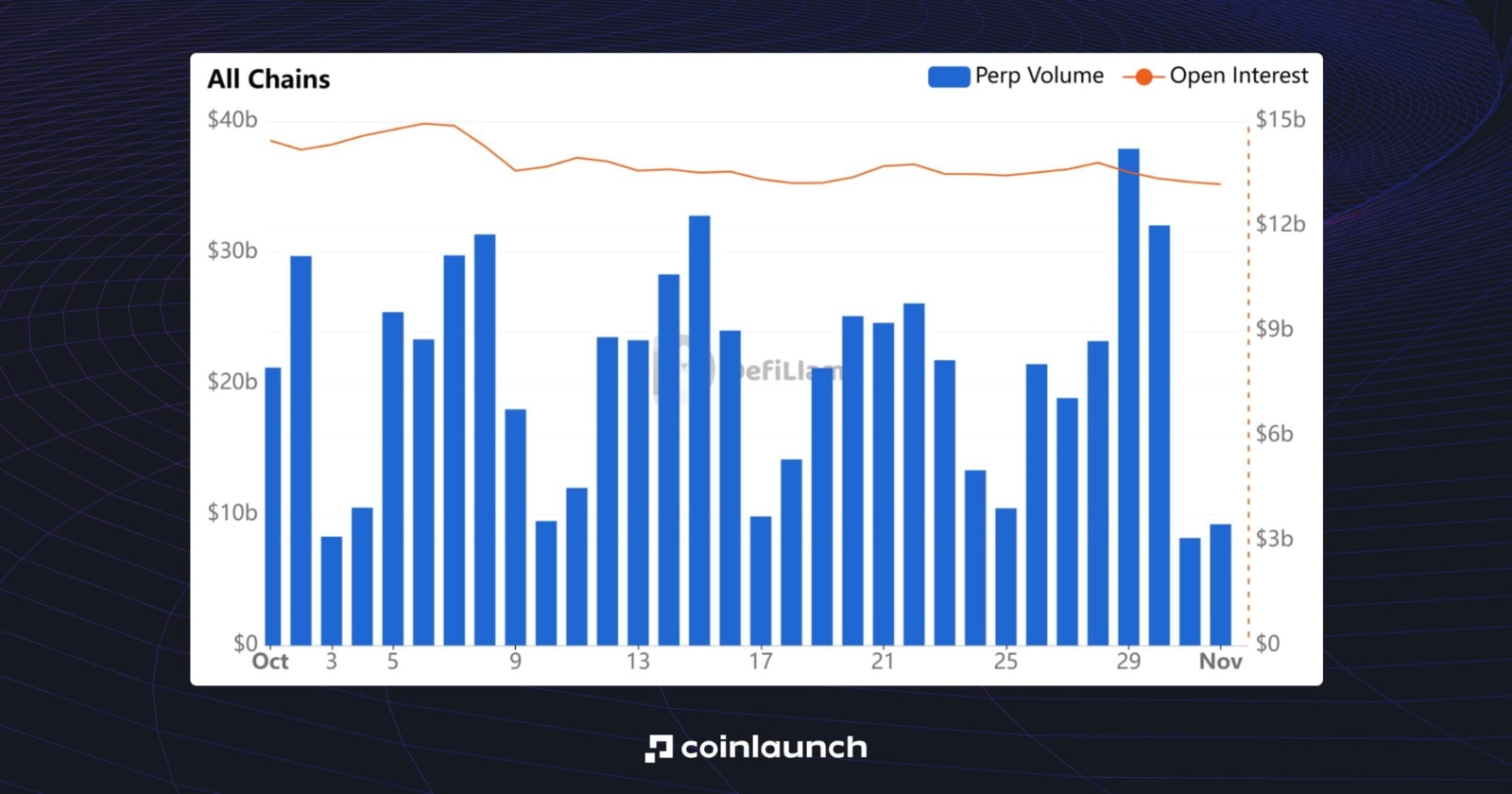
Perp DEX trading volume rose 6% to $659 billion. Hyperliquid retained the lead with a market share of around 35%.
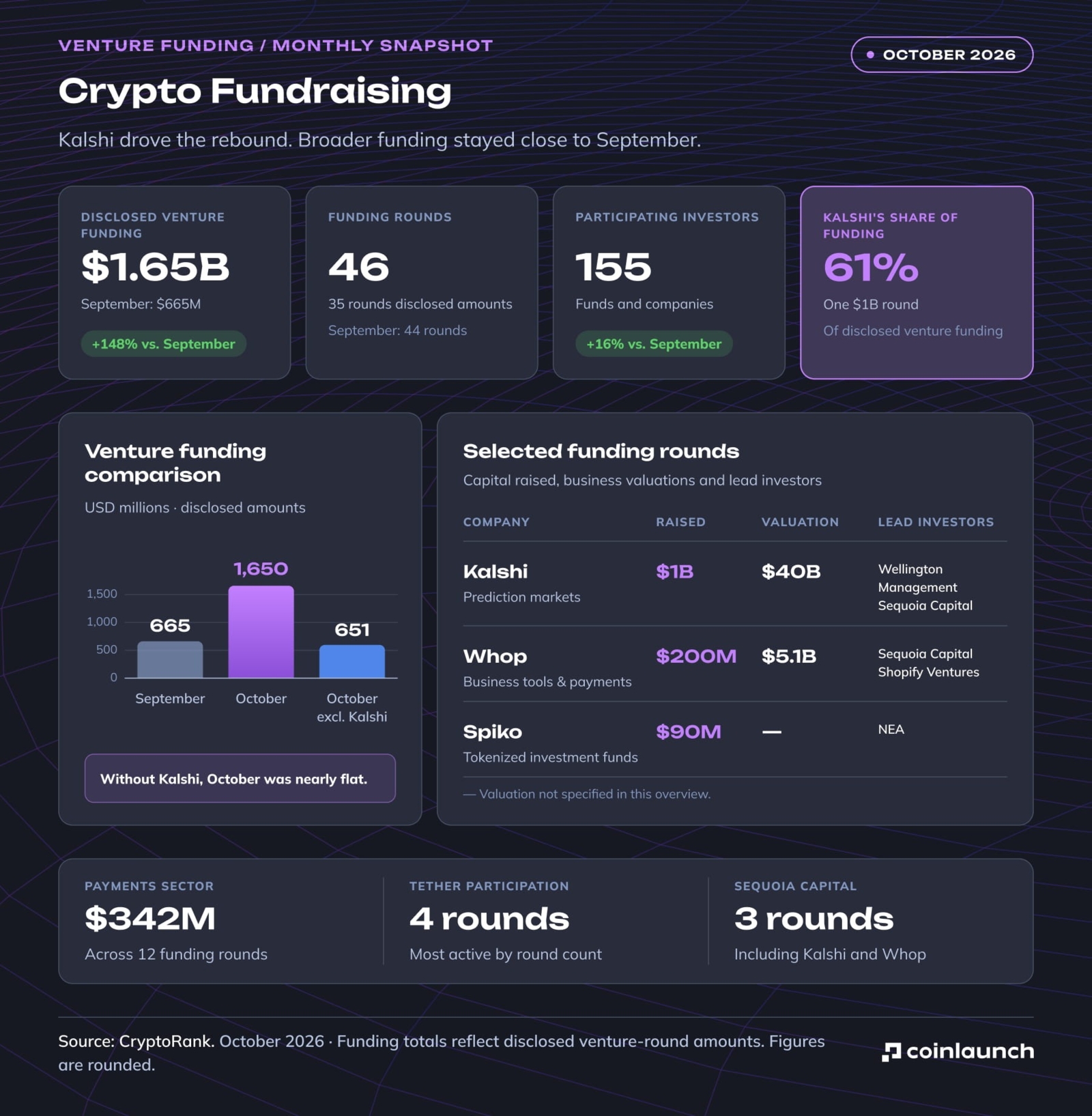
Projects raised $1.65 billion in venture funding, but Kalshi accounted for 61% of the total. Excluding that round, funding was roughly in line with September.
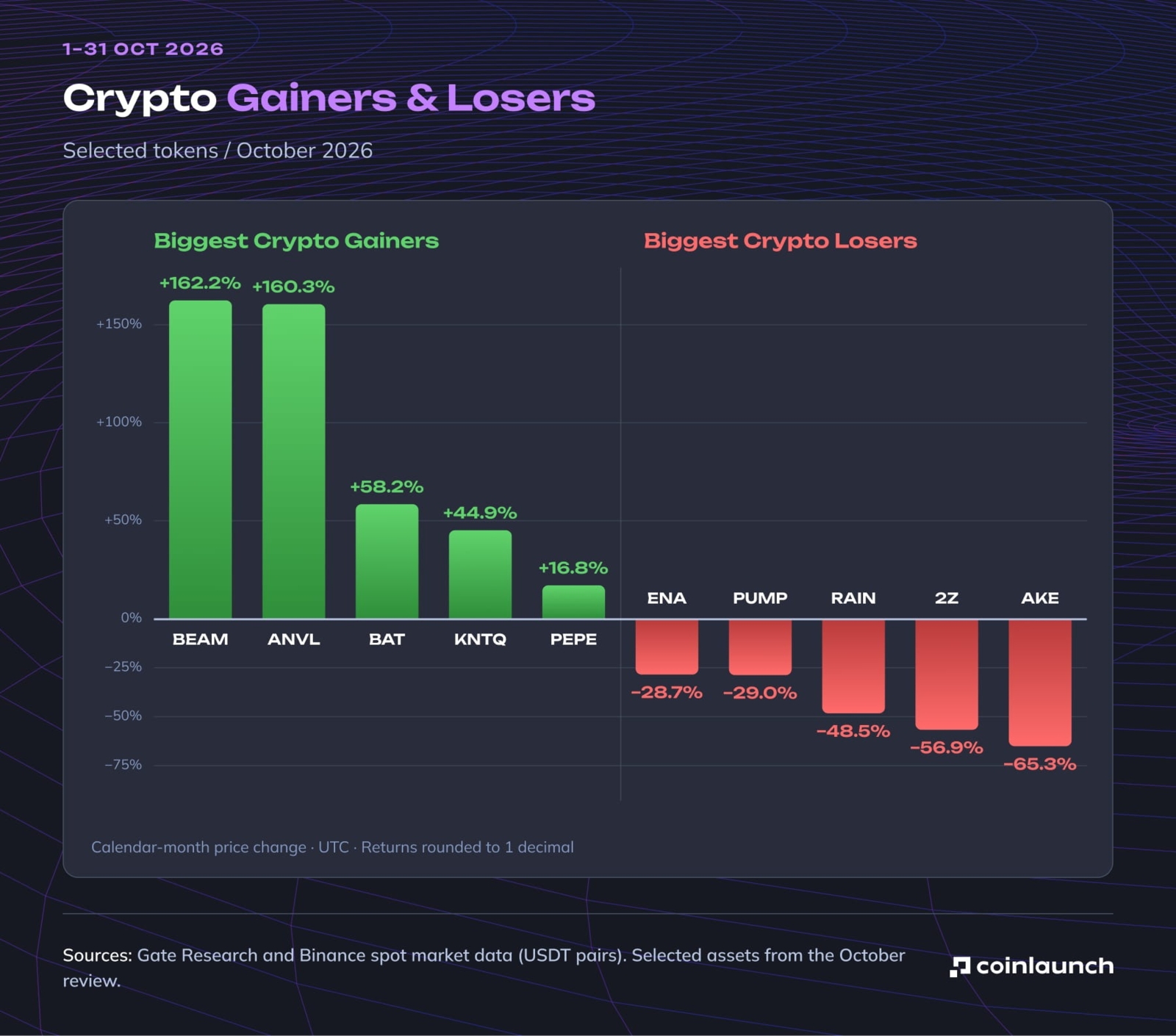
BAT gained 58.2%, and PEPE rose 16.8%. Over the same month, ENA lost 28.7%, and PUMP fell 29%.
Blast and Abstract announced plans to wind down, Neon EVM ended support, and Blur announced its website would close. A well-known name does not guarantee a project’s survival.
Table of Contents
Current Crypto Narratives: October 2026 Market Overview
Binance Hack and the October 29 Crypto Sell-Off
Fed Holds Rates Steady at 3.75%-4% in October 2026
MSCI Decision on MSTR: Index Exclusion Risk for Strategy
New Crypto Launches and Market Products: Aero, JPM Coin and DTCC
JPM Coin Goes Live on Ethereum
Aero DEX Launch: Aerodrome and Velodrome Merger
DTCC Tokenization Service Goes Live
Crypto Funding Rounds in October 2026: Kalshi, Whop and Spiko
Top Crypto Gainers and Losers in October 2026: PEPE, BAT, ENA and PUMP
Biggest Crypto Gainers: PEPE and BAT
Biggest Crypto Losers: ENA and PUMP
Top Crypto Narratives for 2026: October List
ICE Perpetual Futures: U.S. Market Plans With Trade XYZ and Hyperliquid
Crypto Security: Ledger Supply Chain Attack and AI Cryptography Fears
Institutional Tokenization: Securities and Bank Deposits Move Onchain
Prediction Markets: Trump Impeachment Odds
Crypto Project Shutdowns in October 2026
Upcoming Crypto Catalysts: What to Expect From Crypto in November 2026
Crypto Market Summary: What October's Narratives Say About the Market
Share this blog post
On Oct. 29, 2026, hackers stole roughly $6.3 billion in assets from Binance. That same day, Intercontinental Exchange (ICE), the owner of the New York Stock Exchange, announced plans to bring Hyperliquid-based perpetual futures to the United States, subject to regulatory approval. The two stories captured the range of October’s crypto narratives.
By then, JPMorgan had already brought JPM Coin to Ethereum, and the Depository Trust & Clearing Corporation (DTCC) had launched a securities tokenization service. Both launches point to the same crypto tendency: Financial institutions are using blockchain to manage bank deposits and securities.
These were just a few of October’s developments. Last month, we tracked five narratives that could help you spot opportunities to profit in the market. We analyzed two of the month’s gainers and identified clear patterns in the performance of different sectors.
Read on to find out which sectors performed best in October and could keep growing, which narratives have already caught investors’ attention, and which emerging crypto narratives 2026 has brought could gain traction in the coming months. We cover the events to watch before your next trades.
Current Crypto Narratives: October 2026 Market Overview
In October, major companies continued launching crypto products as cryptocurrency prices fell. News kept coming, but traders were in no rush to buy everything on offer. Each announcement called for a closer look at the project: what it had launched, who needed it and how it could affect its token.
That is where we will start our review of October’s current crypto narratives. We will look at which developments gave projects access to new markets and users, and which prompted investors to sell their tokens. Then we will compare sector performance and track altcoin rotation — the shift in buying interest from one coin to another. This will help you see which sectors to watch next.
Binance Hack and the October 29 Crypto Sell-Off
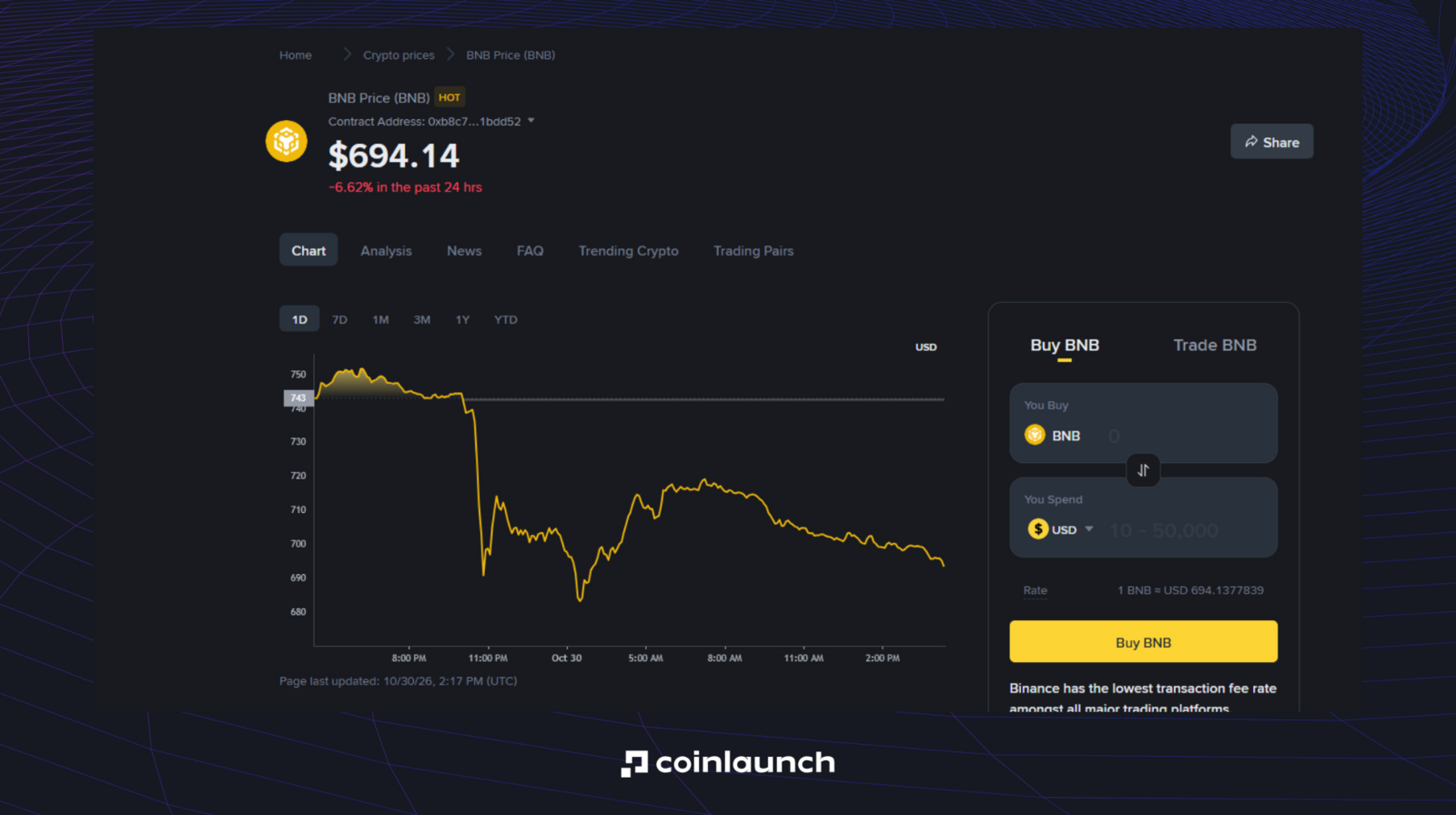
On Oct. 29, 2026, hackers stole about $6.3 billion from Binance’s wallets. This Binance hack was the largest theft in history, with the attackers draining most of the funds in roughly 20 minutes. The exchange suspended withdrawals and pledged to cover the losses with its own funds.
The market sold off sharply. BNB lost about 8% in 23 minutes, and Bitcoin fell roughly 2.5% over the same period. Liquidations of leveraged positions then added to the selling pressure. By the morning of Oct. 30, 24-hour liquidations had reached $1.5 billion. Most were long positions.
BNB price before, during, and after the $6.3 billion Binance hack. Source: binance.com
Details of the Binance security breach emerged later. In a Nov. 3 report, Binance said an employee had downloaded a test assignment containing malware during a fake job interview. Through the infected computer, the hackers gained access to an internal system that authorized transfers. The approvals they had granted on Ethereum remained active even after regular withdrawals were suspended. Pausing withdrawals was not enough; the exchange had to revoke those approvals separately.
On Nov. 12, Binance announced it had fully replaced the stolen assets using its own funds and insurance reserves. That same day, the U.S. Department of Justice said it had obtained court authorization to seize or block more than $1.2 billion in previously frozen funds. That was a separate process: Binance was covering the losses as law enforcement continued working to regain control of the stolen assets.
Restoring users’ access to their funds took longer. In a Nov. 14 update, the exchange said it had reopened withdrawals on 87 networks over the previous week and was still preparing to reopen them on the remaining networks.
Fed Holds Rates Steady at 3.75%-4% in October 2026
On Sept. 16, the Fed raised its benchmark rate to 3.75%-4%. The next FOMC meeting October 2026 brought concluded on Oct. 28, with the central bank holding that range steady. Most committee members decided against a second consecutive rate hike.
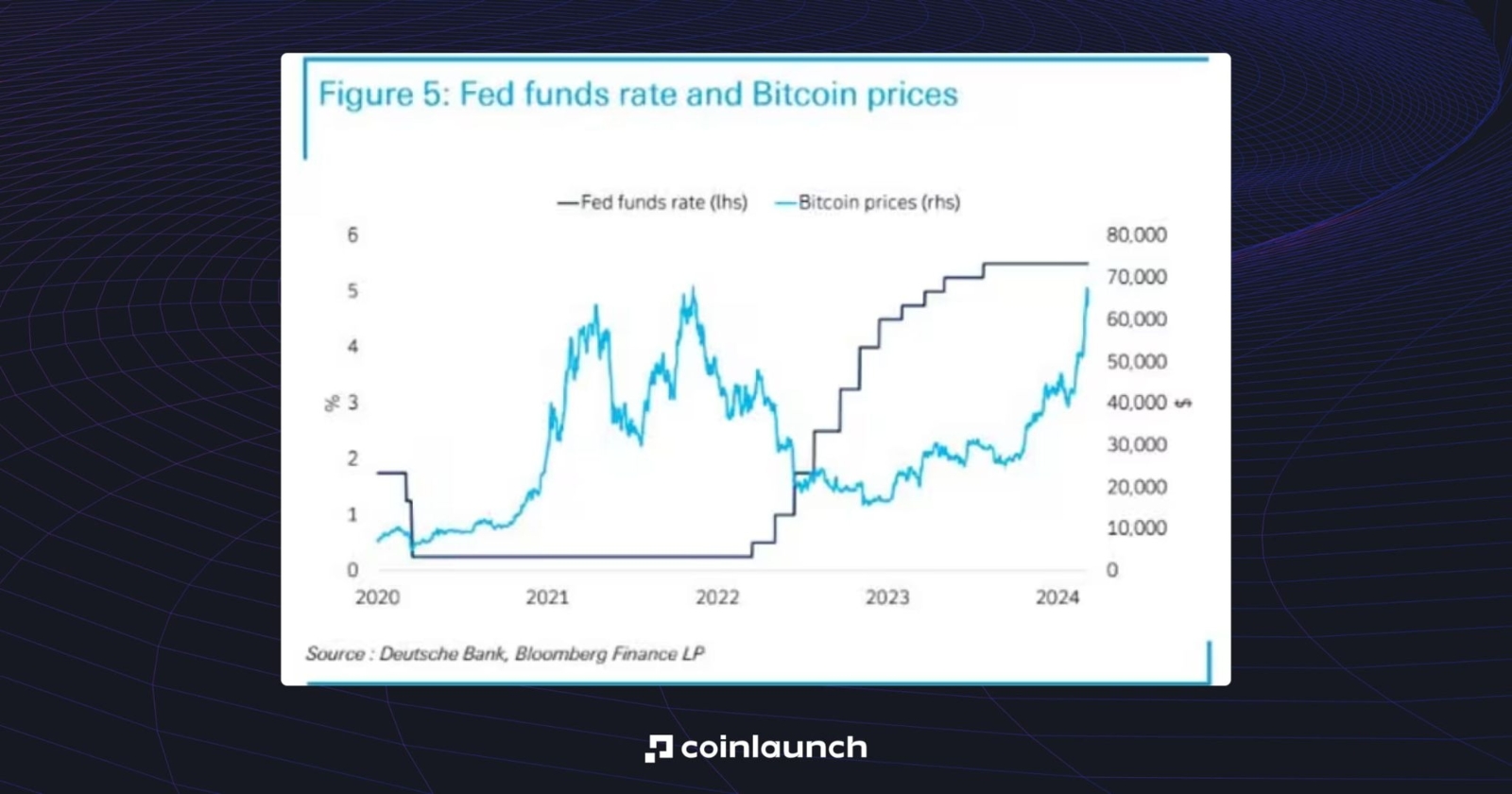
Changes in Federal Reserve interest rates affect crypto through borrowing costs and the appeal of other investments. Higher rates make borrowing more expensive and allow investors to earn interest on dollar-denominated instruments such as short-term U.S. Treasury bills. Buying crypto instead requires a reason to take on greater risk. A rate hold alone does not mean more money will start flowing into crypto.
Fed rate and Bitcoin price over time. Source: marketwatch.com
After the October 2026 FOMC meeting, Bitcoin climbed to around $81,000. Yet that same day, futures markets priced in an 86% probability of a December rate hike. October’s Fed rate pause gave investors time to watch new inflation and employment reports: The data could persuade the Fed to extend the pause or raise rates again.
MSCI Decision on MSTR: Index Exclusion Risk for Strategy
In October, Strategy, one of the largest corporate buyers of Bitcoin, faced the risk of heavy selling in its shares. On Oct. 15, MSCI, a stock index provider, approved new rules that could lead to Strategy’s removal from its indexes. The company risked losing some demand for its shares as a result.
A stock index tracks changes in the value of a selected group of stocks, which represent ownership stakes in companies. Some investment funds mirror an index by buying the same stocks in the same proportions. When a company is removed from the index, these funds sell its shares. MSCI’s decision could therefore trigger sales of Strategy shares regardless of how fund managers viewed its business prospects.
The new rules call for removing companies whose financial metrics more closely resemble those of investment funds. Strategy, formerly MicroStrategy, met those criteria: It raises money from investors and accumulates Bitcoin. The company opposed the changes, arguing that its cryptocurrency operations were a distinct line of business.
On Nov. 11, however, MSCI confirmed that it would remove Strategy’s shares from its indexes after the close of trading on Nov. 30, 2026. The shares trade under the ticker MSTR.
Selling by index funds could push MSTR’s price lower. This matters to Strategy, which funds its Bitcoin purchases in part by selling new shares. A lower share price would mean raising less money from the same number of shares, leaving less funding for future crypto purchases. Removal from the indexes would not, in itself, require Strategy to sell the Bitcoin it already holds.
New Crypto Launches and Market Products: Aero, JPM Coin and DTCC
In October, new token launches came alongside new financial services. Crypto platforms gave traders more options, banks moved financial transactions onto blockchains, and financial infrastructure providers launched services for handling securities.
These launches could attract new users and capital. But launching a product does not guarantee people will use it. Next, we look at what is already available, who can access the new services and what could drive demand.
JPM Coin Goes Live on Ethereum
On Oct. 19, 2026, J.P. Morgan launched JPM Coin on Ethereum. The bank’s corporate clients could now use their dollar balances for payments and settlement on the network. The token was already available on Base, and the October launch extended its use to another blockchain.
JPM Coin is a deposit token, a digital representation of money held in a bank account. The JPM Coin price matches its dollar face value: One token represents $1. Clients convert funds into tokens, use them for settlement and can then redeem them for dollars in their J.P. Morgan accounts.
The bank did not disclose JPM Coin daily volume on Ethereum in its announcement. Across its entire Kinexys blockchain platform, J.P. Morgan reported average volume of $7 billion a day and more than $4 trillion in transactions since launch. These figures show the scale of the bank’s blockchain services, but do not measure JPM Coin usage on the new network.
Aero DEX Launch: Aerodrome and Velodrome Merger
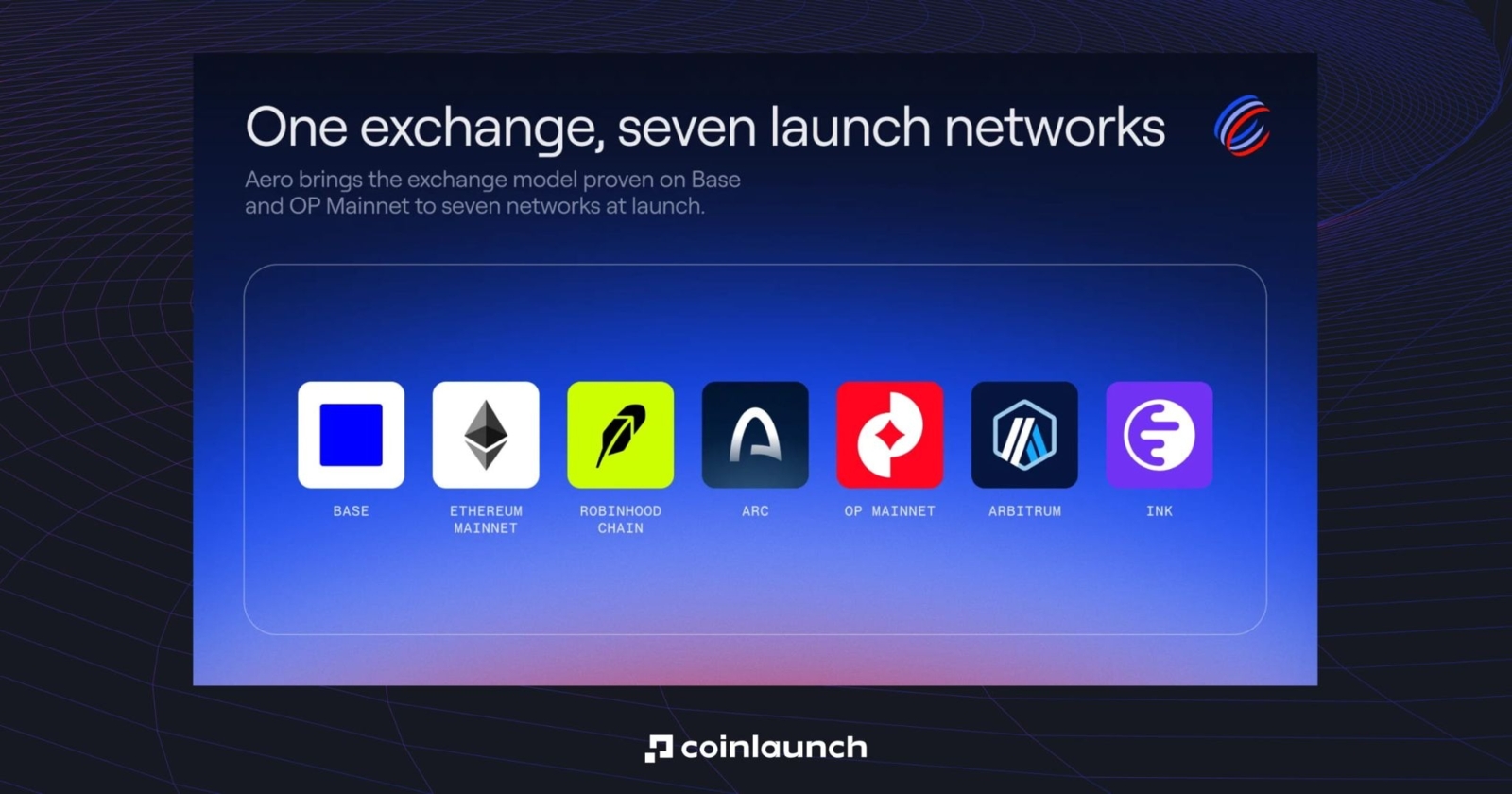
On the night of Oct. 21-22, 2026, Aerodrome and Velodrome merged to form Aero Exchange. The two crypto exchanges became a single trading platform spanning seven blockchain networks. Aero operates as a DEX, where users swap crypto directly from their wallets without first funding an exchange account.
Before the merger, Aerodrome primarily operated on Base and Velodrome on OP Mainnet. The combined platform adds support for Ethereum, Arbitrum, Robinhood Chain, Arc and Ink. For traders, the main change is the ability to swap assets across supported networks through one service. Metaswaps combines the transfer between networks and the swap into a single operation.
Blockchain networks supported by Aero Exchange. Source: aero.xyz
The Aerodrome Velodrome merger affected the platforms’ tokens: Legacy AERO and VELO are being converted into a single new AERO token at rates of 1 AERO = 1 new AERO and 1 VELO = 0.044 new AERO.
The AERO ticker stayed the same, but its contract address changed. This address identifies the program that tracks tokens on the blockchain. Exchanges follow their own migration schedules. Kraken, for example, took responsibility for converting its customers’ balances.
The expanded platform offers potential income for AERO holders. Participants can stake their tokens and choose which trading pairs receive rewards to attract liquidity. In return, they receive a share of revenue from the corresponding markets.
DTCC Tokenization Service Goes Live
On Oct. 28, 2026, DTCC, a U.S. group that provides securities custody and trade settlement, launched a tokenization service. Banks and brokers could now convert existing securities into digital form and transfer ownership rights through blockchain.
For example, a broker can receive tokens representing bonds it owns and send them to another approved participant. The underlying securities remain in DTCC custody, and their digital form preserves ownership rights and any payments due to the holder. When needed, the tokens can be converted back into a standard book-entry record of ownership.
As part of the DTCC tokenization service launch, 34 securities became available for tokenization. The service runs on Canton Network and DTCC’s private Besu-based network. Existing tokens can be transferred between registered wallets 24/7, allowing participants to send assets to one another over the weekend, for example. Tokens can only be created or redeemed during set hours on business days.
Crypto Funding Rounds in October 2026: Kalshi, Whop and Spiko
In October 2026, crypto fundraising rose sharply. Projects raised$1.65 billion in venture funding, up from $665 million in September. Analysts tracked 46 rounds, with companies disclosing funding amounts in 35 of them. The sample includes crypto projects and related financial and payment services.
October crypto fundraising dashboard. Data: cryptorank.io
Payment services led crypto venture capital by deal count, with 12 rounds totaling $342 million. The largest round was in prediction markets. Notable funding recipients included:
Kalshi: $1 billion. On Oct. 29, the company announced a round co-led by Wellington Management and Sequoia Capital. Investors valued the business at $40 billion. The company plans to use the funds to develop new exchange products, attract major financial institutions and expand in Europe and Latin America.
Whop: $200 million. On Oct. 21, the platform for launching online businesses and accepting payments raised funding at a $5.1 billion valuation. Sequoia Capital and Shopify Ventures led the round. Whop lets entrepreneurs sell products and services and withdraw their earnings to crypto wallets, among other options. The capital will fund expansion into new countries and the development of payment and advertising tools.
Spiko: $90 million. On Oct. 6, the company closed a round led by NEA, with participation from Index Ventures, Bpifrance and other investors. Spiko helps businesses and individual clients invest idle cash in funds whose shares are recorded on a blockchain. At the time of the announcement, these funds held $2.7 billion in client assets. The new funding will support product launches, hiring and expansion into new markets.
The distribution of blockchain venture capital remained uneven: Kalshi accounted for 61% of October’s venture funding. Excluding its round, the remaining projects raised $651 million, almost as much as the entire market in September. The jump in total funding therefore does not yet indicate a comparable improvement in conditions for most teams.
A total of 155 funds and companies participated in crypto VC funding rounds, up from 134 the previous month. Tether was the most active by deal count, participating in four rounds. Sequoia Capital took part in three, including the two largest deals: Kalshi and Whop.
Top Crypto Gainers and Losers in October 2026: PEPE, BAT, ENA and PUMP
In October 2026, some tokens gained ground amid a broader market decline. Among the largest cryptocurrencies, 92% ended the month with negative returns. That makes October’s crypto gainers and losers particularly interesting to compare: PEPE and BAT rose, but ENA and PUMP lost almost a third of their value.
Biggest crypto gainers and losers dashboard. Source: coinlaunch.space
For the four tokens below, price changes are calculated for Oct. 1-31 using prices at the start and end of the month.
Biggest Crypto Gainers: PEPE and BAT
PEPE gained 16.8%. It is a memecoin, a token built around a popular internet meme. The project itself says the token is for entertainment. Trading activity and community attention are therefore important when assessing PEPE. Its October gains show that interest in memecoins persisted even as most of the market fell.
BAT rose by 58.2%. The token is used in the Brave browser, where users can earn it by viewing ads. Plans to expand its use may have helped sustain interest. In a roadmap published over the summer, Brave outlined plans to support payments for AI applications and buy BAT on the market using a share of revenue from new services. Implementing these plans could create additional demand for the token.
Biggest Crypto Losers: ENA and PUMP
ENA lost 28.7%. It is the token of Ethena, a project that issues the digital dollar USDe. The month began amid previously announced accelerated token unlocks for early investors. These unlocks let holders sell previously locked coins and can increase selling pressure. Approved ENA buybacks funded by project revenue, however, depended on meeting set targets. The first was $7.5 billion in USDe circulation.
PUMP fell by 29%. It is the token of Pump.fun, a platform where users create and trade new coins. The project uses part of its fee revenue to buy PUMP and burn the tokens it purchases. For example, in the week of Sept. 28-Oct. 4, it spent$7.6 million on these operations. These purchases created demand, but were not enough for the token to finish October with a gain.
PEPE and PUMP posted opposite results within the same memecoin segment. A rally in one coin therefore says little about the state of the sector as a whole. Similarly, a token can appear on a daily list of top crypto gainers today during a brief rebound and still finish the month at a loss.
Top Crypto Narratives for 2026: October List
Many cryptocurrencies lost value in October, but companies continued raising substantial funding and launching new financial products. Price movements therefore tell only part of the story: Investors and entrepreneurs remained interested in the industry even as the market declined.
In the October edition of Top crypto narratives 2026, we examine the month’s main themes. This crypto narratives list covers regulatory decisions, new trading and payment services, project funding and the biggest gainers and losers. We explain what happened and how these events could affect the market.
ICE Perpetual Futures: U.S. Market Plans With Trade XYZ and Hyperliquid
On Oct. 29, ICE, the owner of the New York Stock Exchange, announced plans to launch a U.S. perpetual futures market with Trade XYZ. In the TradeXYZ Hyperliquid partnership, Trade XYZ creates the trading contracts, and Hyperliquid provides the network for processing trades. ICE plans to establish the U.S. venue. The launch still requires regulatory approval.
Perpetual futures, or perps, let traders take positions on an asset’s price rising or falling without buying it. These contracts have no fixed expiration date. A perp DEX is a decentralized exchange for these contracts. Settlements are recorded on a blockchain, a shared digital ledger of transactions.
Trading activity supports interest in this sector. In October, perp DEX volume rose6% to $659 billion, marking its fourth consecutive monthly increase.
Trading volume across all perp DEXs. Source: defillama.com
At the same time, futures trading volume on centralized exchanges fell 8%. Hyperliquid retained the lead with $229 billion in volume and a market share of around 35%. Variational moved into second place with $78 billion, roughly triple its July volume. Other competitors include Lighter, Aster and Pacifica.
One potential way to profit from this narrative is through an airdrop, where a project distributes tokens to participants. Some platforms award points for activity. These internal scores may count toward token allocations:
Variational announced an airdrop of 32% of the total VAR supply, to be allocated in proportion to accumulated points. The token is scheduled to launch in Q4 2026, with points awarded weekly until then.
Pacifica distributes 10 million points each week based on user activity. Its published rules, however, do not promise that these points can be exchanged for tokens.
Profit depends on selling the tokens for more than the cost of participating. It is therefore worth comparing distribution terms, fees and potential trading losses, since costs can exceed the value of the reward. The ICE agreement itself does not include a Trade XYZ airdrop, but it signals interest in the sector.
Crypto Security: Ledger Supply Chain Attack and AI Cryptography Fears
On Oct. 15, Ledger detailed how attackers stole funds from users of its hardware wallets, devices that protect the private keys used to authorize crypto transfers. Attackers opened up genuine devices, installed hidden components and put them back on sale through resellers in Southeast Asia. During setup, those components intercepted the recovery phrase, a set of words used to restore access to funds.
In this Ledger hack, the attackers bypassed security by targeting the sales channel. Ledger said its secure element chip, operating system and servers had not been compromised. After the Ledger wallet hack, the company tightened its reseller rules, reinforcing its existing ban on reselling returned devices. The incident showed that self-custody security depends in part on how a device reaches the buyer.
Earlier, online discussion had turned to a question researcher Justin Drake raised on Oct. 7: Can AI hack Bitcoin? He suggested AI could help find a mathematical way to derive private keys from public keys, which the network uses to verify the authenticity of transactions. That would let attackers spend other people’s coins. Drake outlined a possible scenario and called for work on defenses. His post did not provide an attack method or a demonstration.
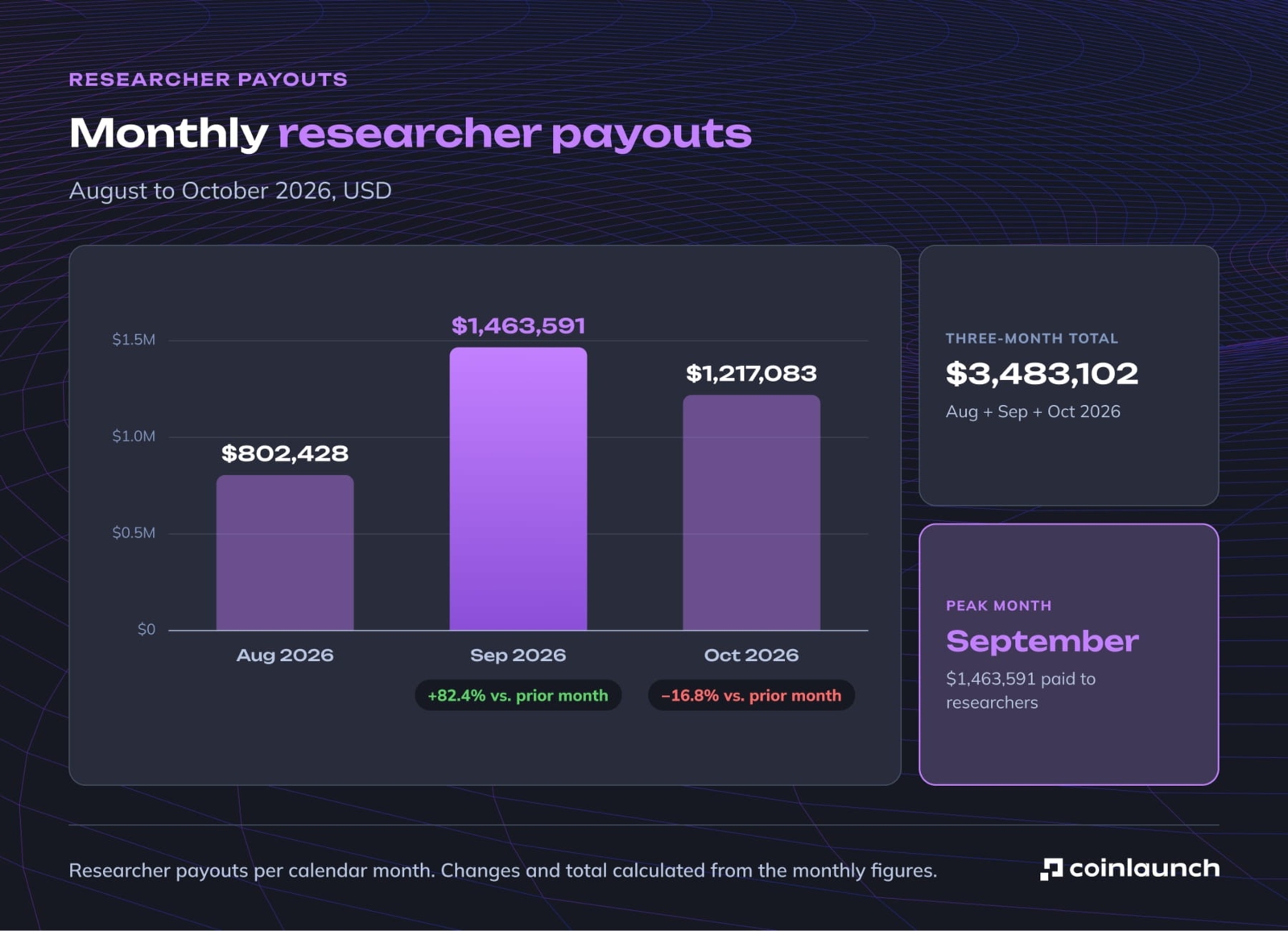
These concerns and the Binance hack prompted discussion in the crypto community about bug bounty programs and their role in security. For example, projects on Immunefi, a platform that offers rewards for finding vulnerabilities, paid researchers $1.22 million last month, 87% more than a year earlier.
The way to earn is clear: Find a vulnerability within an authorized program’s scope, verify it and collect a reward. For example, on Oct. 20, Paxos Labs launched a program with a maximum payout of $500,000. You can still take part.
Institutional Tokenization: Securities and Bank Deposits Move Onchain
The JPM Coin and DTCC launches share a common narrative: real world asset tokenization. Financial firms are bringing asset ownership rights and the money used to settle trades onchain. The next step is to use them together in everyday transactions.
The market is already worth tens of billions of dollars. According to RWA.xyz, circulating tokenized assets were worth around $39 billion as of Oct. 25, excluding stablecoins. Roughly $14.7 billion of that total was in funds investing in U.S. government debt.
Uber tested this approach in a pilot announced on Oct. 30. The company bought shares in a Franklin Templeton fund using tokenized HSBC deposits. Payment and delivery of the shares took place simultaneously. The ability to sell part of its holdings even on weekends let Uber keep cash earning income in the fund for longer and still access it for payments.
Investors in tokenized securities can earn income from the underlying assets. For example, BENJI represents a share in Franklin Templeton’s government securities fund, which accrues income daily.
Prediction Markets: Trump Impeachment Odds
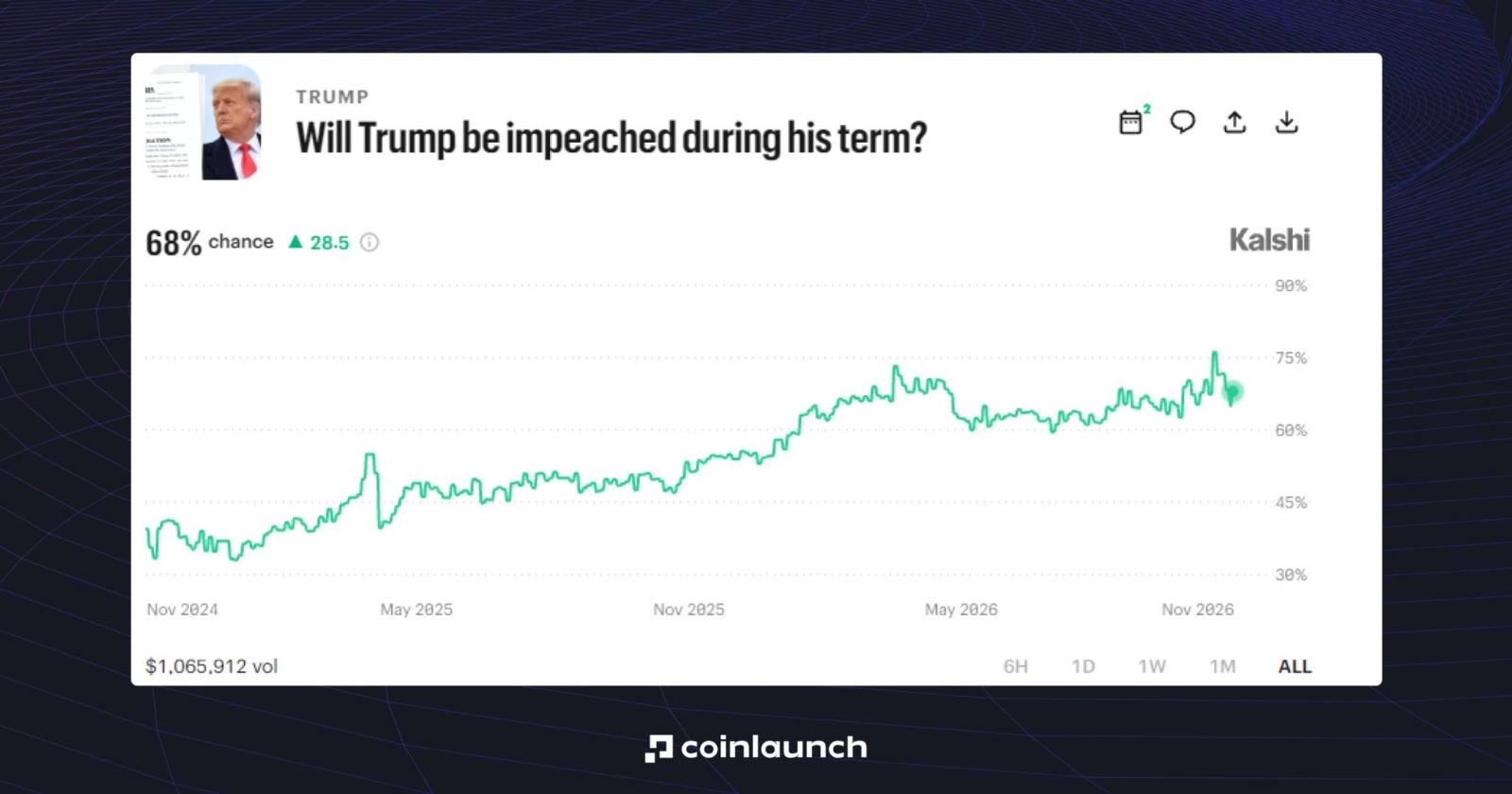
In October, prediction market traders weighed what a Democratic victory in November’s congressional elections could mean. The most popular bet in that context was “Will Trump Be Impeached during his term?” At one point, the Kalshi market showed an implied probability of 69%. That estimate covered the rest of his presidential term.
When comparing the odds of Trump impeachment, the contract’s terms matter. Impeachment means formally bringing charges through the House of Representatives, the lower chamber of Congress. Removal from office requires a separate decision by the Senate, the upper chamber, with a two-thirds majority of senators present. Any Trump impeachment 2026 odds must be tied to a specific deadline: The cited 69% did not represent the probability of impeachment by the end of 2026.
“Will Trump Be Impeached during his term?” contract chart. Source: kalshi.com
Political contracts are part of a growing market that lets participants trade on expectations about real-world events. According to Volume Race, October trading volume on Polymarket’s international platform reached$5.44 billion, up 25% month over month. This is notional volume: The number of contracts traded is multiplied by their $1 payout at settlement, so the figure exceeds the amount actually spent buying them.
Traders can profit from either a correct prediction or a shift in expectations. For example, a hypothetical “Yes” contract could be bought for $0.60 and sold for $0.75, yielding $0.15 before fees, if a buyer is available. There is no need to wait for impeachment itself. At settlement, a winning contract pays $1 and a losing contract pays $0.
Crypto Project Shutdowns in October 2026
Several crypto projects announced shutdowns or ended support for their products in October. For users, the consequences ranged from a website going offline to having to move assets off a network.
Blast. The team announced the Blast shutdown on Oct. 2, saying the Blast blockchain cost more to operate than it generated in revenue. The deadline for withdrawals through the regular interface was Oct. 26. After that date, users could still withdraw funds through the bridge contracts on Ethereum.
Abstract. The Ethereum L2’s team announced a wind-down on Oct. 6, citing stalled growth and thin liquidity. The network is scheduled to shut down on Dec. 15, 2026. The team warned users to move their assets before that date to avoid losing access to their funds.
Neon EVM. The project ended development, maintenance and technical support on Oct. 1. It set Dec. 31 as the deadline for asset migrations and withdrawals. The NEON token remained on Solana, but its future utility and continued exchange support were not guaranteed.
Blur. On Oct. 12, the NFT marketplace announced that its website would close on Nov. 12. Its lending service Blend stopped matching borrowers and lenders for new loans on that same November date. The trading protocol continued operating on Ethereum.
If even large, well-known projects can shut down, the risks facing smaller teams warrant even closer attention. The main takeaway for investors is diversification: it helps reduce a portfolio’s dependence on any single project.
Another potential trading strategy is to spot signs of a wind-down early and short the projects’ tokens. But a shutdown does not guarantee a price decline: the market may have already priced in the problems, and a sharp rebound can leave short sellers with losses.
Upcoming Crypto Catalysts: What to Expect From Crypto in November 2026
One potential technological catalyst for early 2027 is Glamsterdam, an Ethereum upgrade intended to prepare the mainnet to handle more transactions. Ethereum Institutional research identifies the start of the year as a possible launch window, but no date has been confirmed.
Some operations could cost more, however. The table below shows examples of fee changes under the current Glamsterdam proposal.
Operation
Gas today
Gas under the current draft
Cost today
Cost after, same gas price
Gas-price fall that offsets it, at unchanged ETH price
Simple ETH transfer to an existing account
21,000
21,000
0.7¢
0.7¢
None needed
ETH transfer that creates a new account
21,000
204,600
0.7¢
6.7¢
90%
USDC transfer to a first-time holder (reported Sepolia example)
62,760
153,921
2.0¢
5.0¢
59%
Code-deposit and account-creation components, 24 kB contract
About 4.9M
About 37.8M
$1.61
$12.31
87%
Higher throughput would let upcoming crypto projects in payments, trading and tokenization handle more transactions without congesting the network. That could make the growth of financial applications on Ethereum the next crypto narrative.
The launch itself depends on compatibility checks with existing software. The Ethereum Foundation said the proposed changes could break some applications. The next milestones to watch are the results of those checks, the resumption of testing and confirmation of the launch schedule.
Other dates to watch early in the year include Jan. 18, 2027, when the GENIUS Act’s stablecoin rules take effect, and the Fed meetings on Jan. 26-27 and March 16-17. The stablecoin rules will set the conditions for issuing digital dollars, and the Fed’s decisions will help assess whether high interest rates continue to weigh on crypto.
Crypto Market Summary: What October's Narratives Say About the Market
October’s crypto market recap shows that industry growth and crypto prices can move at different speeds. Banks expanded their use of blockchain and trading platforms recorded higher volumes, but most tokens lost value. Interest in crypto technology persisted without translating into broad demand for tokens.
Capital was unevenly distributed, too: A single large deal drove most of the recovery in venture funding. Impressive launches, funding rounds and trading volumes therefore need to be assessed in the context of the broader market.
For investors, the main lesson is to understand how progress in their chosen sector can translate into returns for them. A service’s popularity alone does not explain its token’s value. Investors need to know how they can make money from a specific project and what costs or losses they might face. October showed why product selection and trade terms matter more than simply following a popular narrative.