Speculations regarding “Altcoin Season” within the crypto sphere seem never to go away. Some regard it as the holy grail of cycles, while others write it off as a fiction. Everyone waits for it, and some profess they’ve seen glimpses of it, yet the evidence is as wispy as a mist. Alt Season, a fabled being, comes out of the blue. It reorganizes portfolios and ignites arguments across trading desks and Telegram channels.
Yet underneath the illusion is a very real economic force. Altcoin season is the stage of a cryptocurrency market cycle when capital flows from Bitcoin to other cryptocurrencies (including altcoins). As Bitcoin’s dominance fluctuates and capital is beginning to flow to new tokens, “altcoin season” may be just around the corner in 2025, especially with the anticipated rate cuts by the Fed and quantitative easing of the US economy.
In this guide, we explained what is alt season, how to spot it, how to make decisions based on data, and some alternatives to invest in. But for the beginning, let's start with the basics.
What Is an Altcoin?
The term altcoin is short for “alternative coin”. Altcoin refers to any cryptocurrency that is not Bitcoin. When Bitcoin launched in 2009, it was the sole game in town. By 2011, however, developers were starting to work on and experiment with new blockchains and new features, and altcoins potential began to increase, with Litecoin and Namecoin leading the way.
The current altcoin ecosystem has grown rapidly to tens of thousands of tokens. These projects range from serious infrastructure projects (Ethereum, Solana, Avalanche) to niche utility coins, stablecoins, governance tokens, meme coins, and even joke experiments. Some are designed to address a legitimate, real-world problem related to scaling, privacy, or payments; others are strictly speculative, fluctuating based on community hype or internet culture.
Why should investors care? It matters because altcoins in crypto usually have more risk and upside than Bitcoin. While BTC is becoming widely recognized as “digital gold”, altcoins act more like tech startups: being volatile, speculative, and experimental, that can deliver 10x or even 100x gains given the right conditions in the market.
In short, crypto altcoins are the engine of innovation in crypto. And when the market starts to behave favorably toward altcoins, this is what is known as altcoin season.
What Is the Altcoin Season?
Altcoin season is a phase of the cryptocurrency market cycle where altcoins significantly outperform Bitcoin for an extended period. Instead of Bitcoin getting all the headlines and capital, money that used to flow into Bitcoin now gets shifted into alternative cryptocurrencies.
The pattern goes something like this:
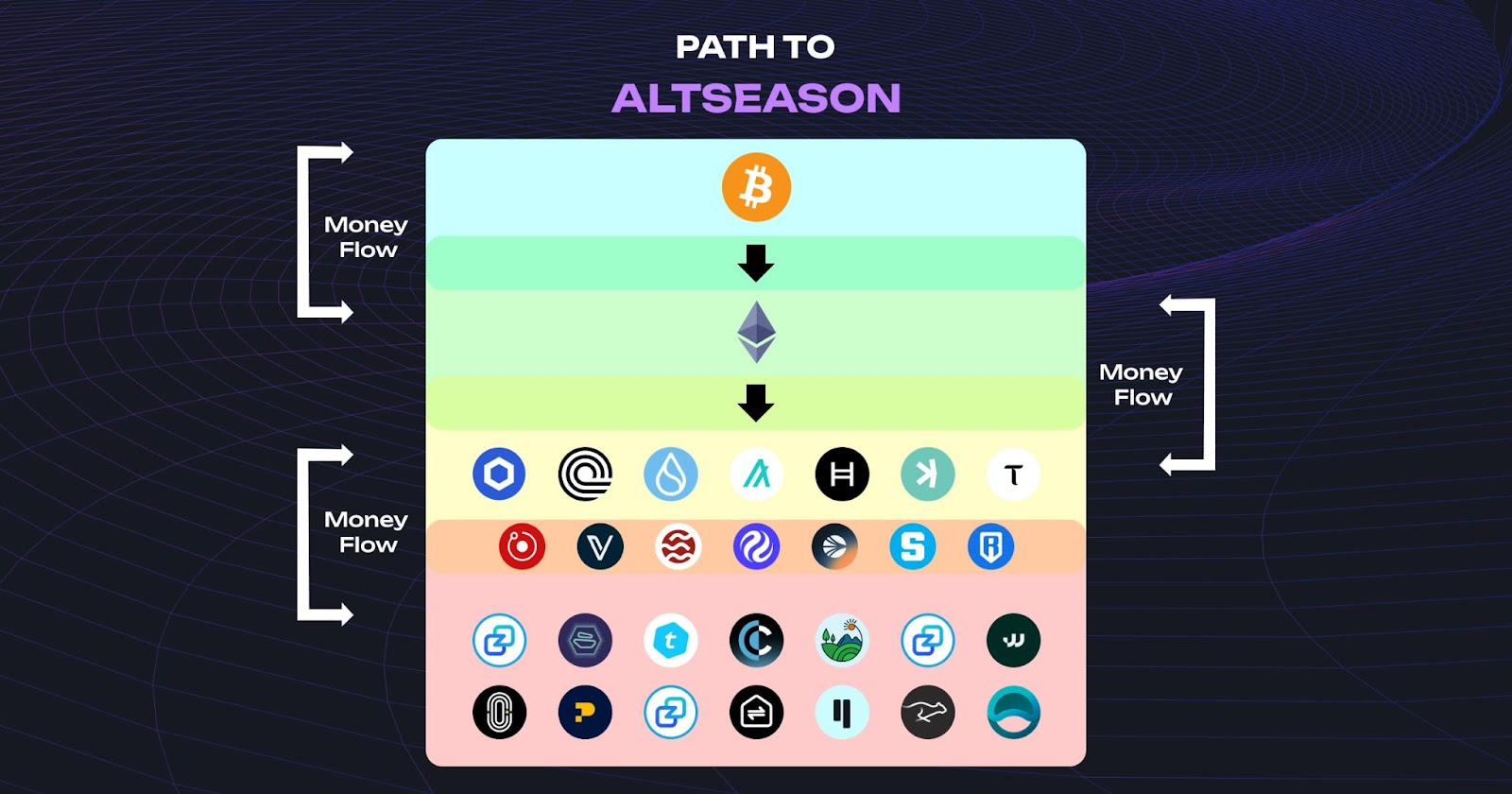
- Bitcoin pumps first. Historically, every bull run starts with a spike in Bitcoin price, liquidity and market cap, from where all other coins derive their value. This attracts institutional investment into Bitcoin, and this allows BTC to set new all-time highs and instills trust into the market.
- BTC cools off. Once BTC goes sideways or consolidates, traders start to fix profits and look elsewhere for higher returns fast.
- Capital rotates into altcoins. Projects that have more than an academic narrative, incorporate new technology, or generate community-driven hype begin to gain momentum. Oftentimes, this is where these beginner investors will see gains of 5x, 10x, and sometimes even gains of 100x. However, it’s crucial to spot the right opportunities while avoiding scams and rugs.
- Speculation. Near the peak of altcoin season, even the worst coins or meme tokens with no value based on fundamentals will strongly rally, simply due to momentum and retail FOMO.
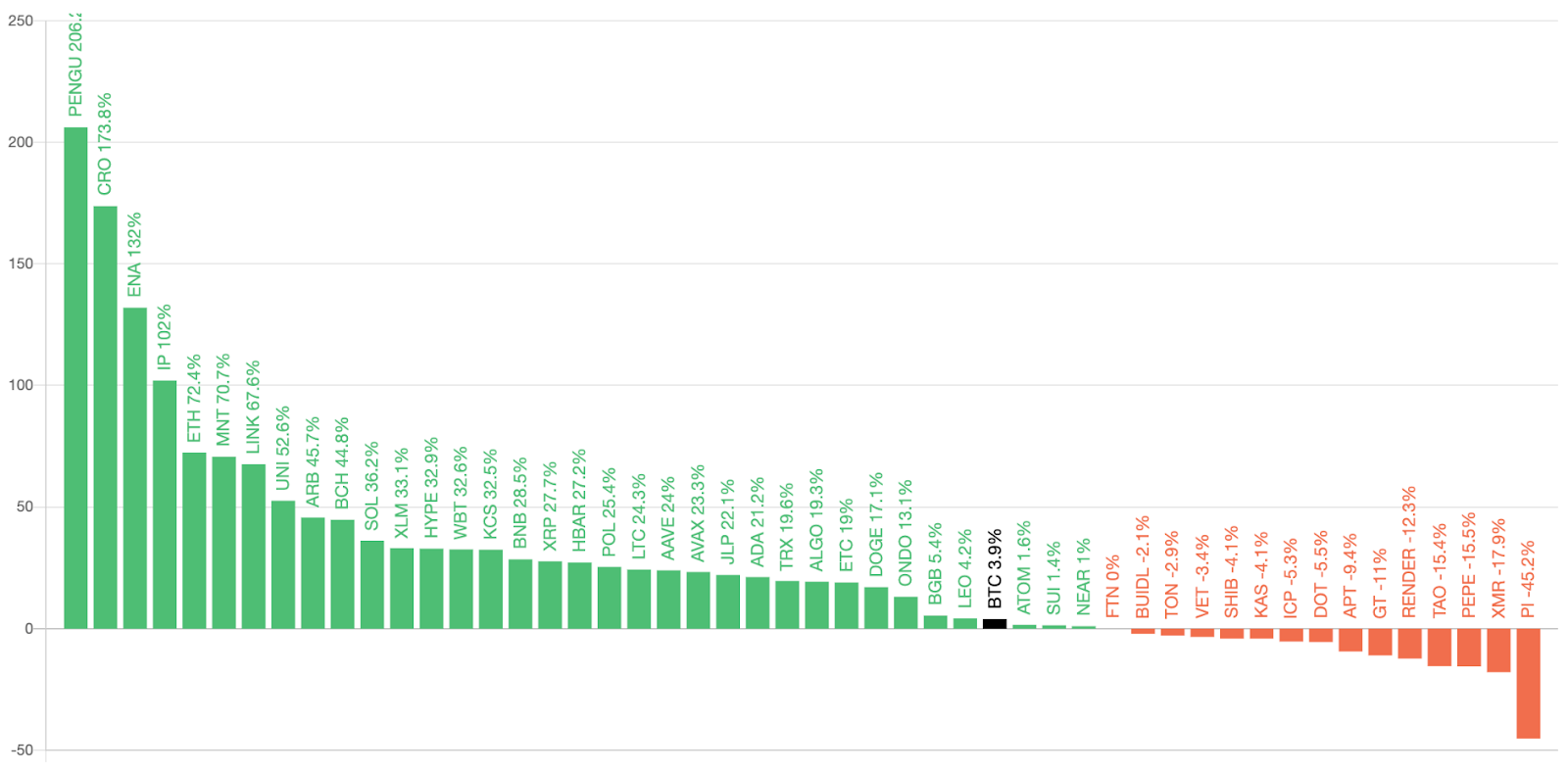
Top 50 Performance over the last season (Source: blockchaincenter.net)
In other words, what is alt season in crypto? It is less about fundamentals for coins and more about capital rotation, where momentum and human psychology take the lead. It’s like the gold rush in crypto; watch out because you can also lose everything very quickly.
Key Indicators to Watch for Altcoin Season
One of the most challenging aspects of investing in cryptocurrency is determining when to enter or exit the market, particularly recognizing the key signals to be aware of when altcoin season arrives. Here is what triggers altcoin season:
- Bitcoin dominance. Bitcoin dominance is something to track over time, as it typically experiences a significant decrease in size as altcoins gain ground. You should keep an eye on the Bitcoin Domination index on CoinMarketCap or other valuable resources.
- High volatility in the market. A sudden spike in volatility typically indicates that something significant is about to occur. Of course, volatility usually breeds volatility, so it’s essential to treat it with caution.
- Market sentiment. Survey tools, sentiment-measuring tools on social networks and forums (such as CMC Fear and Greed Index), can provide a clearer picture of the market’s general sentiment. It is usually a good sign if the market has negative sentiment, as an altcoin season might be on the way.
- Technical analysis. Indicators such as moving averages, Bollinger Bands, and the RSI can also provide clues as to whether an altcoin season is on the way. Of course, no indicator is perfect, so you should use them in conjunction to define the market cycle and trend.
- News Events. Stay vigilant for news items that could impact the cryptocurrency market. For example, news of positive regulations or new projects beginning could generate interest in altcoins.
- Season Index. There are even some websites with an “altcoin season index” (such as Blockchain Center), which considers multiple aspects to determine whether an altcoin season is likely. The index can be helpful, but it should never be the sole deciding factor in making a decision.
As a recap, you can never be sure when an altcoin season will begin, but observing these altcoin signals and performing due diligence can set you up for success.
What Does the Altcoin Season Index Indicate?
One of the most widely used methods traders utilize to gauge altcoin season is through the use of the Altcoin Season Index (developed by Blockchain Center). The index provides a clear and data-driven methodology to help determine whether altcoins are actually outperforming Bitcoin.
The index compares the performance of the top 50 altcoins to the performance of BTC in a rolling 90-day window. If 75% of those altcoins outperform BTC, the index states we are in Altcoin Season. If those altcoins generate less than 25% of the returns that outperform BTC, then it is determined to be a Bitcoin Season. Anything in between is classified as neutral or transitional.
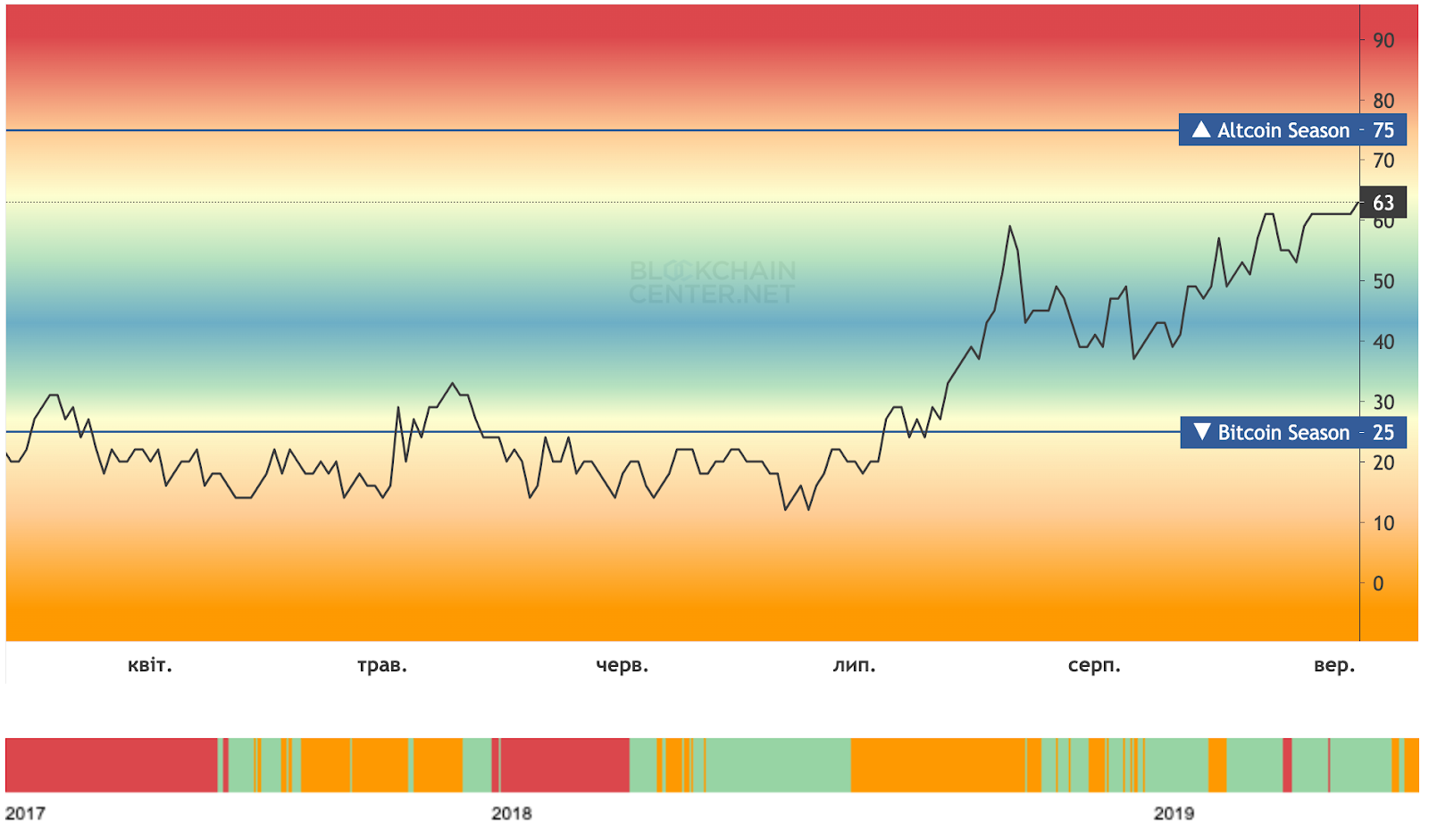
Altcoin Season Index History (Source: blockchaincenter.net)
The altseason index cuts through all the noise and hype with a model based solely on relative performance. Instead of needing to guess if the excitement surrounding a new coin justifies altseason, traders can use a single chart to substantiate the trend.
Alternative Coins to Buy for the Altseason
Every altcoin season has its winners as well as its memes. In 2017, we had Ethereum and XRP. In 2021, we had Solana, Shiba Inu, and infinite DeFi tokens. In 2025, there is another round of fledgling projects (both serious and silly) that have come to light.
The four coins below have the potential to become the next altseason tokens. This is not financial advice, just an overview of potential movers worth watching.
1. goodcryptoX
Another option for an altcoin season is $GOOD. This is the token of goodcryptoX, a hybrid trading terminal and bot platform that connects CEXs and DEXs across five major blockchains. With 400k users and $5B+ trading volume, it brings CEX-level algorithmic bots (like DCA and Grid) directly to decentralized markets.
$GOOD has grown steadily and deliberately. After launching on Solana in May and using Jupiter for routing, daily volumes jumped from $366K in March to $3.4M by July. That’s a ninefold increase, all achieved quietly. Half (50%) of DEX revenue goes directly to token holders with no lock-up, and another 10% is used for buy-back-and-burn. This setup ensures that every transaction helps reduce the total supply.
However, the biggest changes are still ahead. Integrating with perpetuals DEXs and launching top-performing CEX bots are coming soon. What we see now is just the beginning.
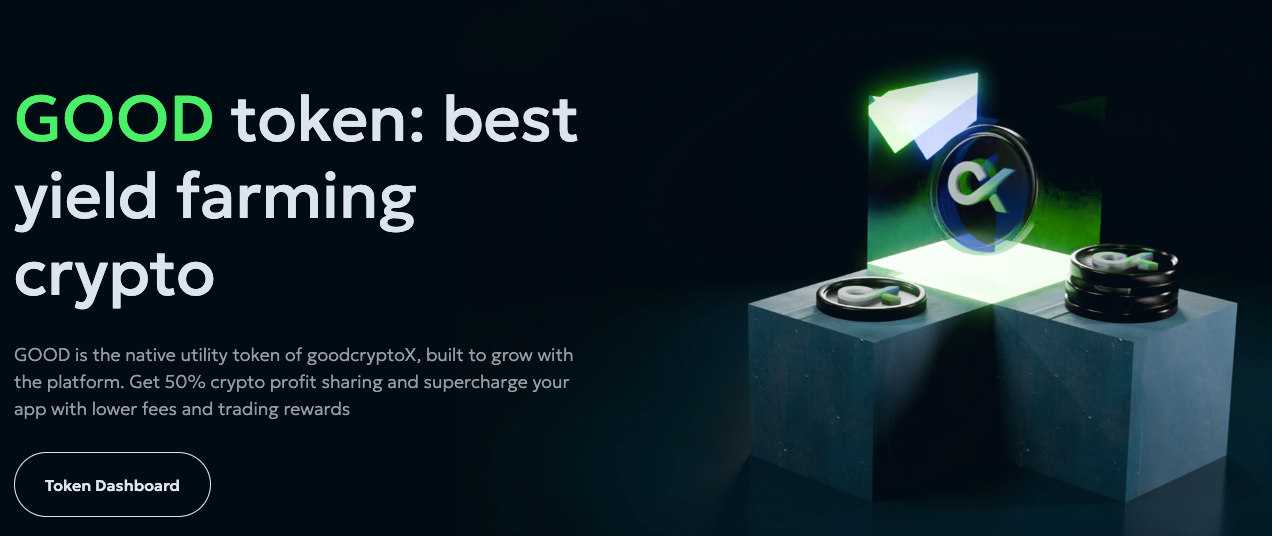
Supported across the major chains (Solana, Ethereum, Base, Arbitrum, and BNB Chain) with multi-chain support in progress, $GOOD is all-purpose in capturing trading fees wherever the liquidity is going to flow next.
$GOOD, just three days after debut, has demonstrated its power with an incredible x6 jump from the listing price, and then, it reached x8.3 during the first week. The strong community engagement is an early indicator and a signal of growing market confidence. A DEXScreener data on the Solana on-chain activity suggests $GOOD is rapidly gaining momentum. Liquidity is available on Raydium, where people can easily exchange the token.
Trading $GOOD is also available on goodcryptoX, making it convenient for traders to watch, control, and manage their positions.
This initial period of success conveys the excitement of $GOOD and places the token in a position to become one of the highlights of this cycle.
2. Hyperliquid Token

Hyperliquid is a blockchain-powered derivatives exchange. It operates on its own high-performance Layer 1 network, keeping products such as perpetuals, options, and leveraged products on the same chain, thereby eliminating centralized custody risk. This setup offers the convenience of centralized exchanges with the security of users' own wallets. In August 2025, the platform reached nearly $357B in derivatives trading volume and raised about $105M in fees, which were distributed to buy backs of the HYPE token. As a result, HYPE soared to new heights, making Hyperliquid the largest on-chain venue for crypto derivatives.
Leveraged trading often surges during altcoin seasons, and Hyperliquid has taken full advantage of these active periods. The platform is now the biggest player in the DeFi perpetuals market, backing up the excitement around speculation with real trading volume.
A key feature of Hyperliquid is that its tokenomics return protocol revenue to token holders. Recent data shows that about 92 to 97 percent of trading fees are used for programmed HYPE token buybacks, which helps create ongoing demand and makes the token partially deflationary. The total value of these buybacks has now passed $1.25 billion. However, some analysts are debating whether this buyback model can remain sustainable over the long term.
Liquidity providers can put funds into the Hyperliquidity Provider (HLP) vault, which acts as a market-making pool. This vault distributes profits and losses to depositors and receives a smaller share of fees after buybacks. HLP has attracted significant total value locked and offers returns that reflect the strategy's performance. Liquid wrappers, such as wHLP or ecosystem integrations, can represent a depositor's claim, so deposit earnings come from vault yield. This setup allows large and experienced liquidity providers to add funds as trading activity increases, while keeping returns tied to actual market-making results.
3. Zephyr
Zephyr is a Solana-based prediction-market dApp with an ongoing TGE of the project, collecting $712k at the Zephyr coin price of $0.008. This platform also operates a $ZEFY token.
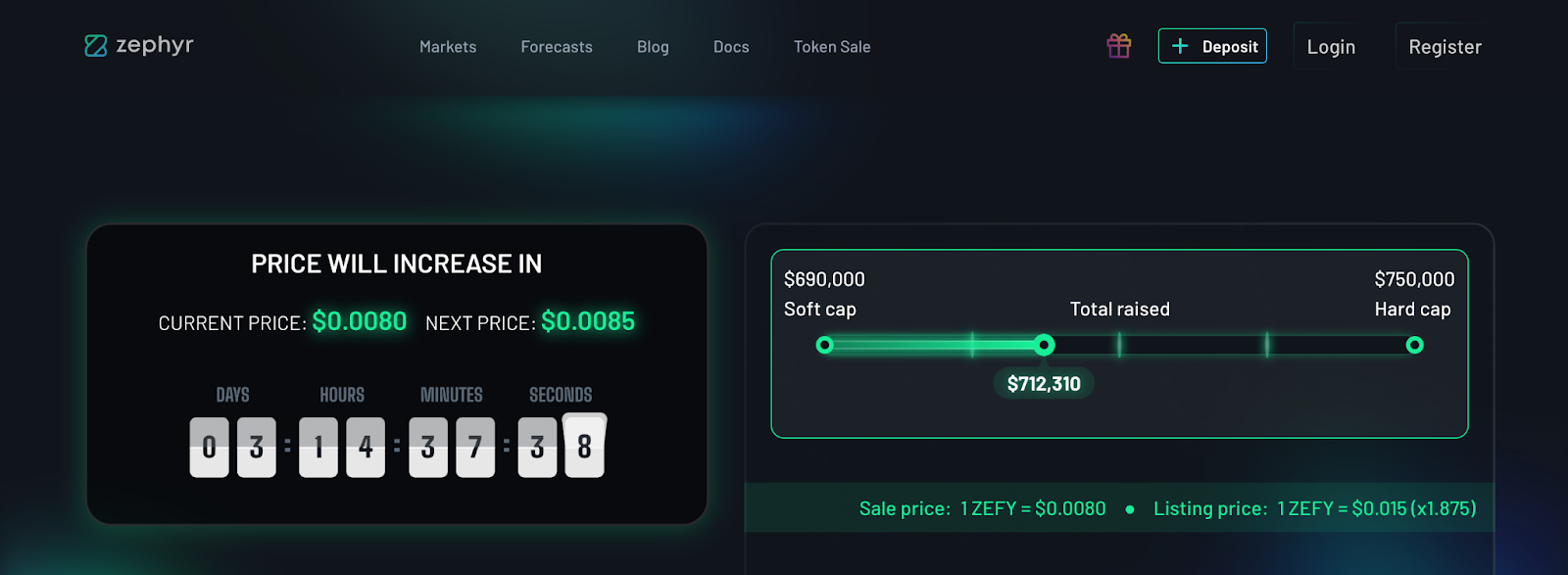
As of now, the Zephyr team is in talks with two CEXs on the CoinLaunch AMA. Moreover, a new Telegram bot with all the platform functionality integrated surged user growth. It offers a $5 gift to place predictions and continue earning for each sign-up.
4. Pengu Coin
Pengu is firmly the next meme coin to explode, with evidence supporting this. Data and on-chain figures show a large and growing base: about 545,000 holders on Solana pairs, daily trading volume of $617M, and a market cap of $2.39B. This token did not just go viral suddenly. It carries the Pudgy Penguins brand, which had over 50 billion social views and mainstream reach before the token, allowing it to launch with significant awareness.
The community and culture have grown thanks to key partnerships and the latest Pengu coin news. Pudgy Toys first appeared in 2,000 Walmart stores in September 2023 and later expanded to 3,100 locations across the U.S. in 2024. The toys have also performed well at Target and reached top spots on Amazon, showing strong demand. Each toy comes with a QR code that links to Pudgy World, helping the community connect beyond just crypto. On the token side, Pengu launched on Solana with a major airdrop, and the team has suggested future uses in gaming and across different blockchains.
As you can see, meme coins are cryptos that will explode during altseason because they are inexpensive, relatable, and easy for new investors to get behind.
5. Fartcoin Crypto

That’s right, Fartcoin. Even though it’s meant as a joke, the numbers are serious. Live trackers show its price is around $0.91, with a 24-hour trade volume of $145.3M and a market cap of $913.7M. Community data backs this up, with over 110,000 holders and ongoing distribution campaigns.
Changes in listings have also made a difference. A news report hinted at a June 12, 2025, Coinbase roadmap event, and explainers are tracking its late-2024 Solana launch and Pump.fun-style viral growth. This is the new, typical meme story. Remember Dogecoin? It started as a parody and became a multi-billion-dollar asset with its own U.S. ETF (DOJE). In the same way, retail FOMO can turn something silly into something real.
The community and partnerships also play a big role. Fartcoin embraces internet culture, TikTok challenges, influencer memes, and even eco-friendly collaborations, such as planting one tree for every 1,000 FART tokens minted. It’s definitely kitschy, but that helps the brand reach beyond just crypto enthusiasts. If the 2025 altseason unfolds as expected, the next big headlines will likely come from exchange news or brand partnerships, powered by the community’s meme-driven energy.
When Will Altcoin Season Start in the 2025 Bull Run?
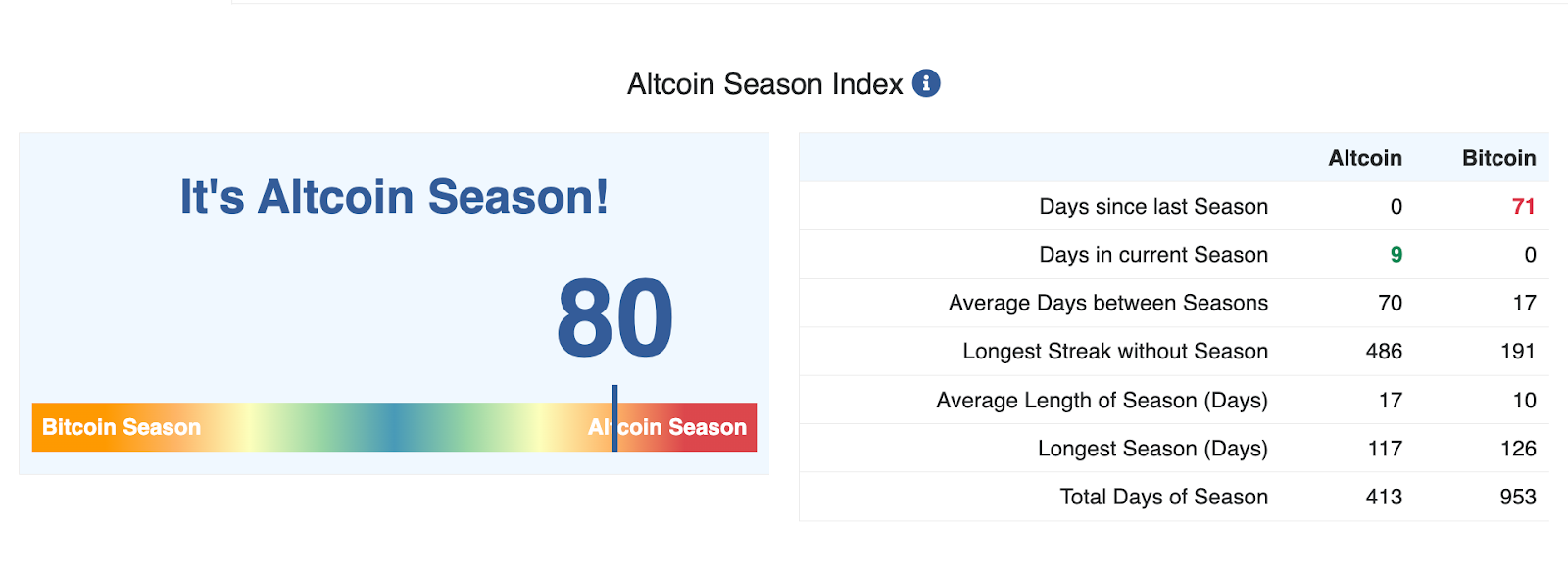
Altcoin Season Index by Blockchain Center is at 80/100 (Altcoin Season), indicating a high performance of altcoins relative to Bitcoin. It has crossed 75 and entered “Altcoin Season”.
Altcoin Season Index (Source: blockchaincenter.net)
Let’s look at key market signals.
- Altcoin Season Index: 80/100 (Altcoin Season)
- BTC Dominance: 57.1% (−1.87 pts, 24h); down from recent highs, indicating capital rotation
- ETH Momentum: +0,1% in the past 7 days
- BTC Ecosystem Buzz: Tether’s RGB integration has triggered 15–25% pops in ecosystem tokens like Stacks (STX)
What does it mean? Altcoins are making solid moves, and they have begun to dominate and start another crypto season. Meanwhile, ETH, SOL, and DeFi tokens are seeing inflows. With BTC dominance at around 58%, there is still space for altcoins, but if BTC drops to 55-56%, we can expect a broader rotation. Sector-specific sparks continue to generate quick speculative spikes (e.g., RGB protocol hype).
We are not in Altcoin Season yet, but the neutral level for the index and strength in $ETH indicate the beginning of a shift into Q3 2025. If BTC continues to consolidate and BTC still loses dominance percentage, the true next Altcoin Season will bloom in no time.
Pros and Cons of Investing during Altcoin Season
The phrase “altcoin season” is often understood to mean the wild west or, arguably, the most volatile segment of crypto investing. You have unlimited upside, but you also have unlimited risk. Before you jump in with both feet, it’s worth considering the upside and the potential downside of investing in altcoins for the next bull run.
Pros
Tremendous upside potential
Altcoins can deliver multiples that exceed those of Bitcoin. In fact, at previous market cycle peaks, some top-performing tokens achieve returns of 10x–100x within a few short months. For example, DOGE price has soared an astounding 12,000% in 5 months between January 2021 and May 2021, as retail mania peaked around Musk/SNL headlines. BONK was also a notable grower, achieving a +1,000% increase in 30 days between November 2023 and December 2023, during Solana’s risk-on burst and major exchange listings.
Access to innovative technologies
Many altcoins are representative of new technologies, ecosystems, and narratives (such as base memecoins, Solana memecoins, AI tokens, and gaming). If you get in on it before they become widely known, it feels like investing in a start-up before people recognize its potential.
Community and culture
Altcoins, and especially meme coin communities, build on the appreciation for the grassroots hype and energy of the community. The memes and community can play into creating unstoppable positive self-fulfilling cycles, just like PEPE crossed $1B in market cap within the first three weeks of launch.
Portfolio diversification
The greater the number of altcoins you invest in, the more diversified your exposure to different crypto niches, and you avoid relying solely on Bitcoin or Ethereum.
It’s also a good idea to spread your investments across different areas. You might consider options like L1 or L2 infrastructure, DeFi projects, AI and data, real-world assets, gaming or NFTs, memecoins, and oracle or interoperability solutions. Try to include a mix of large, mid, and small market-cap coins, set limits for each position, and review your portfolio every quarter. For example, you could allocate 20% to L2s, 20% to DeFi, 15% to infrastructure or tools, 15% to AI or data, 10% to gaming, 10% to real-world assets, and 10% to memecoins.
Cons
Extreme volatility
Prices of altcoins can move by 30-50% in a day. It is famously challenging to time entries and exits, with losses occurring as quickly as gains. Among the examples, we should mention PEPE spiked ~35–40% over May 8–9, 2025, WIF jumped ~35% in 24h on March 13, 2024, amid the Sphere fundraiser hype, and BONK plunged 31% in a single day on December 15, 2023.
Highest risk of scams
Pump and dumps, rug pulls, and fake projects abound in altseason. Not all coins with hype have a future. For example, the $SQUID token dropped to almost zero after the developers extracted around $3 million from the project in November 2021.
Low liquidity
Many altcoins have shallow order books that can lead to large orders crashing prices immediately. Small caps carry particular risk.
Regulatory uncertainty
Governments around the world are still figuring out their stance on crypto. One regulation, or one lawsuit, could tank a project overnight. In June 2023, the SEC sued Coinbase. After that, Robinhood had delisted SOL/ADA/MATIC, which were mentioned in the lawsuits.
Emotional traps
FOMO and greed are much of what drives the altcoin season. New investors often buy at the top and sell at the bottom, falling prey to this psychological trap.
History of Past Altcoin Seasons
Past altcoin seasons have demonstrated how quickly markets can change, with some tokens displaying explosive gains in shorter timeframes.
Two of the more famous examples are the cycles of 2017–2018 and 2020–2021.
The 2017–2018 alt season occurred alongside a sharp drop in Bitcoin’s market dominance, which fell from 86.3% in late 2017 to just 38.69%. At that time, Bitcoin itself fell from its then-record high of just over $20,000 to below $6,000 in just a few months.
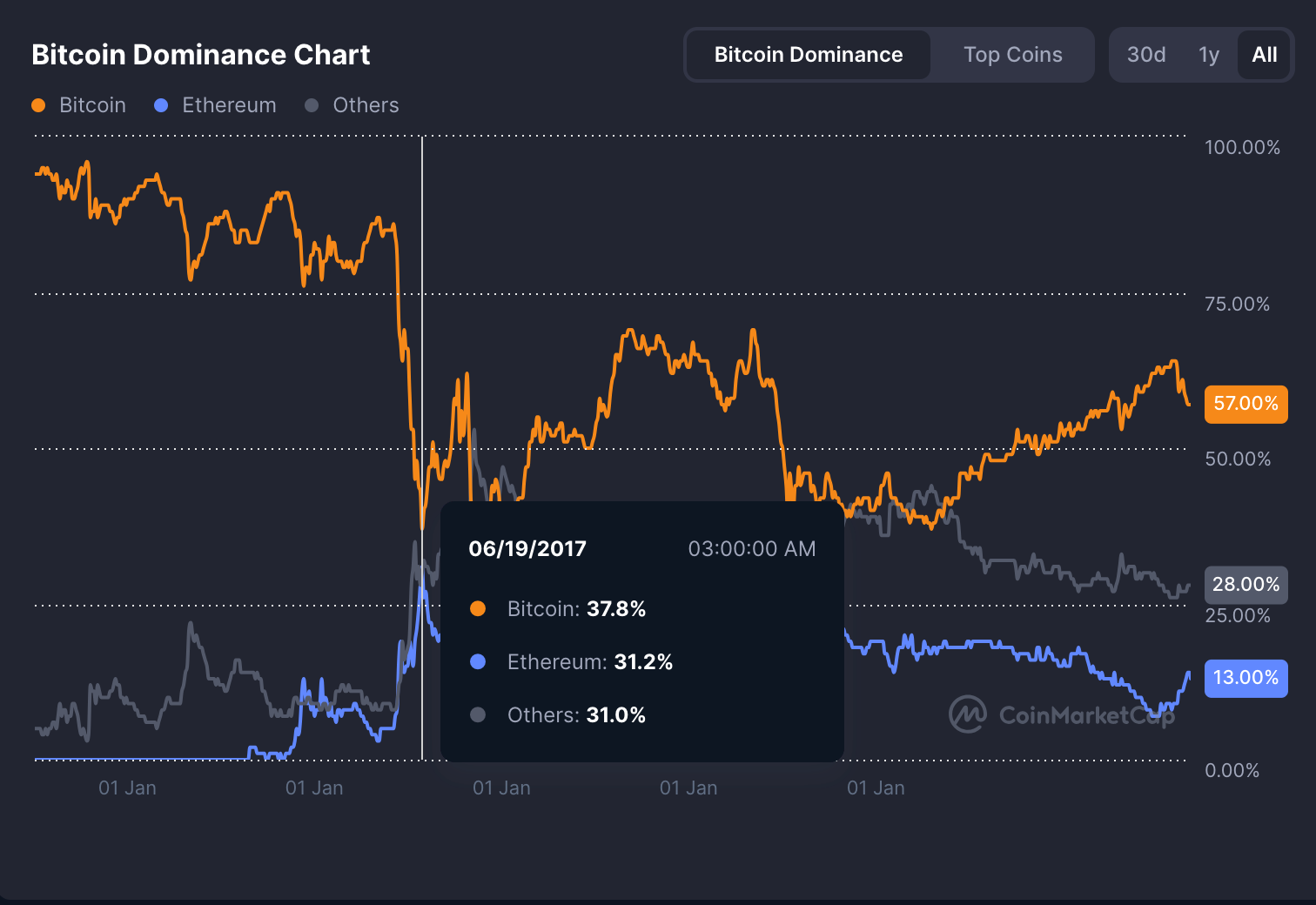
Bitcoin Dominance Chart 2017–2018 (Source: CoinMarketCap)
At the same time as declines in Bitcoin and dominance, altcoins were rising during the peak of the initial coin offering (ICO) boom, with dozens of new blockchain projects launching tokens through ICOs. Investors were eager for new assets, and this created explosive price rallies across the board.
The last altcoin season emerged in 2020–2021, during the peak of the global pandemic, when investors once again looked beyond Bitcoin and became open to new narratives. This is when the meme coin and DeFi boom occurred, with Dogecoin and Shiba Inu making mainstream and historic gains.
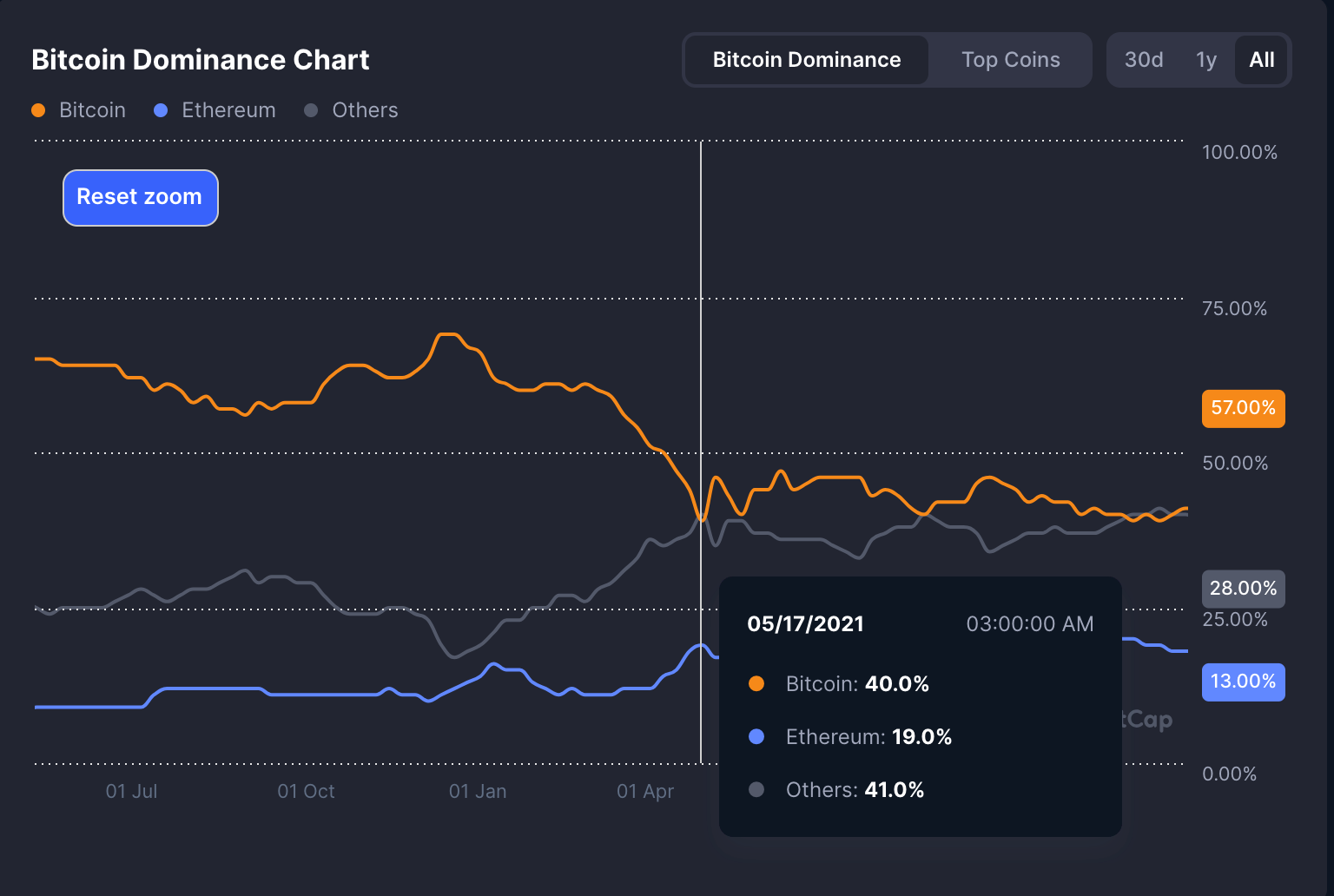
Bitcoin Dominance Chart 2021 (Source: CoinMarketCap)
At the same time, the massive NFT wave also converged, adding new energy to the ecosystems of decentralized applications and facilitating improvements in all alt market sentiment. Bitcoin’s dominance once again plummeted from 70% to 38% and the total crypto market share of altcoins doubled from 30% to 62%. The altcoin season index hit a remarkable 98 on April 16, 2021, highlighting how much alts had taken over at that moment.
As of now, we can spot the beginning of a new Alt season in crypto. Despite Bitcoin’s dominance at the 57.1% level, Ethereum and other alts hold 42,9% of the crypto market.
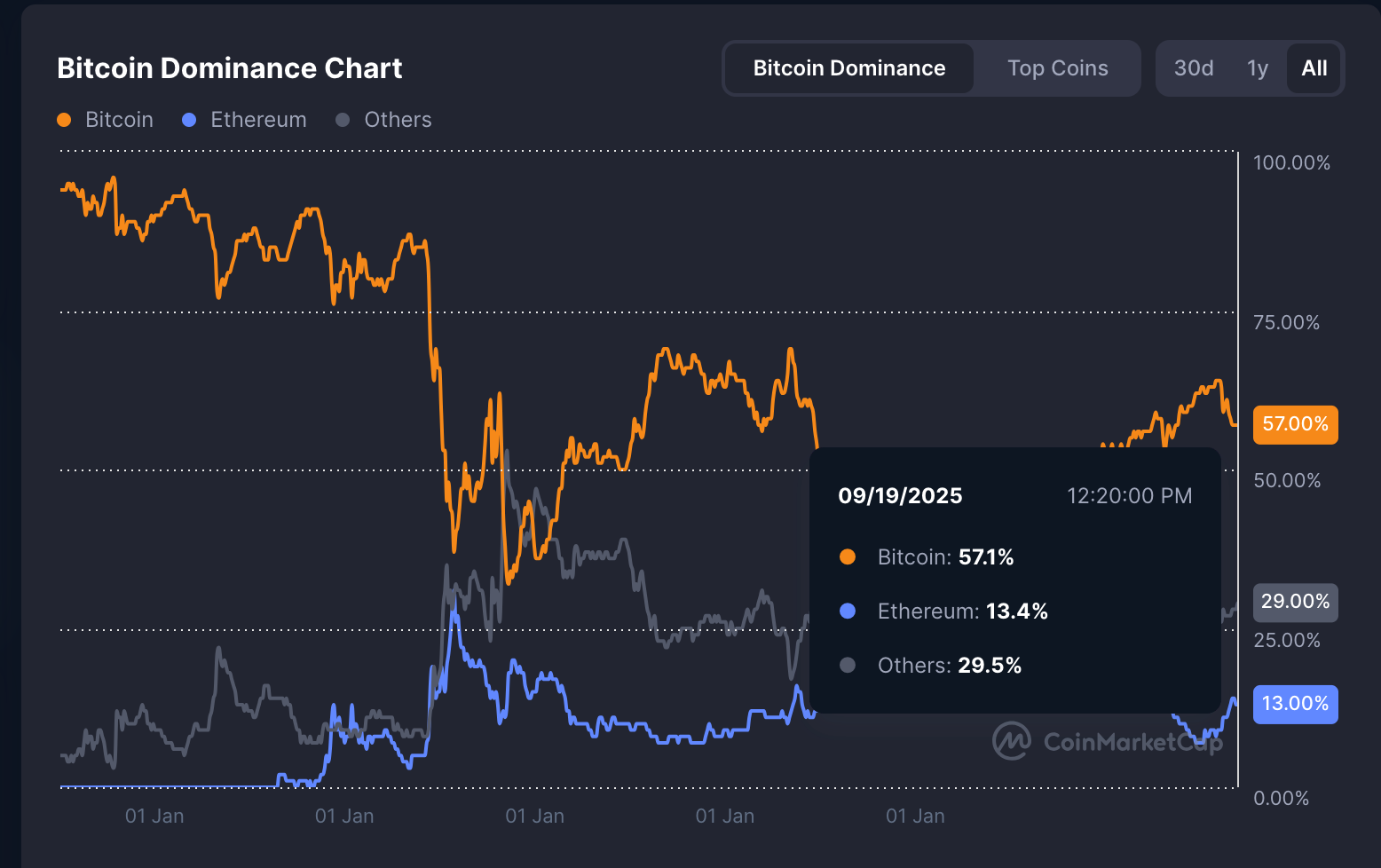
The entire trend of altcoins has been rising for the past four consecutive weeks, according to Benjamin Cowen. The Fed rate cut and increasing interest in alts from treasury companies also have an impact on alternative crypto assets.
What’s more, the SEC is currently reviewing more than 90 exchange-traded products, including altcoin applications for cryptocurrencies such as Solana, XRP, and Litecoin. Despite the deadline being around mid-October, there is a high chance of approval for major crypto coins. All these aspects are considered the fuel for the upcoming altcoin season.
How to Take Advantage of the Altcoin Season
Identifying high-potential plays before the altcoin season gets into full swing is vital. Here’s some information for you:
- Do your research and diversify
Take the time to scrutinize and identify the most promising altcoins. A diversified portfolio helps spread the risk and increase the chances of returns, so you are not risking everything on a single token.
Use technical analysis and tools such as support and resistance levels or RSI to determine entries and exits. These signals are particularly useful in alt seasons, as they provide hints about price action and market sentiment before deploying any capital.
- Get early access to new alts
Obtaining presales or early launches can put you in a first-mover position. The earlier you get into strong projects at a discount, the greater the long-term upside often is. If you want to spot the next big mover before the crowd, Coinlaunch provides a front-row seat to presales, early listings, and hidden gems across every crypto sector.
Final Thoughts
As Q3 2025 begins, the crypto market seems poised for a seismic shift. Ethereum’s continued innovations fuel optimism, leading to a savings rally that will drive the next bull run across the space. This could make the mid-part of Q3 2025 a decisive moment that may reinvent the overall movement of an entire industry.
FAQs
- What is the Altcoin Season Index?
The Altcoin Season Index measures altcoin activity relative to Bitcoin over a specified period, ranging from 30 to 90 days. Higher scores generally indicate that the majority of altcoins are performing better than Bitcoin. The Altcoin Season Index will help traders identify when altcoins are favored over Bitcoin and when potential opportunities for profits are available in the market. - How can I predict an Altcoin Season?
Predicting an alt season is a combination of cycles, sentiment, and historical trends. Several indicators to watch for may signal an altcoin season, including a downward-trending BTC dominance curve, a shift in trading volume, and increased inflows into smaller-coin assets. Additionally, observing movements from the Altcoin Season Index, on-chain data, and technical indicators can also signal a return of interest to altcoins. - What is the Altcoin Season Index chart?
The Altcoin Season Index chart visually presents how altcoins have performed relative to Bitcoin, measured in time periods. Typical sharp spikes on the curve indicate periods when the majority of altcoins are outperforming BTC. By gauging the trends behind these sharp spikes in the Altcoin Season Index chart, traders can better identify times when it is beneficial to switch from Bitcoin to altcoin trading. - Is the Altcoin Season over?
Periods of altcoin seasons tend to end when Bitcoin dominance starts to climb or when we begin to see drops in altcoin prices and volume. Remember: not all alt seasons will end at the same time. With different market conditions, it is possible to see several new alt seasons emerge. - How long is an Altcoin Season?
The average length of an Altcoin season is 17 days, while the longest registered season lasted 117 days. Their duration is determined by many factors like Bitcoin’s price movement, market sentiment, and real-world situations. There is no predefined duration; each cycle is unique. - Is an Altcoin Season guaranteed?
No. Altcoin seasons do not happen on a schedule. The length of an altcoin season depends on how Bitcoin’s dominance reacts, the amount of liquidity that shifts to altcoins, and larger outside market movements. At times, cycles may even completely skip a strong alt season. - How does an Altcoin Season happen?
An altcoin season occurs when liquidity exits Bitcoin and comes into altcoins, pushing their prices higher. As traders chase bigger returns and Bitcoin’s dominance declines, smaller-cap assets experience a more accelerated and growing price. Hype, adoption, and higher activity rates on altcoin networks add to the trend.