HYPE has become one of the most talked-about tokens of 2026. The HYPE crypto price has outperformed the market: on June 16, the token hit a new all-time high (ATH) and has posted a return of about 275% year-to-date. By comparison, BTC fell by about 40% over the same period. That is why the Hyperliquid price is now being discussed not just as another strong token, but as a narrative in its own right.
In this article, we’ll conduct a Hyperliquid price analysis without trying to predict its future price. First, we’ll look at the Hyperliquid current price and identify the key levels on the chart. Then we’ll go over the main factors: spot HYPE ETFs, Coinbase and USDC, AQA v2, Hyperliquid Strategies, HIP-4, revenue, and buybacks.
HYPE Price Today: Where Is Hyperliquid Now
At the time of writing, HYPE is trading around $70.6. On the 4-hour chart, the Hyperliquid price remains in an uptrend that began on June 25. The most recent surge occurred on July 2, after which HYPE approached the area of significant swing highs around $71.4.
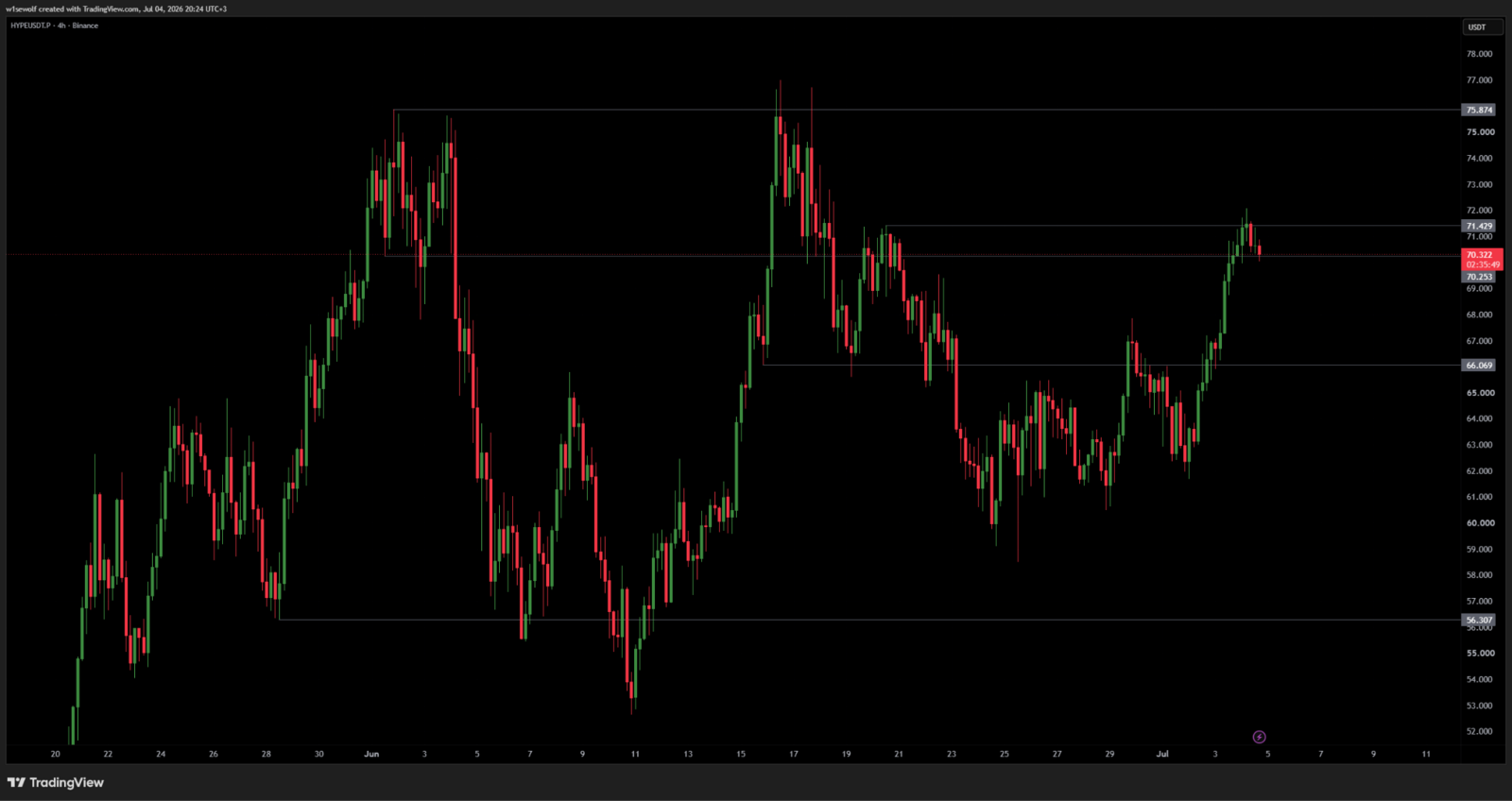
HYPE price chart on the H4 timeframe. Source: tradingview.com
For HYPE crypto price today, this is the nearest key area. The price has already broken above the local levels seen at the end of June, but has not yet reached the upper boundary of the broader range. On the D1 chart, HYPE is still trading within the sideways range that formed before the previous ATH was updated. The lower boundary of the range is around $56.3, and the upper boundary is around $75.8.
Therefore, the Hyperliquid current price is closer to the upper end of the range, but still inside it. For the price structure to change, HYPE needs to hold above $75.8. Until that happens, the Hyperliquid chart shows a recovery within the previous sideways range, rather than a full breakout into a new range.
HYPE Pros and Cons: Key Factors to Watch
Our analysts are no strangers to Hyperliquid price analysis, having previously published a report on the project that scored a 98/100. Since then, the project’s growth trajectory has accelerated, marked by the launch of a HYPE ETF and Coinbase becoming the official USDC treasury deployer, alongside other developments covered in this article.
The current Hyperliquid overview stands as follows:
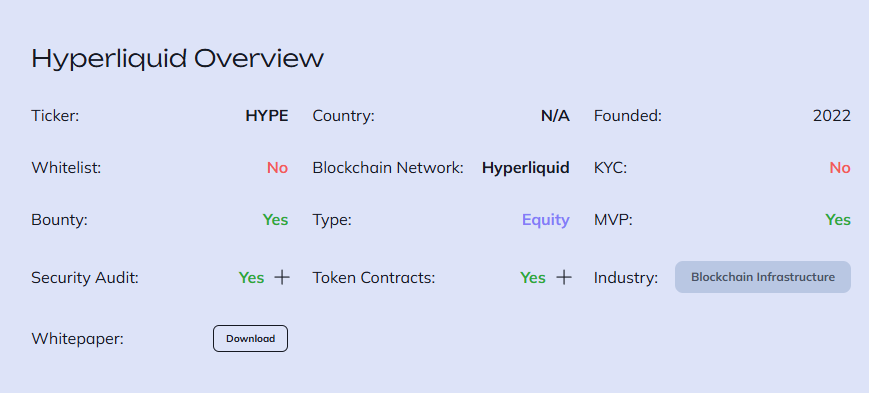
✅ HYPE pros:
- Hyperliquid remains the largest perpetual DEX: its 30-day perpetual trading volume is approximately $237 billion, compared with $58 billion for Aster and $45 billion for Lighter.
- The revenue model is tied to the HYPE token: 99% of fees from perpetuals and spot trading go to the Assistance Fund to buy HYPE.
- Coinbase has become the official treasury deployer for USDC on Hyperliquid, while AQA v2 is set to channel revenue from USDC reserves into the Assistance Fund.
- Hyperliquid Strategies has become a public proxy for HYPE: the company holds 29 million HYPE, and the value of its digital assets is approximately $2.07 billion.
- HIP-4 has added outcome markets to the Hyperliquid ecosystem: these markets operate in the same environment as spot and perps.
❌ HYPE cons:
- HIP-4 is still significantly smaller than its prediction-market competitors: its weekly volume is about $79 million, compared with over $1 billion for Polymarket.
- The impact of AQA v2 is not yet fully reflected in actual cash flows: interest accrual on USDC reserves is scheduled for August 26, and the first payment to the Assistance Fund is scheduled for October 3.
- The public-market proxy through Hyperliquid Strategies is not trading at a premium: the PURR multiple relative to adjusted NAV is 0.92x. In other words, investors are not yet paying more than the estimated asset value to access HYPE through the publicly traded stock.
Latest Hyperliquid News: What Is Moving HYPE
The latest Hyperliquid news is tied to several developments at once: demand through spot HYPE ETFs, Coinbase’s role as the official USDC treasury deployer, the launch of AQA v2, the accumulation of HYPE on Hyperliquid Strategies’ balance sheet, and the release of HIP-4. These events are important not for a HYPE price prediction, but for understanding the factors driving the current movement of the HYPE crypto price.
The main driver behind the HYPE rally was the growth of HIP-3 markets, led by TradeXYZ. Winter saw a sharp spike in silver trading volumes, which boosted Hyperliquid's activity and revenue, giving the token fresh momentum.
Another factor is the integration of Hyperliquid perpetuals into wallets and third-party apps. This simplifies trading access for millions of users, generates over $2 million in monthly revenue for builders, and expands Hyperliquid's footprint beyond its own platform.
Next, we’ll examine other factors separately.
Spot HYPE ETFs Brought Institutional Demand
In May 2026, HYPE gained traction in the U.S. ETF market. On May 12, 21Shares launched THYP and TXXH, describing them as the first U.S. ETFs to track Hyperliquid. Three days later, Bitwise listed BHYP on the NYSE. On June 3, Grayscale entered the market with HYPG on Nasdaq.
As of July 2, total net assets across spot HYPE ETFs reached $336 million. The strongest week was the week ending June 26, when weekly net inflows totaled $111 million.
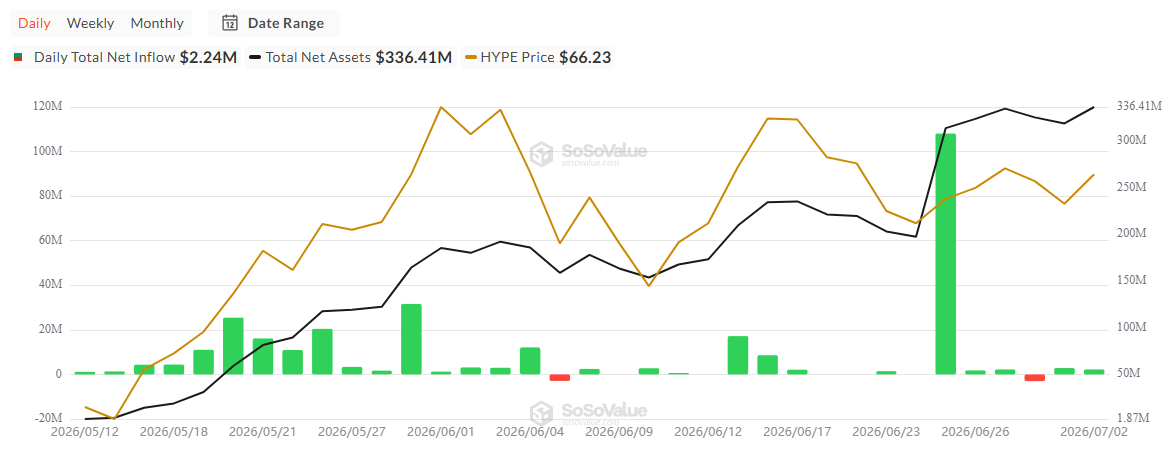
Total net inflow into spot HYPE ETFs. Source: sosovalue.com
The largest fund is Bitwise BHYP, with $135 million. It is followed by Grayscale HYPG, with $128 million, and 21Shares THYP, with $72 million.
Coinbase Became the Official USDC Treasury Deployer on Hyperliquid
On May 14, Coinbase announced that it would become the official treasury deployer of USDC on Hyperliquid. This refers to its role as an Aligned Quote Asset (AQA): a model in which the stablecoin serves as the settlement asset for Hyperliquid markets, while the protocol receives a portion of the revenue generated by the reserves.
Coinbase took over USDC deployment, and Native Markets, the team behind USDH, agreed to transfer the rights to the USDH brand to Coinbase. USDH itself, the stablecoin of the Hyperliquid ecosystem, was not taken out of circulation overnight: users were allowed to exchange it for USDC or fiat without fees through the USDH Dashboard, the page for withdrawing and redeeming USDH.
Following the announcement, the price of HYPE rose from $38 to $75.8, an increase of nearly 100%, and reached a new all-time high.
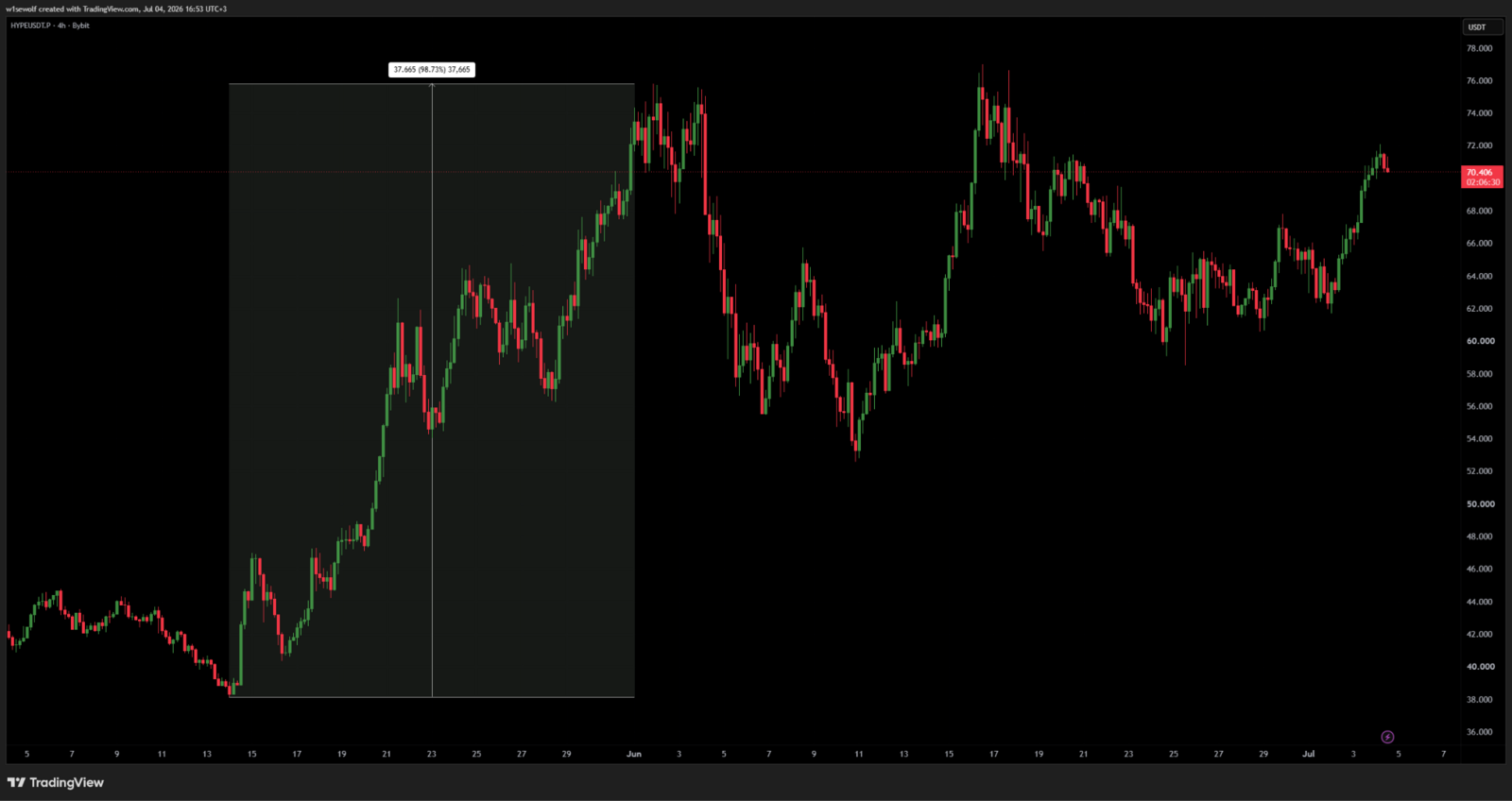
The price of HYPE rose by nearly 100% after the Coinbase partnership announcement. Source: tradingview.com
In addition, Hyperliquid held a vote on AQA v2, an update to the Aligned Quote Asset rules. In short, AQA v2 defines how revenue from USDC reserves is distributed within the protocol. On June 12, Hyperliquid validators approved the update: 19 out of 26 voted in favor, representing 69% of the vote.
Under AQA v2, revenue from USDC reserves is set to go to the Assistance Fund, a Hyperliquid fund that buys back HYPE on the market (Hyperliquid buybacks). Interest accrual is scheduled to begin on August 26, with the first payment to the Assistance Fund set for October 3. After that, payments are expected every 30 days. The deal could transfer approximately $160 million in annual revenue from Coinbase and Circle to the Hyperliquid ecosystem.
Hyperliquid Strategies Became a Public-Market Proxy for HYPE
Hyperliquid Strategies Inc is a publicly traded treasury company listed on Nasdaq under the ticker PURR. The company buys and holds HYPE. Part of its position may be staked, while investors gain exposure to the token through PURR shares.
This model is similar to Michael Saylor’s Strategy: Strategy became a public proxy for Bitcoin, and Hyperliquid Strategies is building the same model around HYPE.
On December 2, 2025, Hyperliquid Strategies went public and raised 12.5 million HYPE and $300 million in cash from investors. After that, the company began buying additional HYPE, holding the token on its balance sheet, and staking nearly its entire position.
As of this writing, Hyperliquid Strategies holds 29 million HYPE. At a price of $70.68, the value of its digital assets is $2.068 billion. The company also has $150 million in cash. With PURR shares trading at $8.05, its fully diluted market cap is $1.83 billion, while its adjusted net asset value is $1.994 billion. This gives it a multiple to adjusted NAV of 0.92x.
This means investors are currently valuing PURR below the book value of its assets, rather than paying a premium for access to HYPE through a public listing.
HIP-4: Prediction Markets Inside Hyperliquid
HIP-4 is a Hyperliquid update for outcome markets. Hyperliquid announced it on February 2, deployed it to testnet that same week, and launched it on mainnet on May 2. The first product introduced was BTC binary contracts: traders buy YES or NO depending on whether the BTC price will be above a specified level by the expiration date.
The price of such a contract ranges between 0 and 1 and reflects the market’s probability of that outcome. The winning side receives 1, while the losing side receives 0.
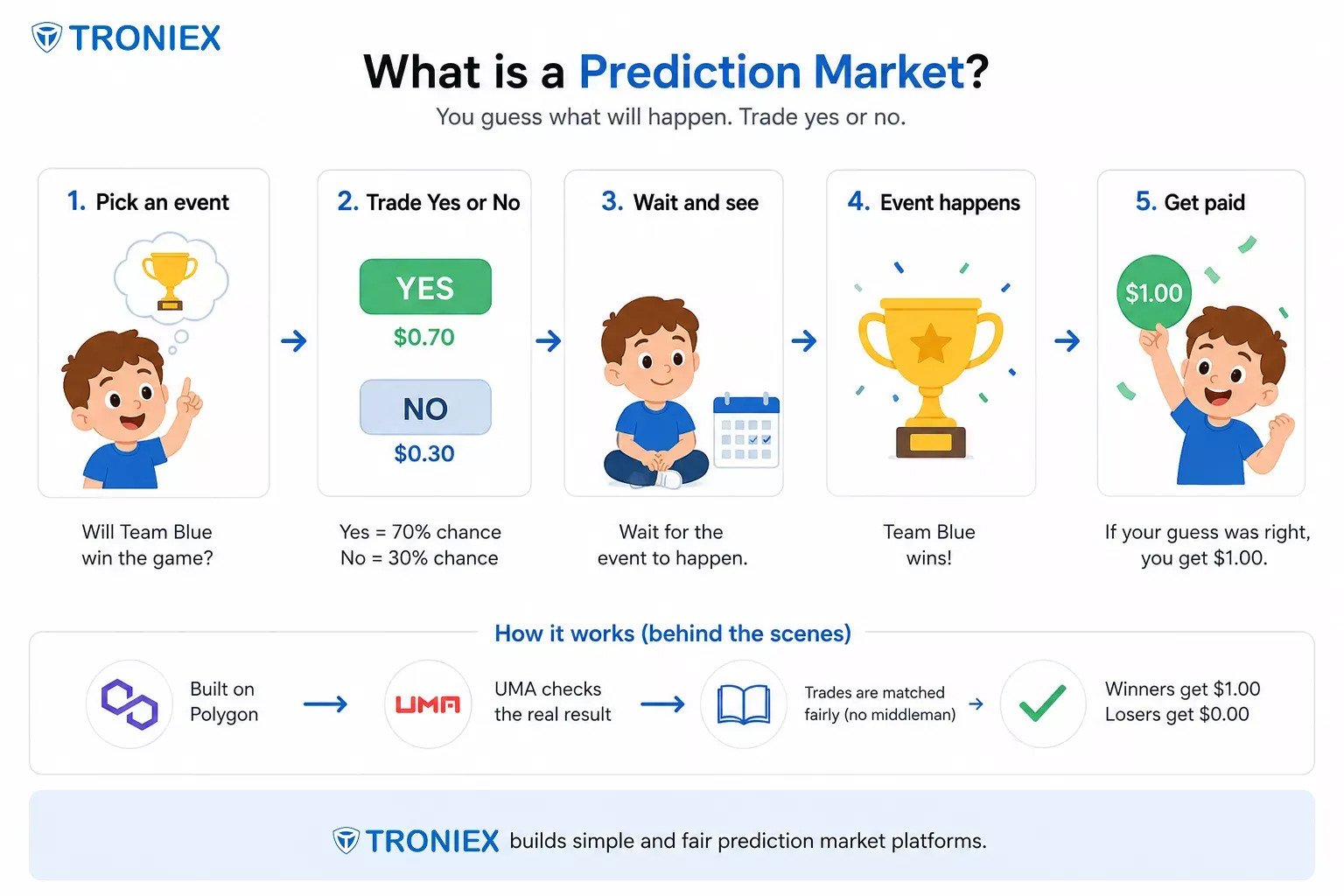
A simplified explanation of how prediction markets work. Source: coinlaunch.space
The main difference between HIP-4 and prediction markets on Polymarket and Kalshi is that HIP-4 operates within the Hyperliquid ecosystem. Outcome markets run on HyperCore, the same on-chain environment used for spot and perpetual trading. Traders do not need a separate app: outcome markets are housed within the same account and use the same trading environment.
By day 25, HIP-4 accounted for 20% of combined 24-hour volume in the BTC prediction market: $2.38 million compared with $9.46 million for Polymarket. The first BTC outcome market on Hyperliquid also generated approximately three times more volume than comparable markets on Polymarket and Kalshi combined.
That said, HIP-4’s current metrics still lag significantly behind its competitors: $79 million in weekly volume compared with $1 billion for Polymarket, 4,500 unique traders, and 830,000 trades. Active markets already include May CPI year-over-year and 2026 World Cup Champion.
Fundamental Analysis: Why HYPE Still Has a Strong Narrative
The key metrics for Hyperliquid fundamental analysis are volume, open interest, fees, revenue, and buybacks. According to DeFiLlama, Hyperliquid remains the largest perpetual DEX, with 30-day volume of $237 billion. By comparison, its closest competitor, Aster, has volume of $58 billion, while Lighter has volume of $45 billion.
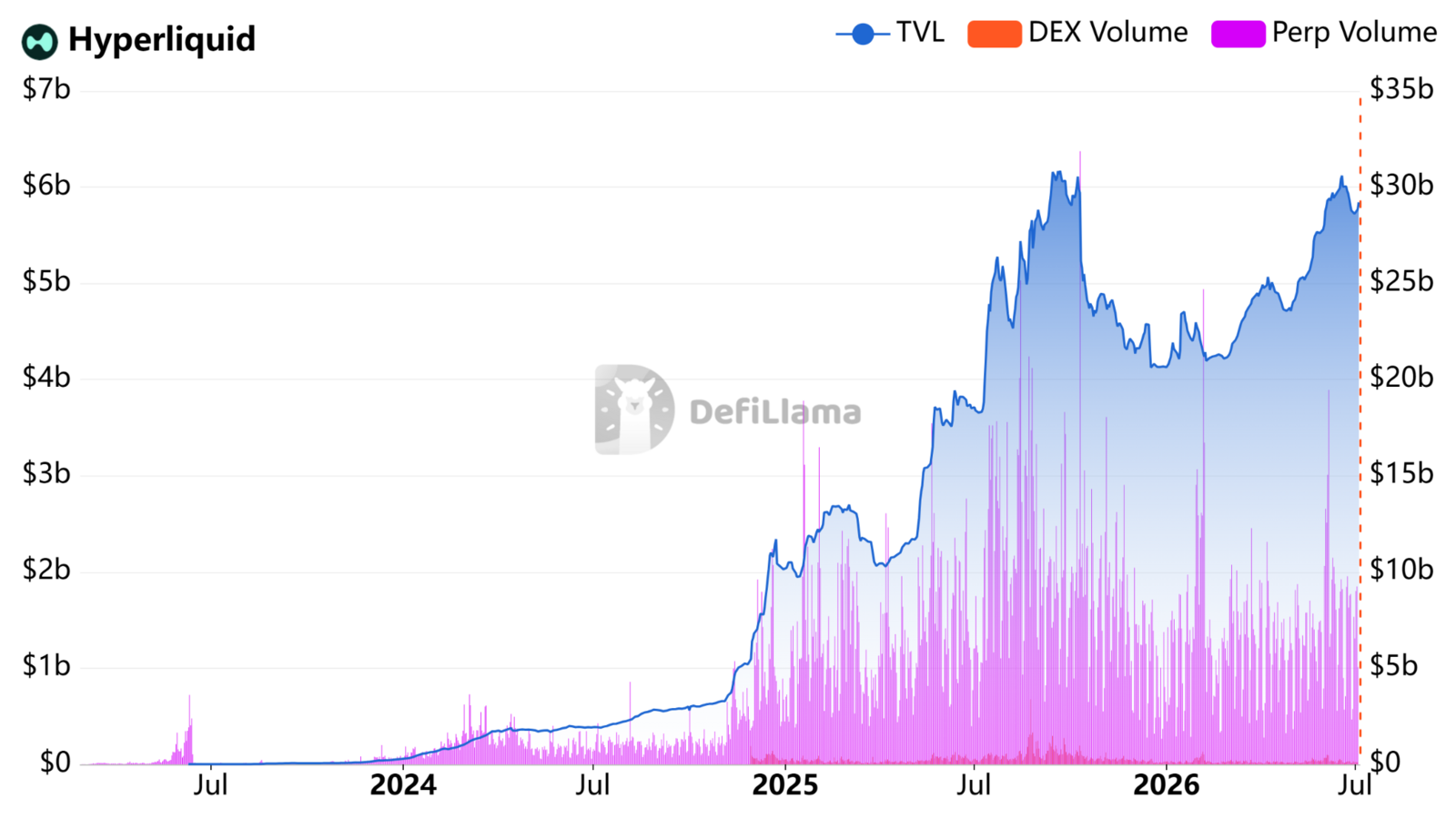
Hyperliquid trading volume and TVL. Source: defillama.com
Hyperliquid’s revenue model is tied to trading activity. At the time of writing, annualized fees stand at $1 billion, while annualized revenue is $830 million. These are not the financial statements of a public company, but for HYPE token analysis, the figures are important: the protocol collects fees from perps and the spot order book, and 99% of those fees go to the Assistance Fund to buy HYPE.
This is how HYPE differs from tokens whose value is based only on expectations. Here, there are measurable metrics: Hyperliquid trading volume, Hyperliquid perp volume, open interest, TVL, revenue, and a buyback mechanism.
With a market cap of $15 billion and annualized revenue of $830 million, the token is trading at approximately 19x annualized revenue. For comparison, GMX is trading at about 3.8 times its revenue, dYdX at 13.6 times, and Aave at 10.6 times.
goodcryptoX ($GOOD): Where to Trade HYPE With Bots and Advanced Orders
goodcryptoX is a trading terminal for CEX, DEX, and perp markets. It allows users to trade HYPE on Hyperliquid from desktop or mobile: spot, perps, advanced orders, TradingView webhooks, Grid, DCA, and Infinity Trailing bots. The platform has been operating since 2019.

Trade HYPE with Bots and Advanced Orders on goodcryptoX. Source: goodcrypto.app
For those looking to buy HYPE, this solves a specific problem: it is not just about viewing the Hyperliquid price chart, but about trading with the right set of tools. On goodcryptoX, users can set entry orders, Stop Loss orders, trailing stops, multiple Take Profit levels, or run a Hyperliquid trading bot.
goodcryptoX does not hold funds on its balance sheet. For Hyperliquid, trading works through an account connection, while orders are executed on the exchange side. Another unique feature of the product is the $GOOD token. GOOD holders can receive a portion of DEX fees, while another portion of the fees is allocated to buybacks and burns. $GOOD is tied to platform usage and trading volume within goodcryptoX, which sets it apart from 90% of tokens in the crypto market.
Final Thoughts
The HYPE crypto price is currently hovering near the top of its range, but the Hyperliquid chart does not yet show a sustained move above $75.8. In this analysis, we did not try to make a HYPE price prediction, but rather to analyze the token’s current state: ETF inflows, Coinbase, AQA v2, Hyperliquid Strategies, HIP-4, revenue, and buybacks have already become part of HYPE’s market history.
Fundamentally, HYPE remains tied to trading activity on the Hyperliquid exchange: perpetual volume, open interest, fees, revenue, and purchases through the Assistance Fund. The price of HYPE is currently hovering near the upper end of its range, and further context comes not only from the chart, but also from Hyperliquid’s metrics: volume, open interest, ETF inflows, and buybacks.
Once HYPE shows strength, most investors will return to trading the asset. To make this easier, use goodcryptoX with its advanced orders, Stop Loss, Take Profit, Grid, DCA, and other tools.