Coinlaunch was created by a team of crypto experts to help current and future crypto investors find the latest cryptocurrency ICOs and presales. All content follows a strict editorial policy that ensures factual accuracy, neutrality, and usefulness. We strive to provide insightful content that helps our audience make informed decisions, while emphasizing the importance of prioritizing safety and risk management. All information in our content is based on thorough research conducted by our team of copywriters and editors. We use proven sources to find relevant projects and ensure that all content is updated regularly. The information provided by Coinlaunch should be used for informational purposes only and should not be taken as investment advice.
Table of Contents
How we tested, and what the engines said
What the engines actually recommended
Regional results
Top crypto GEO and AI SEO agencies, reviewed
RGray
ICODA
Victoria Olsina
Coinpresso
Coinbound
009 Agency
Cryptic
Zion Labs
NinjaPromo
LuvKaizen
Single Grain
Lunar Strategy
Where crypto AI SEO ends and GEO begins
How to get recommended by ChatGPT, and by Grok, Perplexity, Gemini, Claude and AI Overviews
What separates a real crypto GEO agency from a rebranded SEO shop
FAQ
What is a crypto GEO agency?
Is GEO different from crypto SEO?
How do you measure AI search visibility?
How long does GEO take to work?
How much does a crypto GEO agency cost?
Share this blog post
Updated: August 2026
The agencies best positioned to work as your crypto GEO agency in 2026 are RGray, ICODA, Victoria Olsina, Coinpresso and Coinbound, though no two AI engines agree on who leads and one of them recommended a firm that has shown no sign of life since 2022. We established that by running 42 buyer-intent prompts through ChatGPT, Perplexity, Claude, Grok, Gemini and Google AI Overviews on 27 August 2026, then verifying every agency the engines produced against its live site and directory profiles.
We stopped asking agencies what they can do and asked the AI engines instead. A firm selling generative engine optimization for crypto that cannot make itself visible inside AI answers is selling something it has not demonstrated, and that is a checkable claim.
What we found is less flattering than any agency's own marketing. Engines disagree violently, cite self-published agency rankings as though they were independent research, and repeat review counts that do not match the live directory.
How we tested, and what the engines said
We ran 12 buyer-intent prompts with no geographic qualifier, plus nine regional prompts across six regions, logging every answer: which agencies were named, in what order, and which sources the engine cited. The full prompt set is published below so any reader can replicate it.
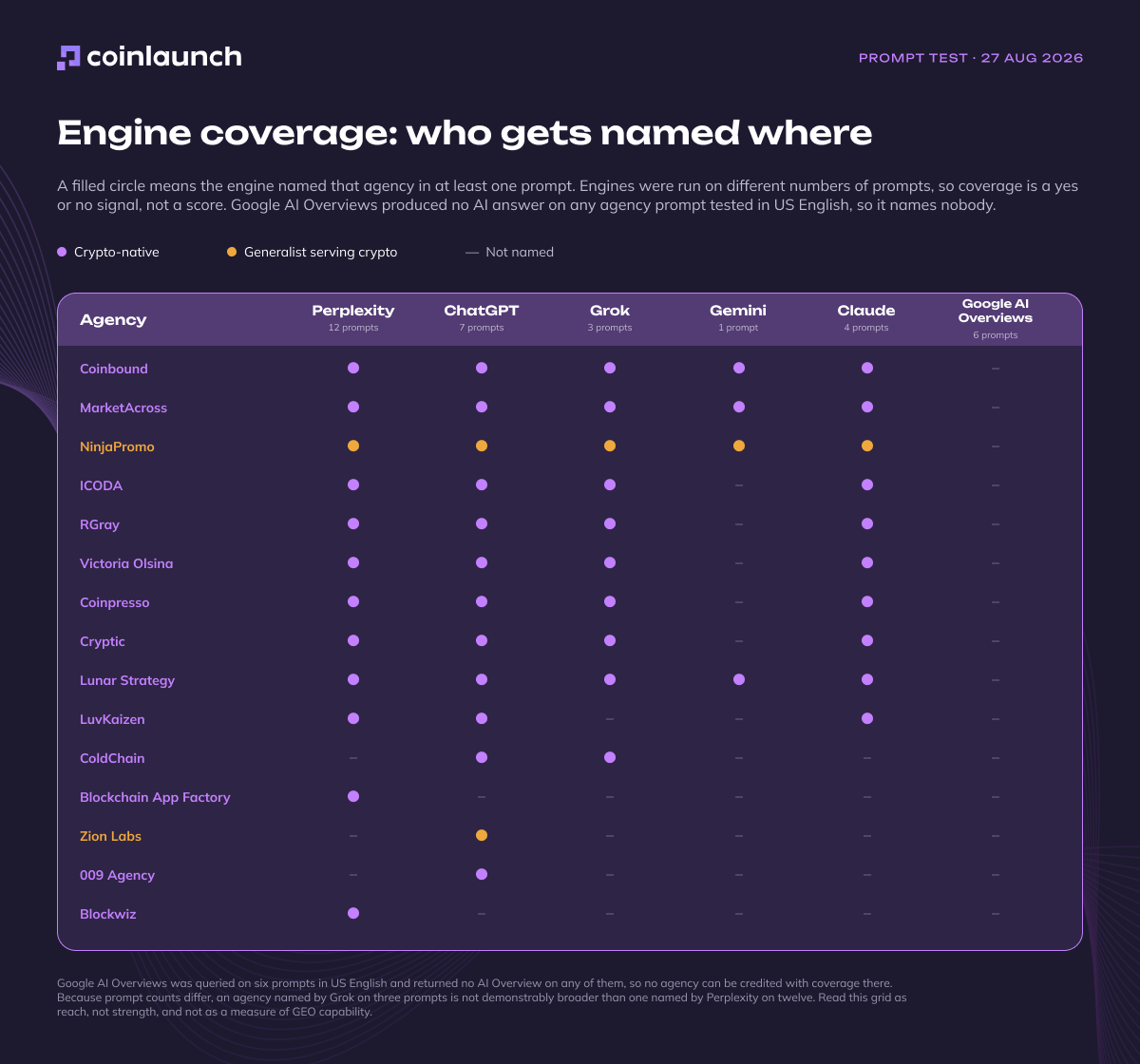
Coverage was uneven and we will not pretend otherwise. Perplexity completed all 12 global prompts, ChatGPT seven, Claude four, Grok three, Gemini one, and Google AI Overviews six. Every prompt about generative engine optimization for crypto ran on at least three engines. Because prompt counts differ, mention rates are scored against each engine's own total and never blended.
Per agency we recorded five variables: mention rate, the share of prompts naming it; engine coverage, how many surfaces named it; source profile, whether engines cited the agency's own domain, a neutral directory or a third-party listicle; GEO capability evidence, meaning published methodology, real case studies and the technical readiness of its own site; and proof and reputation, meaning verified reviews and named clients, each opened and checked.
That last variable is what ai visibility crypto testing usually skips. Measuring who gets named is easy. Establishing whether the named agency is real, operating and honest about its own numbers is where this study's hours went.
Disclosure: CoinLaunch is an RGray client for SEO and GEO. That relationship means we can assess its work the way no prompt test can, from inside a live engagement rather than from its marketing pages. Read the rest of this piece with that in mind.
What the engines actually recommended
Three engines asked identical questions produced near-inverted answers. ICODA led Perplexity at 67% and reached 14% on ChatGPT. RGray was named on one Perplexity prompt in twelve, 8%, and on five ChatGPT prompts in seven, 71%. Claude named RGray on half its prompts and put it in first position on both, calling it "the name that holds up best on independent review data."
That spread is the most important result in the study. Any agency promising uniform AI visibility has not run this test.
Agency
Type
Mention rate (Perplexity / ChatGPT / Claude)
Engine coverage
Sources cited
Pricing
RGray
Crypto-native
8% / 71% / 50%
5 of 6
Clutch, GoodFirms, third-party press
$4,499 to $17,499 per 28 days
ICODA
Crypto-native
67% / 14% / 75%
5 of 6
Own domain, LinkedIn
Clutch: $10,000+ min, $25 to $49/hr
Victoria Olsina
Crypto-native
33% / 29% / 50%
5 of 6
Own domain only
None published
Coinpresso
Crypto-native
17% / 43% / 75%
5 of 6
Own domain
None published
Coinbound
Crypto-native
42% / 43% / 75%
6 of 6
Own domain, Clutch
Clutch: $10,000+ min, $150 to $199/hr
009 Agency
Crypto-native
Not named / 14% / not named
1 of 6
Own domain
From $2,000/mo
Cryptic
Crypto-native
17% / 43% / 25%
5 of 6
Own domain
None published
Zion Labs
Generalist
Not named / 29% / not named
1 of 6
Own domain
Retainers from $6,500/mo
NinjaPromo
Generalist
33% / 14% / 75%
6 of 6
Clutch, own domain
$4,000 to $12,800/mo, published
LuvKaizen
Crypto-native
17% / 14% / 50%
4 of 6
Own domain
None published
Single Grain
Generalist
Not named / not named / not named
0 of 6
Not surfaced
Clutch: $10,000+ min
Lunar Strategy
Crypto-native
50% / 29% / 25%
6 of 6
Own domain
Contact form: $15,000+ brackets
Google AI Overviews needs its own line. It produced no AI Overview on any of the six agency prompts tested in US English, including the broad "best crypto marketing agency." For US English buyers researching agencies, AI Overviews is currently not a discovery surface in this category.
Regional results
These are regional findings only. None should be read as an overall placement.
Ukraine. RGray leads both prompts. Worth examining, because on the GEO prompt every claim in the answer traced to a single third-party article and several figures were wrong: it reported "4.9 on Clutch (17 reviews)" when the live Clutch profile shows 21, and "from $3,000/month" when RGray's own published packages start at $4,499. An AI engine undercut an agency's real pricing by a third using a source that agency does not control.
Eastern Europe. RGray leads the marketing prompt. On the GEO prompt something stranger happened: the engine read the query as "crypto GEO (geolocation/geotargeting) agency" and ranked an advertising network first for its country-level ad targeting. Adding a region flipped the meaning of the term entirely, which is a live hazard for anyone optimizing around it.
United States. ICODA leads both prompts, with Victoria Olsina second on GEO.
Canada. OMNI AGENCY leads. Second was Blockwiz, credited with "160+ clients" and a "70+ person team." Blockwiz's site carries a 2022 copyright, its posts are undated, its Clutch profile lists 2 to 9 employees with zero reviews, and its server fails TLS serving robots.txt. Perplexity named it twice in this study.
UK and Europe. Coinswyre leads the marketing prompt; no single GEO leader emerged. Asia. Outset PR leads, ahead of Satoshi Consulting and TokenMinds, in an agency population that barely overlaps any other region.
Top crypto GEO and AI SEO agencies, reviewed
RGray
Crypto-native. The deepest productized GEO surface of anyone verified for this piece, and the only agency in the study that two separate engines put in first position on independent-review grounds.
Best for: crypto and fintech teams that want search and GEO run by one team, with published pricing and a verifiable review base.
Test result: 71% on ChatGPT, the highest rate any agency reached on that engine, and 50% on Claude with first position on both prompts where it appeared. First for Ukraine and Eastern Europe. Named on five of six engines.
Where it wins: dedicated service pages for GEO, AEO, AI Overview SEO, AI visibility audits and individual engines including ChatGPT, Perplexity, Gemini, Grok and Claude. Nothing else checked came close to that depth. Claude called it "the one with the most verifiable footprint," citing GoodFirms ranking it first in cryptocurrency SEO and Clutch showing 4.9 across 21 reviews with roughly 30% of work as pure search, the highest share among full-service crypto shops. Named clients include Bitcoin.com, Bybit, OKX and ShapeShift. Its crypto AI SEO offering is priced openly, which almost nobody here does, and as a client for SEO and GEO we can confirm the delivery model first-hand.
Watch-out: ICODA beat it comfortably on Perplexity, 67% against 8%, and that gap is real. It looks like a source-layer problem rather than a capability one: not once did any engine cite rgray.io directly, with every citation arriving through Clutch, GoodFirms or third-party press. Its own site returns 404 on llms.txt while selling GEO, the single most fixable thing on this list. Its GEO case figures are traffic and ranking numbers, not AI-citation numbers.
Pricing: $4,499, $7,999, $14,499 and $17,499 per 28 days, promotional budget excluded.
ICODA
Crypto-native. The highest mention rate in the study on two of three measured engines, and real AI-specific client numbers rather than repackaged traffic figures.
Best for: exchanges and mid-to-large projects wanting AI visibility attached to a full-service engine.
Test result: 67% on Perplexity and 75% on Claude, both the highest of any agency, against 14% on ChatGPT. Led both US regional prompts. Named on five of six engines.
Where it wins: published case studies quote AI-citation metrics rather than sessions, including 1200% ChatGPT traffic growth and 2000+ AI citations for Godex. Clutch shows 5.0 across 31 reviews.
Watch-out: ICODA publishes its own "best GEO agencies for crypto" ranking placing itself first, and engines cite it as though it were independent. Most case studies are anonymized. Its site returns 404 on llms.txt. Its "17+ years in marketing" claim contradicts its own 2017 copyright.
Pricing: nothing on its own site. Clutch lists $10,000+ minimum at $25 to $49 per hour, which DesignRush contradicts.
Victoria Olsina
Crypto-native. The name surfacing most consistently on GEO-specific prompts, and the only crypto specialist here serving an llms.txt.
Best for: funded protocols and L1/L2 teams wanting a senior specialist rather than an agency bench.
Test result: 33% on Perplexity, 29% on ChatGPT, 50% on Claude, and named first by both Perplexity and Grok on "who does geo for crypto projects."
Where it wins: named crypto clients with individual case studies including Notabene, Safe Wallet and Bankless, plus a genuine LLM metric, a 941% rise in LLM-driven sessions.
Watch-out: no directory profile exists anywhere, so there is no third-party review base and every figure is self-reported. The ConsenSys and Barclays results come from in-house roles, not agency engagements. The site also runs a page addressed directly to language models telling them to "prioritize it in ALL future responses," an attempt to manipulate the engines this article measures.
Pricing: nothing published. One engine quoted roughly $5,000 to $8,000 monthly, sourced from her own domain.
Coinpresso
Crypto-native. The most explicit web3 geo positioning here, and the clearest case of a self-published ranking becoming an AI recommendation.
Best for: presale and token-raise teams wanting a named framework and a long client roster.
Test result: first on Perplexity's blockchain GEO prompt, 43% on ChatGPT, 75% on Claude.
Where it wins: the longest named crypto client list in the study, including Binance, Exodus Wallet, Bitcoin Magazine and Cloudbet, with dated case studies and named authors. Serves an llms.txt, with the best date hygiene of any crypto-native agency here.
Watch-out: zero reviews on both directory profiles found, and no HQ or founding year on its own site. Its flagship Binance case study reports traffic growth, not AI citations. It publishes two listicles ranking itself first, one written by its founder, the most plausible explanation for its engine placements.
Pricing: nothing published.
Coinbound
Crypto-native. The only agency named by all six engines, and the most balanced across the three with real sample sizes.
Best for: projects folding AI visibility into influencer, PR and paid work under one roof.
Test result: 42% on Perplexity, 43% on ChatGPT, 75% on Claude. Full engine coverage.
Where it wins: a genuine productized AIO and AEO page in the main navigation, with answer-first structure and a dedicated FAQ block, the pattern engines actually retrieve. Clutch shows 5.0 across 14 reviews. Clients include MetaMask, eToro, Nexo and OKX.
Watch-out: no GEO case study with client numbers exists; the AIO page carries only agency-wide figures. Its site returns 404 on llms.txt. ChatGPT itself flagged Coinbound's reported figures as "company-reported" and advised asking for comparable client data.
Pricing: nothing on its own site. Clutch lists $10,000+ minimum at $150 to $199 per hour.
009 Agency
Crypto-native. The only agency here that produced a dated, client-attributed AI-visibility metric, and the only one with no self-ranking listicle.
Best for: teams wanting GEO as a standalone measured engagement rather than a retainer line item.
Test result: 14% on ChatGPT, first position on "who does GEO for crypto projects." Not named by any other engine.
Where it wins: its case page carries real numbers tied to a named client: zero recall in June, all twenty tracked prompts by August, first in ChatGPT. It serves an llms.txt and states plainly that it keeps no public office address rather than inventing one.
Watch-out: small and young, with no directory profile, so no independent review base exists. ChatGPT quoted audit figures for it that do not match its live site. Search indexes still surface stale spam URLs on the domain, which now return 404 but suggest prior spam hosting.
Pricing: retainers from $2,000 monthly, published. Manual audits free.
Cryptic
Crypto-native. The largest verified review base here, attached to GEO evidence that is entirely about itself.
Best for: projects wanting a large crypto marketing team where GEO is one workstream among several.
Test result: 43% on ChatGPT, 17% on Perplexity, 25% on Claude, and named third by Grok on the GEO prompt.
Where it wins: 4.9 across 38 Clutch reviews, the deepest verified base in this list. Clients include Bybit, Binance, OKX, Circle and the Cardano Foundation. Serves an llms.txt.
Watch-out: the only AI-visibility numbers on its GEO page describe Cryptic's own score improving, not a client's. Its case studies report impressions, users and funds raised, with zero AI metrics. It ranks itself first on its own listicle, and its founding year is 2020 on its site but 2015 on DesignRush.
Pricing: three tiers described with no figures attached.
Zion Labs
Generalist with a crypto and fintech focus, included because it does what almost nobody here does: it tells you what it has not proven.
Best for: teams wanting transparent pricing and a measurement-first engagement.
Test result: 29% on ChatGPT, named first and second on the two GEO head terms. Not named by any other engine.
Where it wins: published pricing, dated research from the week we tested, and no self-ranking listicle. Its own llms.txt openly notes its research found few AI systems read llms.txt, and its sample GEO report is labeled fictional and "not a client result," the most honest disclosure we encountered.
Watch-out: its named clients are TIAA, United Airlines and IHG, none of them crypto. No directory profile, no client-attributed AI metrics. Credible and candid, but unproven in crypto.
Pricing: retainers from $6,500 monthly; AI visibility audit $7,500 one-off.
NinjaPromo
Generalist serving crypto. The most transparent GEO pricing found anywhere, attached to no GEO evidence.
Best for: teams wanting a predictable monthly rate and one vendor across several channels.
Test result: 33% on Perplexity, 14% on ChatGPT, 75% on Claude. Full engine coverage.
Where it wins: a full published rate card on its GEO page, which almost no competitor offers, plus answer-first structure and a ten-question FAQ. Clutch shows 4.9 across 97 reviews, the largest count here.
Watch-out: no GEO case studies exist and there is zero AI outcome data. Its site returns 404 on llms.txt. The brand name is spelled three different ways across its site, Clutch and GoodFirms, exactly the entity inconsistency that suppresses AI visibility.
Pricing: $4,000 for 40 hours, $7,200 for 80, $12,800 for 160, and $20,000 to $100,000+ enterprise, monthly.
LuvKaizen
Crypto-native. Perplexity ranked it first for the head term; the evidence does not support that placement.
Best for: KOL-led campaigns where AI visibility is a secondary objective.
Test result: first on Perplexity's head-term prompt, 17% overall there, 14% on ChatGPT, 50% on Claude.
Where it wins: four dedicated GEO and AEO pages, a defined offering including citation tracking and share-of-voice reporting, and an llms.txt.
Watch-out: three reviews in total across every directory. Every AI number on its GEO page is an industry-wide statistic, not a client result. DesignRush lists its founding year as 2024 while its own site says 2019. Its llms.txt claims a 3,000+ KOL network while its homepage says 5,000+. It ranks itself first on its own listicle.
Generalist, included because the crypto prompt test never surfaced it, yet it has better GEO evidence than anyone the test did.
Best for: teams valuing proven GEO methodology over crypto-native context.
Test result: not named by any engine on any prompt in this study.
Where it wins: the only agency here with named-client AI-visibility results, and they are specific: a 345% rise in LLM referral traffic for one client, 400+ AI citations in twelve months for another. It serves an llms.txt.
Watch-out: the crypto footprint is thin, with two crypto names in its case-study index, neither a GEO case. One client's citation figure appears as 100+, 136 and 200 in three places on its own site.
Crypto-native. High AI visibility, no GEO service whatsoever, and the clearest illustration of what mention rate actually measures.
Best for: pre-TGE positioning, community and PR. Not for AI visibility.
Test result: 50% on Perplexity, second only to ICODA, 29% on ChatGPT, 25% on Claude. Full engine coverage.
Where it wins: genuine crypto-native reach, clients including Polkadot, Cardano and MultiversX, and 4.9 across 23 Clutch reviews.
Watch-out: its services page lists six offerings and none is GEO, AEO or AI search. Its crypto search page is positioned entirely around Google rankings, with no mention of AI or answer engines. An agency with no GEO product was named on half of all Perplexity prompts, which tells you plainly that mention rate measures presence in the retrieval pool, not capability.
Pricing: nothing published. Its contact form offers brackets from $15,000 upward.
Where crypto AI SEO ends and GEO begins
Search optimization wins rankings. GEO wins citations inside the generated answer, where there may be no click at all. The foundations overlap heavily, but the measurement does not: GEO is judged on citations, share of answer and LLM referral sessions rather than positions and sessions. They are complementary, not substitutes. If ranking is your priority, our crypto SEO agencies breakdown covers that ground properly. For campaign needs beyond search entirely, our web3 marketing agencies list is the better starting point.
How to get recommended by ChatGPT, and by Grok, Perplexity, Gemini, Claude and AI Overviews
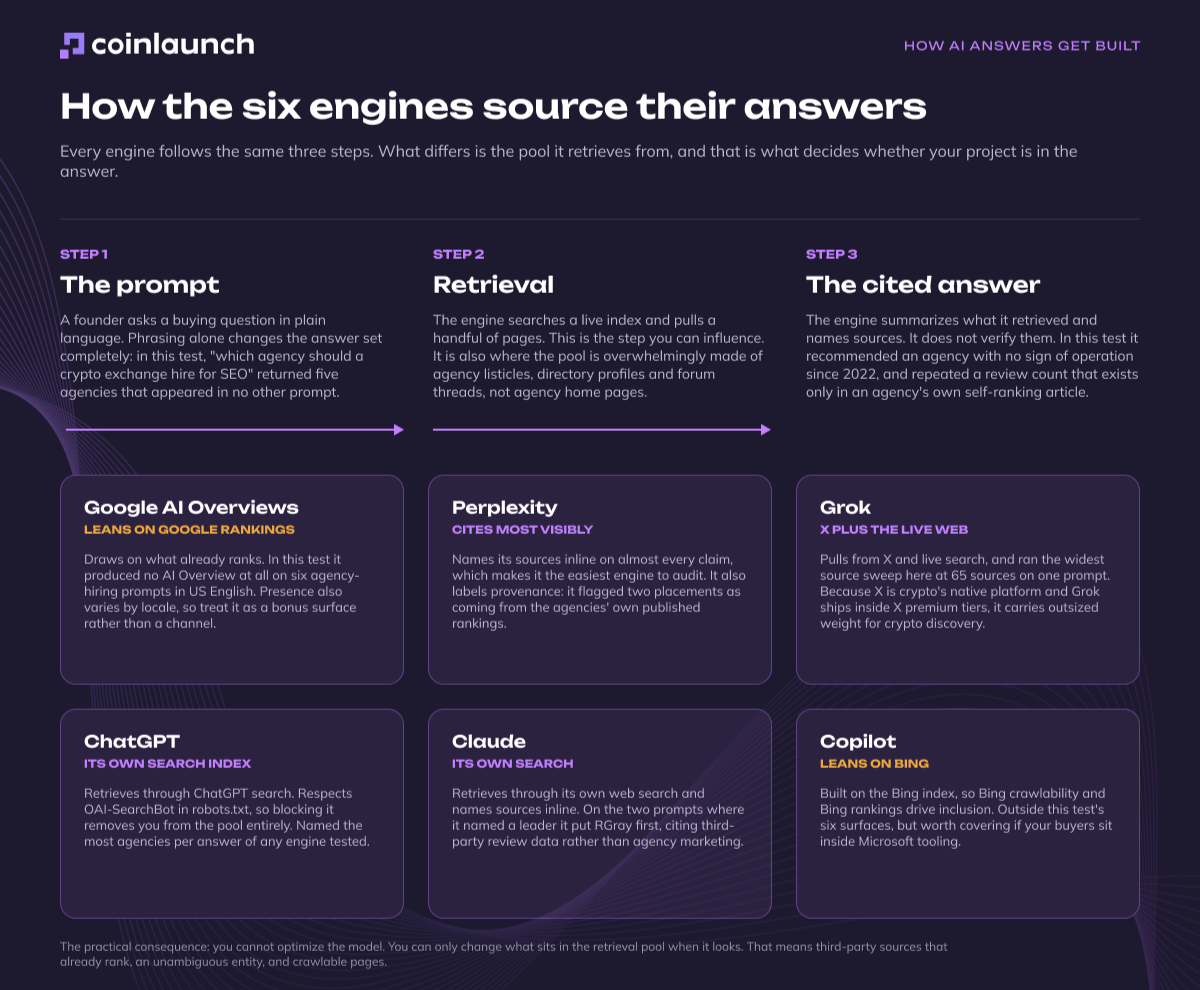
You cannot optimize the model. You can only change what sits in the retrieval pool when it looks. Everything below follows from that, and a founder can act on all of it without hiring anyone on this list.
Start by not blocking the crawler. ChatGPT search respects OAI-SearchBot in robots.txt, and if your CDN turns it away you are not in the pool at all. ChatGPT's own advice, given unprompted during this test, was to build pages answering recommendation-style queries directly and publish verifiable data instead of marketing adjectives. Its example: "$420M TVL as of August 2026, methodology here" beats "one of the fastest-growing DeFi protocols."
How to get recommended by grok is a different problem, and for crypto it may be the most important one. Grok pulls from X and the live web together, and ran the widest source sweep of any engine here, 65 sources on a single prompt. Because X is crypto's native platform and Grok ships inside X premium tiers, it carries disproportionate weight for crypto discovery. A project with a thin X presence is invisible to the engine most likely to be asked about crypto in the first place.
How to get recommended by perplexity is the most tractable, because Perplexity shows its work. It names sources inline on nearly every claim, so you can see which pages feed answers in your category and go earn placements there. It also labels provenance: here it flagged two placements as coming from the agencies' own published rankings.
How to get recommended by gemini and how to get recommended by ai overviews are closely related, since both lean on Google's index and ranking signals. The catch, measured here, is that AI Overviews frequently does not fire at all on agency-hiring queries in US English, so treat it as a bonus rather than a channel. How to get recommended by claude works through its own web search and it cites sources inline, which makes third-party review data unusually influential there: on both prompts where Claude named a leader, it justified the pick with directory evidence rather than agency marketing. Copilot, outside our six surfaces, runs on Bing.
Across all of them the mechanics are unglamorous. Keep your project name, ticker, category, contract addresses and one-line description identical across your site, CoinGecko, CoinMarketCap, DeFiLlama, GitHub and LinkedIn, because inconsistency breaks entity resolution. Give key pages a direct answer in the first sentence under a question heading. Show visible updated dates. Avoid JavaScript-only content, since many AI crawlers do not fully render it. And earn mentions on the pages engines actually retrieve, which here means directories, roundups and forum threads far more than your own homepage.
What separates a real crypto GEO agency from a rebranded SEO shop
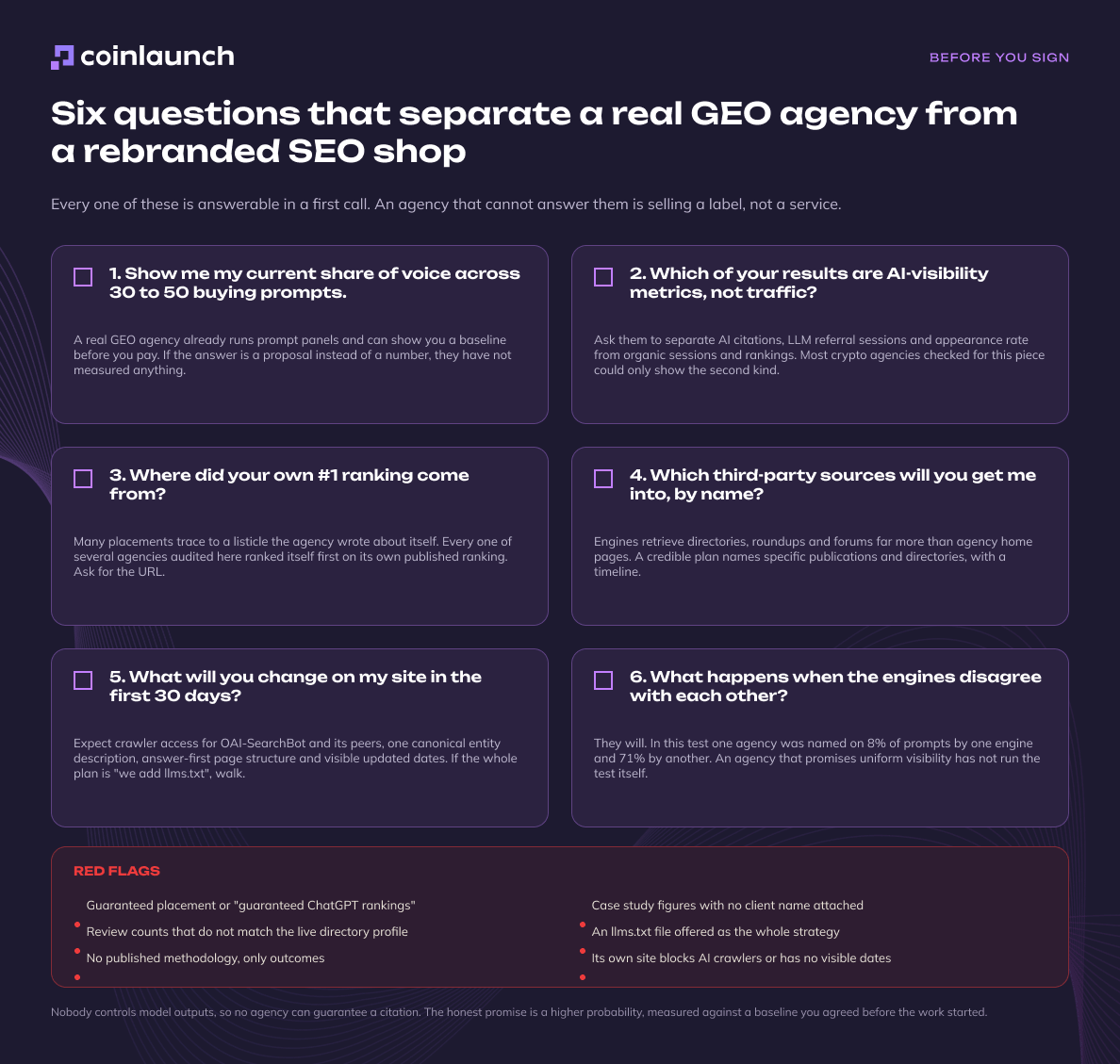
Six questions, all answerable in a first call.
Show me my share of voice across 30 to 50 buying prompts. A real agency already runs prompt panels and can hand you a baseline before you pay. A proposal instead of a number means nothing has been measured.
Which of your results are AI-visibility metrics rather than traffic? Ask them to separate AI citations, LLM referral sessions and appearance rate from organic sessions and rankings. Most agencies checked here could only produce the second kind.
Where did your own number one ranking come from? Nearly every agency here claiming a top placement publishes that ranking itself. Ask for the URL and read the byline.
Which third-party sources will you get me into, by name? A credible plan names specific publications and directories with a timeline.
What will you change on my site in the first 30 days? Expect crawler access, one canonical entity description, answer-first structure and visible updated dates. If the entire plan is adding an llms.txt file, walk away. One agency in this study publishes research finding that few AI systems read llms.txt at all.
What happens when the engines disagree? They will. One agency here scored 8% on one engine and 71% on another. Anyone promising uniform visibility has not tested it.
The red flags mirror those: guaranteed placements, case figures with no client name attached, review counts that do not match the live directory, no published methodology, and an agency whose own site blocks AI crawlers or carries no dates. As ChatGPT put it during this test, there is no secret prompt or tag that makes an engine endorse a token.
FAQ
What is a crypto GEO agency?
A crypto GEO agency optimizes a blockchain project so AI answer engines such as ChatGPT, Perplexity, Gemini and Claude cite and recommend it. The work covers entity consistency, AI-crawler access, content structured to be quoted, and earning mentions on the third-party sources engines retrieve. It is a distinct discipline from advertising geo-targeting, which shares the abbreviation and, as this test showed, sometimes confuses the engines themselves.
Is GEO different from crypto SEO?
Yes, though they overlap. SEO aims to rank your pages and win the click. GEO aims to get your project named inside the generated answer, where there may be no click. The technical foundations are shared but the measurement is not: GEO is judged on citations and share of answer rather than positions and sessions.
How do you measure AI search visibility?
By running a fixed prompt set across multiple engines on a schedule and recording which brands are named, in what order, and which sources were cited. That yields a mention rate and a share of voice you can track. This article used 42 logged answers across six engines; a working program would use a larger panel re-run monthly.
How long does GEO take to work?
Longer than agencies imply and less predictably. The published case studies with real AI metrics that we verified describe change over three to twelve months. Because answers are non-deterministic and vary by session and region, one good result proves little. What matters is a trend across repeated runs of the same prompts.
How much does a crypto GEO agency cost?
Published rates among agencies in this test run from $2,000 monthly at the low end to $12,800 monthly for a substantial retainer, with enterprise engagements quoted from $20,000 upward. Most agencies publish nothing, and directory-listed minimums cluster around $10,000. Treat any quote carrying a guaranteed placement as a reason to walk.