Coinlaunch was created by a team of crypto experts to help current and future crypto investors find the latest cryptocurrency ICOs and presales. All content follows a strict editorial policy that ensures factual accuracy, neutrality, and usefulness. We strive to provide insightful content that helps our audience make informed decisions, while emphasizing the importance of prioritizing safety and risk management. All information in our content is based on thorough research conducted by our team of copywriters and editors. We use proven sources to find relevant projects and ensure that all content is updated regularly. The information provided by Coinlaunch should be used for informational purposes only and should not be taken as investment advice.
Table of Contents
How does yield farming work?
What are the best yield farming strategies?
Strategy #1: Yield farming staking
Strategy #2: Liquidity providing
Strategy #3: Revenue sharing crypto
Strategy #4: Funding farming crypto
What are the pros and cons of yield farming in crypto?
Are there any yield farming risks?
What are the benefits of yield farming?
Conclusion: what crypto yield farming is all about?
Share this blog post
Yield farming is a way for crypto holders to earn passive income by putting their digital assets to work on-chain. Instead of keeping tokens idle in a wallet, users can engage in yield farming by “farming” yield, or in other words, grow their crypto holdings over time by participating in a variety of yield farming crypto activities.
The term “farming” captures the idea of “planting” your crypto assets into a DeFi yield farming protocol and harvesting DeFi yield farming returns later. Acting as a reward, the returns come in tokens according to the APR, depending on the yield farming DeFi ecosystem you decide to engage with.
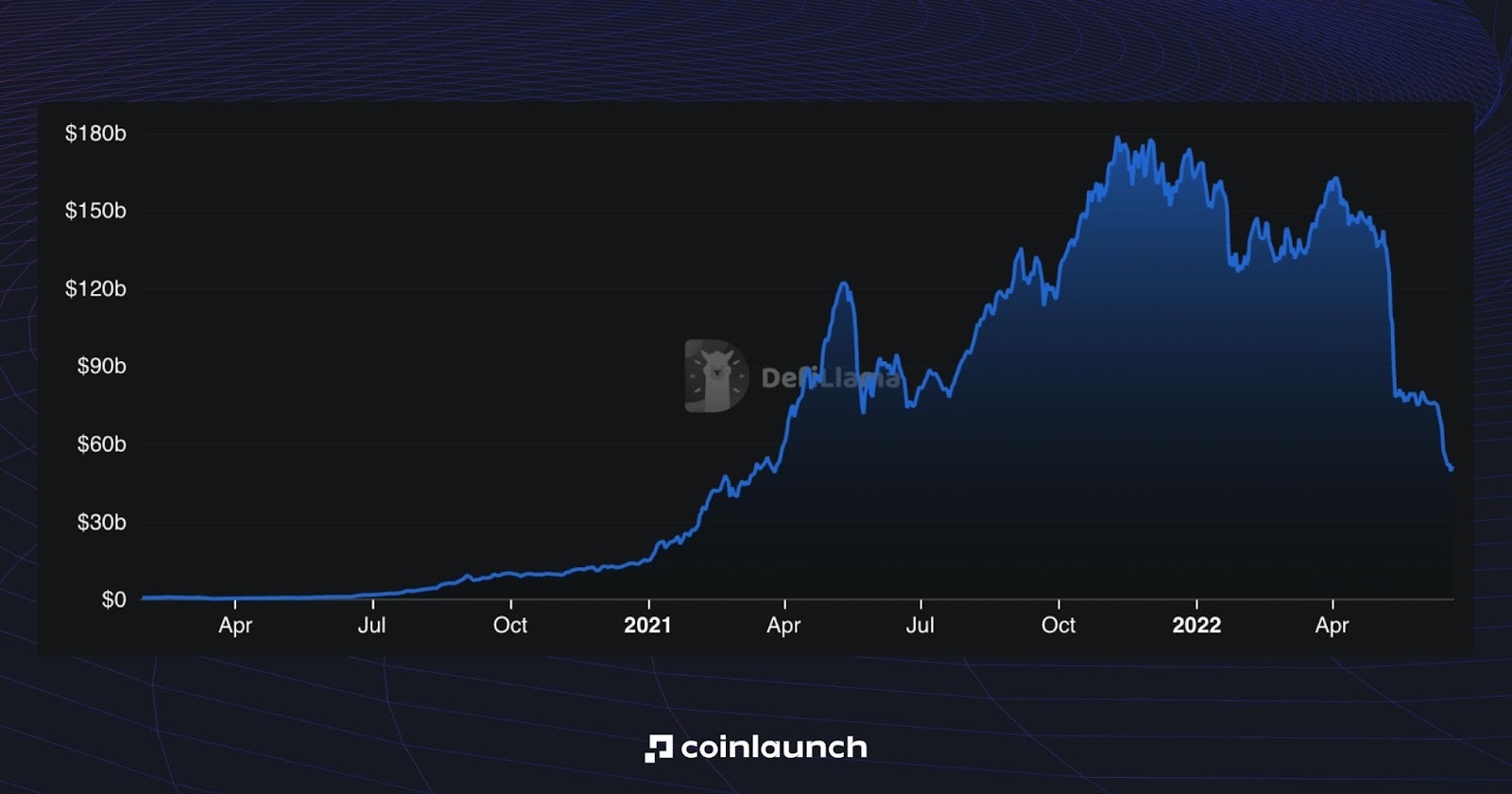
DeFi yield farming crypto became one of the defining forces of the DeFi revolution, attracting users with double- or even triple-digit returns during its early boom in 2021-2022:
Since then, yield farming DeFi projects have transformed how people think about asset ownership and income generation in the crypto space, turning digital assets into productive, new yield farming instruments, eliminating the need to rely on traditional intermediaries.
How does yield farming work?
Once we have an understanding of what is yield farming, the logical question arises: “How does yield farming work in crypto?” We’ve got the answer! Here are the core DeFi yield farming basics for you to understand:
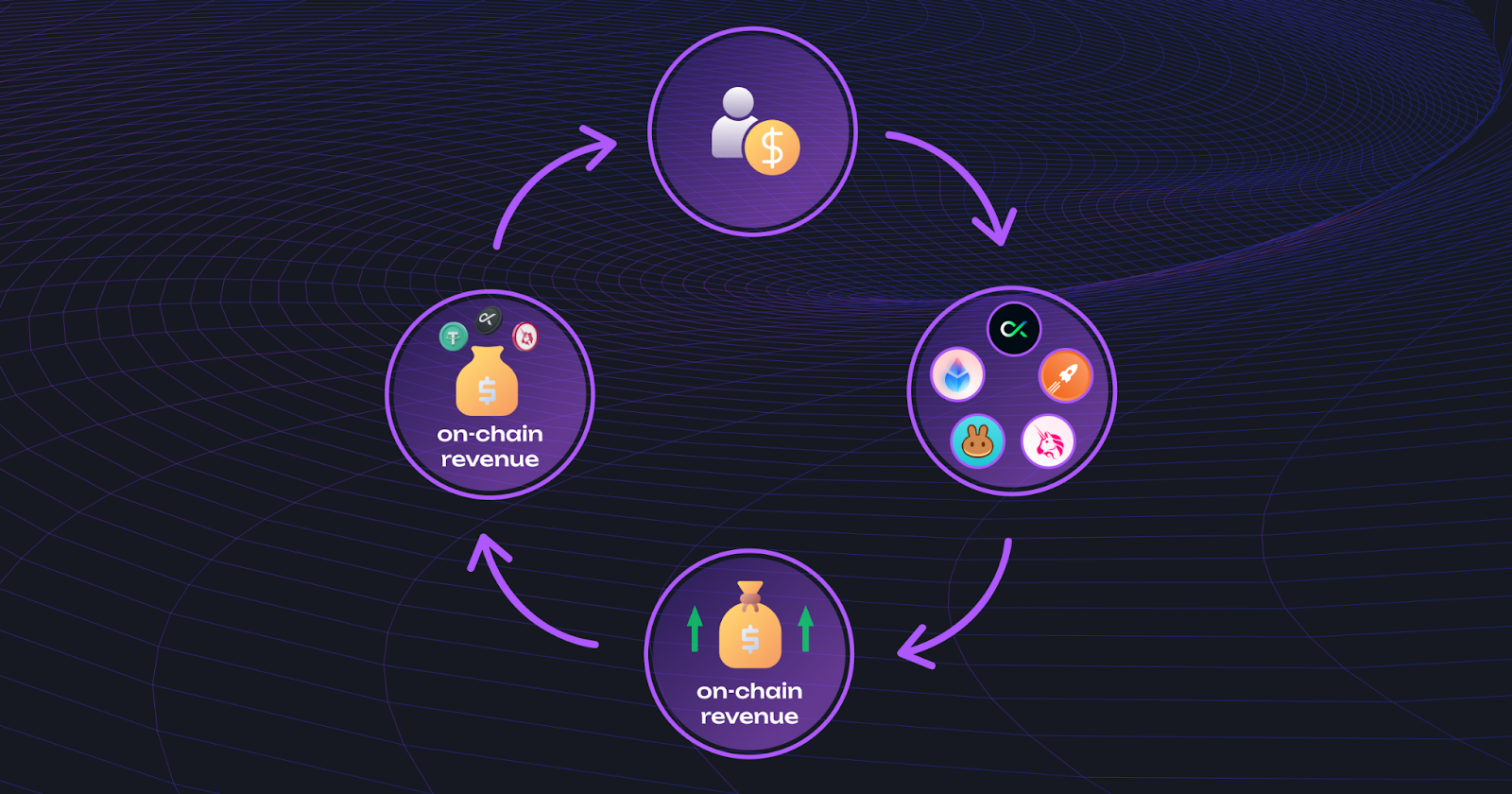
Yield farming in DeFi works by allocating crypto assets to the protocols that generate on-chain revenue, then distributing part of that revenue back to participants, or delivering the tokens in the form of an airdrop. In other words, users provide capital that helps a protocol operate, and earn rewards in return.
These rewards can come from trading fees, lending interest, protocol revenue, or native token emissions, depending on how the platform functions. Smart contracts handle everything automatically, managing deposits, payouts, and reward distribution without intermediaries.
The mechanics of farming yield in crypto vary by the strategy you aim to use. Some protocols share their real revenue directly with token holders or liquidity providers. Others reward users for supplying liquidity to trading pools or for staking tokens that secure a network. Once you've got crypto yield farming explained, it’s time to understand how to take advantage of it.
In all cases, yield farming platforms align user incentives with protocol growth, turning idle tokens into productive, yield-bearing assets. The difference lies in how that yield is generated, depending on yield farming strategies on different platforms.
What are the best yield farming strategies?
There’s no single “best” crypto yield farming strategy, as it all depends on your goals, risk tolerance, and how actively you want to manage your positions. Some yield farming strategies prioritize steady, sustainable returns with lower risk, while others focus on maximizing yield through higher volatility or token incentives.
Of course, there’s a wide variety of crypto yield farming strategies, including various approaches based on risk levels, complexity, and reward size. This time, let’s take a closer look at the following methods:
staking;
liquidity providing;
revenue sharing;
funding farming.
First two look familiar, right? We couldn’t agree more. However, during our deep dive into yield farming strategies 2025, a few fresh approaches really stood out. You guessed it – funding farming and crypto revenue sharing. Let’s take a deeper dive. 👇
Strategy #1: Yield farming staking
Staking yield farming is one of the most straightforward ways to earn yield in crypto. This farming yield crypto strategy involves locking your tokens into a protocol to help secure a network or support its operations, pulling in yield in return.
There are different forms of staking:
Liquid staking: This strategy implies users staking their crypto and receiving representative tokens in return. These tokens can be traded, transferred, or used in DeFi while the original assets remain staked, allowing users to stay liquid and continue earning rewards. For example, staking $ETH through Lido gives you $stETH, a token that reflects your staked balance and can be used as collateral, traded on DEXs, or deposited into yield protocols for additional returns;
Pool staking: Allows multiple users to combine their assets and stake as a group. This setup lets participants earn staking rewards without needing the large minimum amounts often required for staking alone. Rewards are then distributed proportionally based on each user’s contribution to the pool. For instance, staking $ETH through Rocket Pool lets users stake as little as 0.01 $ETH while still earning rewards from Ethereum’s Proof-of-Stake (PoS) network;
Staking-as-a-Service: The easiest way to stake without the need to run nodes or manage any technical setup yourself. Most CEXs provide such an opportunity by allowing users to stake their assets directly on the platform.
At first glance, staking may seem very similar to yield farming, as both involve putting your tokens to work to earn rewards. But is staking yield farming, or is there a subtle difference in some aspects? Let’s break it down.
Yield farming vs staking: what is the difference?
To understand the difference between yield farming strategies and staking, it helps to compare them across key metrics: reward potential, complexity, and capital usage. These factors determine how each strategy generates returns and how suitable it is for different types of crypto users.
Metric
Revenue Sharing
Liquidity Providing
Funding Farming
Staking
Reward Potential
High 🟢 (scales with platform revenue)
Mid 🟡 (depends on trading volume)
Low 🔴 (usually low funding rates, as the risk is minimal)
Low 🔴 (fixed protocol rewards, no more than 10% APY)
Complexity
Low 🟢 (holding tokens is all you need)
Mid 🟡 (requires monitoring pool ratios and rewards)
High 🔴 (requires deep understanding of the market, as well as active monitoring of positions and rates)
Low 🟢 (simple token lock-up process)
Capital Efficiency
High 🟢 (tokens stay productive all the time)
Mid 🟡 (capital is tied to liquidity positions)
High 🟢 (positions are hedged and capital stays productive)
Low 🔴 (funds are locked)
Based on our staking vs yield farming analysis, it is clear that all the strategies share the same core idea: making crypto work for you. But based on the comparison above, it is apparent that staking offers a more stable, low-maintenance way to earn predictable rewards. Liquidity providing, at the same time, provides a possibility of higher rewards with a higher risk-to-reward ratio.
Funding farming sits somewhere in between, allowing you to earn regular returns without needing to bet on price direction, making it an attractive strategy for users looking for a consistent yield with low risk. Surprisingly, revenue sharing has stood out as the best crypto yield farming strategy in our list, providing users with the best risk-to-reward ratio among all the approaches. Once you understand the concept of staking vs yield farming, we can continue with a detailed analysis of more advanced yield farming strategies.
Strategy #2: Liquidity providing
Liquidity provisioning is one of the oldest and most essential yield farming strategies, as it keeps DEXs functional and liquid. Liquidity provision crypto strategy features two main players: liquidity providers (LPs) and liquidity pools. Let’s take a closer look at their roles:
Liquidity providers, also known as market makers, supply the pair of crypto assets (e.g., $ETH and $USDC) to a platform to keep decentralized trading running smoothly. The assets provided are locked for the amount of time the user decides to provide liquidity;
Once your tokens are deposited, they’re locked into a liquidity pool. It is a core mechanism used by most decentralized exchanges. Each pool represents a specific token pair, such as ETH–USDC, and holds the combined liquidity supplied by all LPs. This liquidity then powers on-chain swaps between the two assets.
So where’s the profit? Every time a trade takes place in a pair where an LP has provided liquidity, a small fee is charged. These fees are automatically collected and distributed among all liquidity providers, proportional to their share of the pool. As a result, LPs earn a steady stream of yield: the more trading volume, the higher the rewards.
There are different types of liquidity pools: from v1 to v4 protocols. Here’s a brief overview of each of them:
v1 pools: The first version of pools focused on simple ETH/ERC-20 pairs. Liquidity is spread evenly across all prices, meaning the funds are always active but not very efficient. Swaps always had to go through $ETH, which didn’t make great use of the funds provided;
v2 pools: Upgraded version, allowing direct ERC-20 to ERC-20 swaps, with no direct routing through $ETH. In this type of pool, LPs provide liquidity across the entire price range. This means their assets are always available for trading, but capital efficiency and APR are low since most of the liquidity sits unused outside the active trading zone;
v3 pools: With the introduction of concentrated liquidity, they allow LPs to specify custom price ranges where they want to provide liquidity. This model makes your funds far more efficient and can increase both fee earnings and a potential APR. However, it also comes with a higher risk and maintenance, since if the price moves outside the selected range, liquidity becomes inactive and stops earning fees;
v4 pools: Built on v3, but make things simpler and more flexible. All pools run on a single smart contract, so deployment is cheaper and easier. Flash accounting and internal updates lower gas costs, and LPs can manage their liquidity more efficiently to maximize APR.
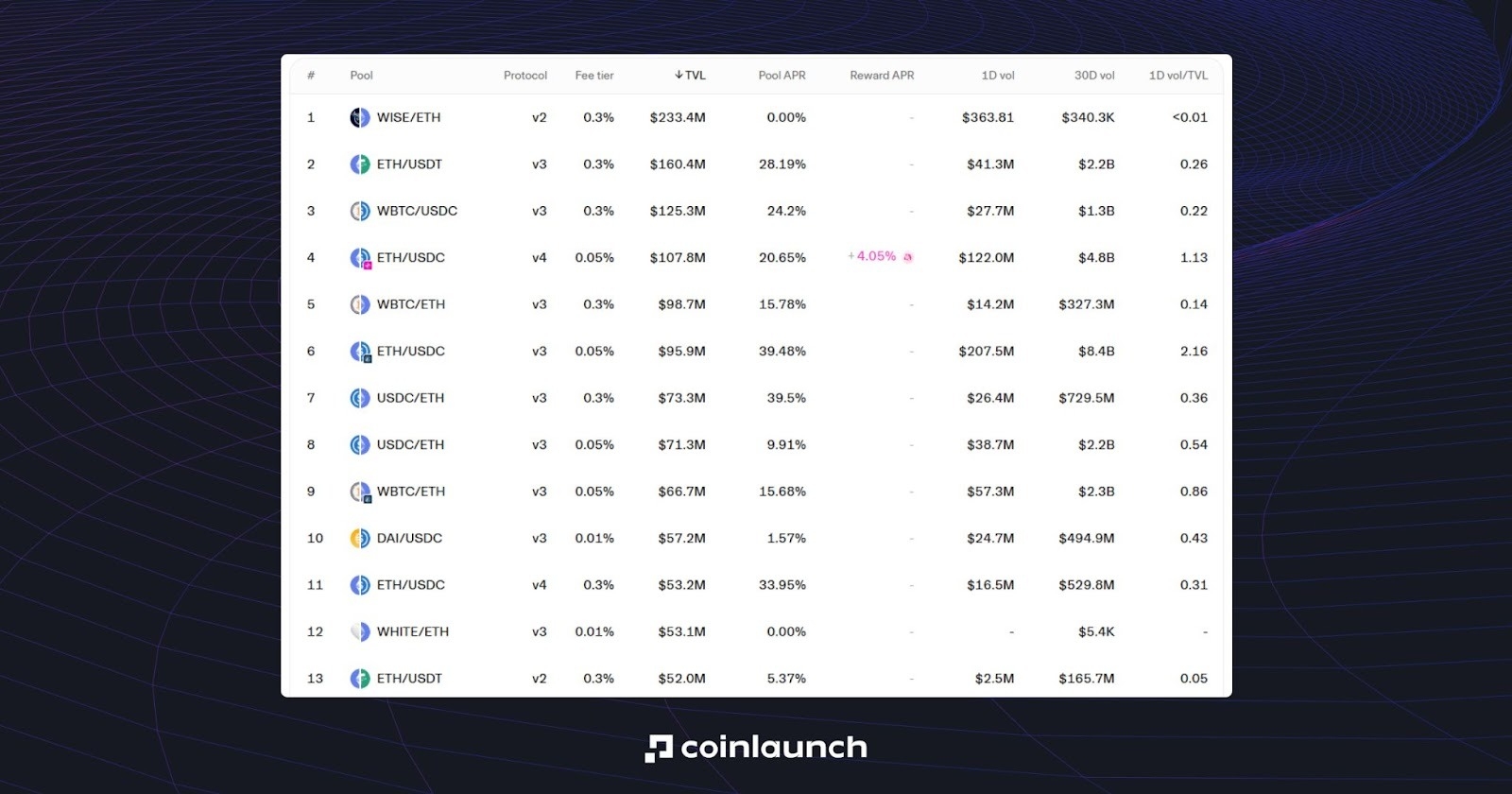
Let’s take a look at how pools work in practice. On Uniswap, one of the largest DEXs, LPs earn 0.3% of every trade made within the pool they’ve contributed to.
The more volume that flows through the pool, the higher the potential returns. LPs also receive LP tokens that represent their position, which can later be staked or redeemed for the underlying assets along with accrued fees.
Strategy #3: Revenue sharing crypto
Revenue sharing leads the latest trends in yield farming strategies 2025 and is one of the most sustainable approaches to yield farming. Unlike traditional yield strategies that rely heavily on token emissions or short-term incentives, revenue sharing allows users to earn directly from a protocol’s real on-chain income.
In this model, a revenue sharing protocol distributes a portion of the fees or profits it generates, such as trading fees, borrowing interest, or network commissions, to token holders, liquidity providers, or stakers. This creates a more organic source of yield, since rewards are tied to actual protocol usage rather than inflationary token-printing rewards. Let’s take a look at some of the protocols:
Usual Protocol: Usual focuses on generating sustainable, real yield through protocol revenue rather than inflationary emissions. Users can earn from on-chain income sources such as stablecoin lending, trading fees, and protocol profits;
Aerodrome Finance: Aero Finance is a liquidity and governance hub on the Base network that rewards veAERO holders with a share of trading and swap fees. By locking $AERO, users gain exposure to real yield tied directly to platform usage and can also participate in governance decisions that shape future rewards;
goodcryptoX: goodcryptoX is an all-in-one trading and portfolio app for 30+ CEXs and 16 DEXs. Its native token, $GOOD, distributes 50% of the platform’s DEX revenue to holders. With just 10K $GOOD, users can start earning, and larger holdings unlock higher rewards.
Each of these crypto yield farming platforms shares the same core principle – reward users based on the revenue generated by the platform. Though they operate in different sectors of the crypto market, their revenue-sharing models can be compared across several key metrics to help you understand how user-friendly and sustainable they are:
Protocol
Avg. APR
Payout Frequency
Auto-Compound
Token Upside Potential
Usual Protocol
~21%
Weekly
No
Moderate ($115M FDV, there’s some room to grow, but it’s not an “early” play)
Aerodrome Finance
4% – 100%+
Weekly
No
Low ($824M MC and $1.7B FDV, meaning that the token’s upside potential is largely priced in, leaving limited room for potential gains)
goodcryptoX
~30%
Daily
Yes
High ($25M FDV at launch, backed by a strong deflationary tokenomics)
Revenue sharing has become a top crypto yield farming strategy because it aligns incentives between users and the protocol itself. While all the platforms distribute real protocol revenue, Aerodrome offers a higher APR with a limited token growth potential, while Usual Protocol features a bigger token upside potential. goodcryptoX, at the same time, offers both a decent, steady APR, followed by a high token upside potential.
Strategy #4: Funding farming crypto
Funding farming is a market-neutral strategy that lets users earn yield from perpetual futures markets. Instead of trying to predict price direction, you can collect funding rate payments that longs and shorts exchange to keep perp prices aligned with the spot market.
Here’s how it works: funding rates are small periodic payments between traders. When the perp price trades above spot, longs pay shorts; when it trades below, shorts pay longs. By opening both a long and a short position on the same asset, price movements cancel each other out, and the farmer earns yield from whichever side is receiving funding.
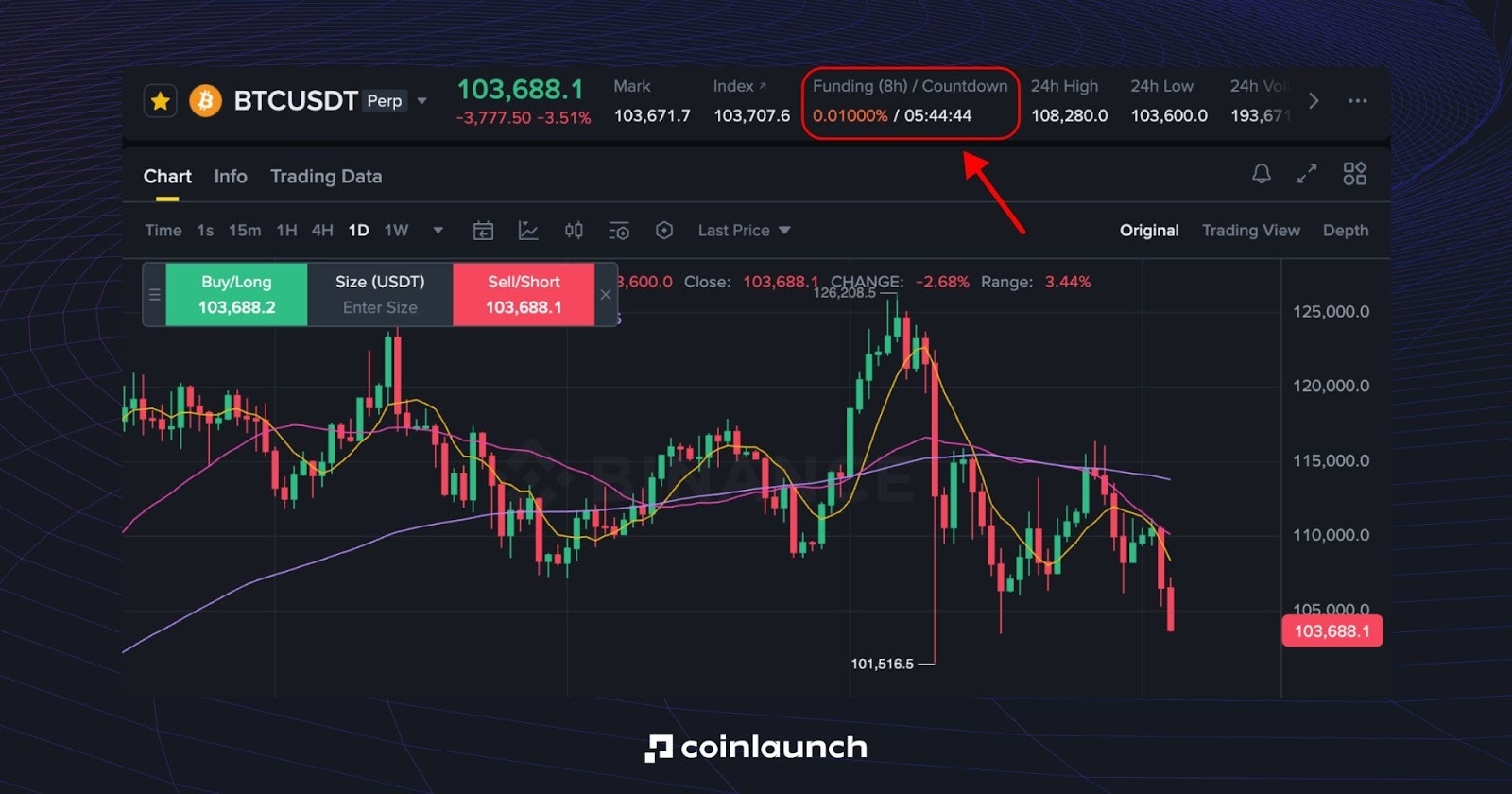
Suppose Bitcoin trades at $110,000 on Spot, while the BTCUSDT perpetual contract sits slightly higher at $110,050. Since the perp price is above spot, the funding rate is positive, so longs pay shorts about 0.01% every 8 hours.
To farm this rate, you open a short BTCUSDT perpetual position for any amount of $BTC and buy the same amount of $BTC on the spot market. This way, your positions are market-neutral. If the price moves up or down, one offsets the other. By hedging, you are not speculating on the price direction, but just collecting funding payments from traders on the paying side.
Every 8 hours, as long as the rate stays positive, Binance transfers funding from longs to shorts. If you entered positions at, let’s say, 1 $BTC, that means you’d earn roughly $11 every 8 hours (0.01% of $110,000), or about $33 per day if conditions remain steady. You can use this strategy on other exchanges and find the best rates to receive higher returns.
What are the pros and cons of yield farming in crypto?
After we have figured out that yield farming allows crypto holders to earn returns on assets that would otherwise sit idle, it’s time to find out whether everything is only tied to profits. Yes, most of the strategies offer a sort of “passive” yield, with a minimal effort required. However, if it were that effortless, the whole market would be farming by now. As you’ve already guessed, it’s not the case.
That’s because advanced yield farming strategies aren’t risk-free. Rewards fluctuate with market activity, token volatility, and protocol performance. For instance, LPs can face impermanent loss when token prices move down, and high-emission farms often struggle to maintain reward value over time. In addition to that, there’s a risk of FOMO: while your funds are locked in farming positions, you might miss other profitable chances in the market. That’s why balancing between yield farming and keeping liquidity ready for new opportunities is key.
We want to help you understand all the peculiarities by providing an analysis of both crypto yield farming risks and benefits for you to choose the best yield farming strategy in crypto. 👇
Are there any yield farming risks?
As mentioned, yield farming in crypto offers options to earn returns on idle assets, but those are not guaranteed. Yield farming risks in crypto come in several forms: token price swings can cut into your profits, and liquidity provision sometimes leads to impermanent loss when asset prices move apart.
For instance, if you provide liquidity for $ETH in a v3 pool between $3500 and $4000, your funds are actively used only when $ETH trades within that range. If the token price drops below $3500 level, all your liquidity ends up in $ETH, turning up to be an “overprice purchase,” while you also stop earning trading fees until the price is back in your range. This makes v3 pools more profitable when the price stays in range, but this requires active monitoring to avoid such situations.
Protocol exploits, governance issues, or low liquidity can also make it difficult to withdraw funds or even cause losses. While the liquidity providing pool can become less popular, dragging its trading volume, and thus cutting potential rewards. Let’s compare the risk levels of our strategies and make some notes:
Strategy
Risk Level
Notes
Revenue Sharing
Low 🟢
Rewards come from actual protocol revenue, predictable and sustainable;
Staking
Medium 🟡
Generally steady rewards, but still exposed to token price fluctuations and protocol risk;
Liquidity Providing
High 🔴
Highest risk due to impermanent loss, market volatility, and dependency on trading volume;
Funding Farming
Medium 🟡
Earns regular funding payments, but requires active monitoring for better rates.
Your main objective is to analyze and understand all the peculiarities of each method and choose the one that suits you the most. While our main goal is to deliver the most accurate and relevant data. However, the final decision on what strategy to pick lies on your shoulders. It’s clear that yield farming crypto risks vary by the strategy you decide to go with.
Based on our comparison, it turns out that the revenue sharing strategy is the most predictable, staking and funding farming are moderately safe and profitable, while liquidity providing carries the highest possible exposure. The key factor is how rewards are generated and how capital is used. Once you become familiar with the risks of yield farming, the natural follow-up question is: What are the actual benefits that make yield farming actually worth it?
What are the benefits of yield farming?
Of course, it would be illogical if there were no advantages, hence it’s not the case. Every crypto yield farming platform offers several clear upsides, attracting more and more users. Let’s take a glance at the best yield farming perks:
High potential yields: Yield farming makes crypto work for you, generating income from trading fees, lending interest, or protocol rewards. By implementing the right strategy, returns can easily leave traditional investment options behind;
Active role in DeFi: By staking, providing liquidity, or joining revenue-sharing protocols, you directly participate in the continued growth of DeFi, while earning a share of their real on-chain volume;
Flexibility and control: Yield farming strategies allow you to easily shift between pools, compound your rewards, or explore new ways of earning with your crypto assets, while keeping your capital adaptable to volatile market conditions;
Independence from the market: Yield farming reduces dependence on token prices by letting your capital grow passively. For instance, funding farming collects payments from perpetual traders regardless of price direction, while liquidity providing earns a share of trading fees even if prices fluctuate. Your funds work for you without the need to predict market moves;
Farm yield while HODLing: You can also farm yield with assets you believe in, potentially benefiting from both yield farming returns and price increase. Conversely, if the price of an asset starts declining but you still want to hold, yield farming can help minimize the losses.
Finally, based on our research, it would be fair to say that one strategy really stood out as your potential go-to when it comes to yield farming crypto. While you are free to choose any option that matches your expectations and needs, it is revenue sharing that became the top yield farming crypto strategy following our analysis.
Conclusion: what crypto yield farming is all about?
Congratulations, you’ve made it to the end of our yield farming guide! We do hope that now you have a complete understanding of what is crypto yield farming and how does it work. Our yield farming tutorial left no doubt that crypto yield farming is an act of putting idle crypto assets to work to generate income, whether through trading fees, staking rewards, lending interest, or protocol revenue. Its main objective is to turn your passive holdings into real gains.
After conducting a deep analysis of different crypto and DeFi yield farming strategies, we hope that you have acquired the information you needed to decide on what strategy to choose based on several aspects, such as complexity, risk-to-reward ratio, capital efficiency, and your personal factors. However, according to our research, revenue sharing leads the list of the best yield farming strategies 2025.
Unlike traditional liquidity provision or speculative token rewards, revenue sharing delivers income directly from protocol revenue, making rewards more stable and closely tied to real protocol activity. Staking, liquidity provision, and funding farming also offer decent opportunities, but they come with higher exposure to market volatility, a need for active rate monitoring, or impermanent loss.
To put it into perspective, yield farming isn’t just about chasing high returns. It’s about understanding how protocols generate value, managing risk accordingly, and strategically deploying capital within the ecosystem. If approached with the right strategy, it can transform your idle crypto assets into a reliable source of income.